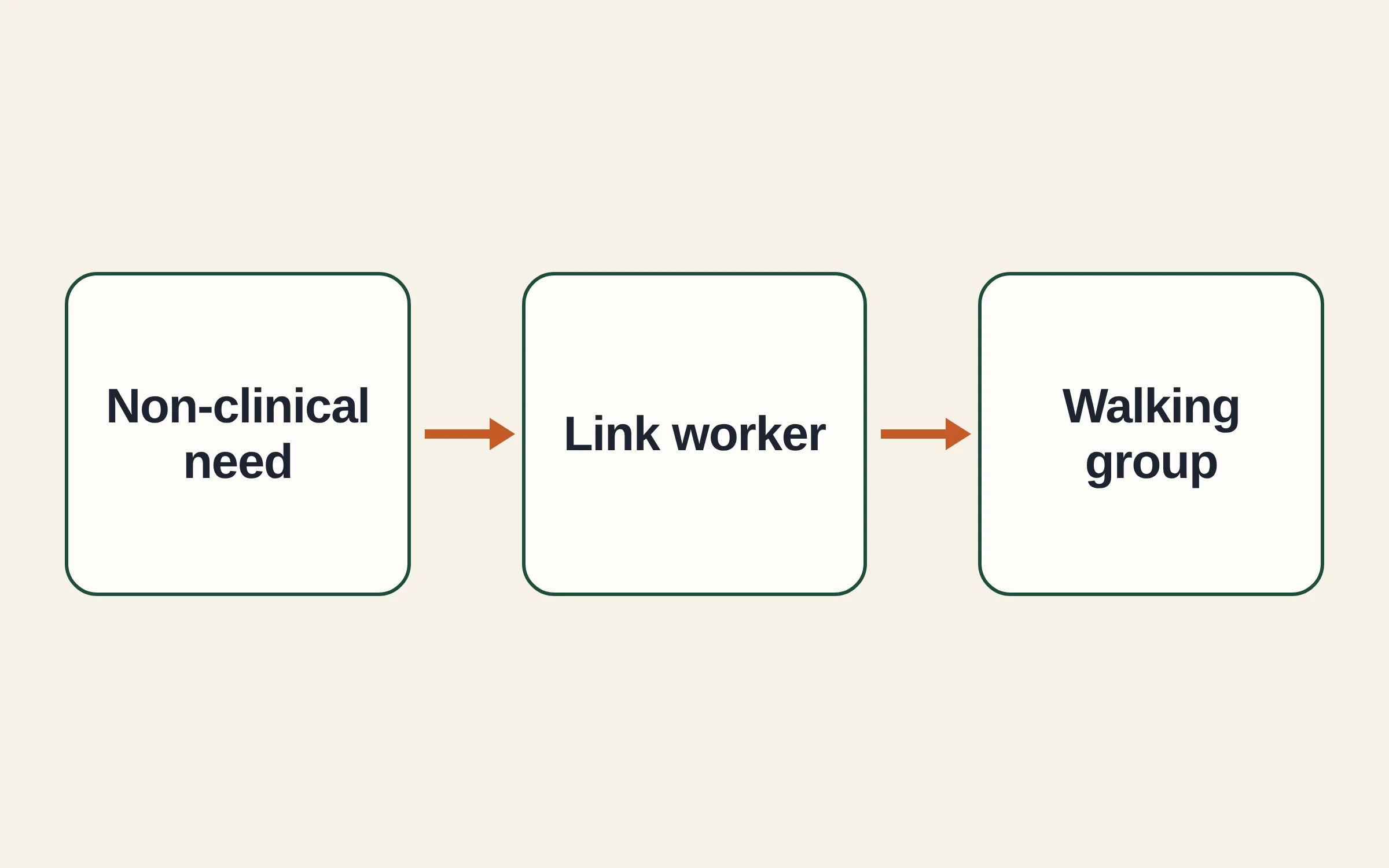
Social prescribing connects a person to a non-clinical community activity such as a walking group. A link worker starts from what matters to that person and makes the introduction. The activity does not replace clinical care. Accept the handoff only after checking who it is for, how the first visit works, and what it will not do.
A walking group reached from these resources can run that check before it accepts the introduction. The answers are yes or no.
What does social prescribing mean in community health?
Social prescribing, also known as community referral, is a process through which a person is referred to non-medical, community-based resources or activities. Nature, art, movement, and service are examples of the kinds of activity in that definition.
The Office for Health Improvement and Disparities describes the same idea as a means of enabling GPs, nurses, and other health and care professionals to refer people to a range of local, non-clinical services. It seeks to address people’s needs in a holistic way, recognising that health is determined primarily by social, economic, and environmental factors.
How do other definitions draw the boundary?
NICE states that there is not yet a universally agreed definition. The term may be described as a process whereby health care professionals refer individuals to non-clinical services within the community which may help improve health and well-being.
The National Academy for Social Prescribing, established in the UK, states an international definition. Trusted individuals in clinical and community settings identify that a person has non-medical, health-related social needs, and then connect them to non-clinical supports by co-producing a social prescription, a non-medical prescription, to improve health and well-being and to strengthen community connections. A National Association of Link Workers aims to support social prescribing staff, to lobby for improvements, and to provide guidance and continuing professional development.
Wider reviews describe the same core step in different words. Broadly, the Milbank Quarterly account says social prescribing refers to identifying patients’ social needs and connecting them with relevant nonmedical services.
The World Health Organization’s Western Pacific news item says social prescribing connects people to non-clinical community services such as social activities, exercise groups, and peer support. Its activity page calls social prescribing a means for healthcare workers to connect people to a range of non-clinical services in the community. Social prescribing can take various forms, but all involve connecting patients to resources in their communities based on individual needs.
Social prescribing is not an intervention by itself, but rather a pathway that helps to address the person’s needs. The World Health Organization toolkit says the link worker is not a counsellor, but someone who will design a referral plan together with the patient.
A University of Florida account separates the activity from clinical treatment. The activities are led by artists and community-based organizations, not health care workers or therapists. The activity is not meant to replace medical intervention. It gives primary-care providers more ways to help patients who are not thriving. Social and creative arts involvement can continue after medical intervention concludes.
A walking group is one community activity the pathway can reach, beside singing and gardening. The group is not the pathway, and it is not clinical care.
How is social prescribing organized in the UK compared with other models?
In the UK, a social prescribing link worker may engage with a patient to support them with a plan of signposting or referrals to support in the community. Doctors can refer some of their patients to that link worker, who can then suggest local social groups. People can also self-refer for support in many areas. The option is open to GPs and allied medical staff, and to non-medical professionals in social care and charity work.
In England, social prescribing is one of the 6 components of universal personalised care. The NHS Long Term Plan published in January 2019 has a commitment to personalised care and to increasing access to social prescribing for the whole population. Self-referral is also encouraged. In England, the name is typically used for general practitioners who identify patients who may benefit from nonmedical supports and refer them to a link worker. Link workers assess patients’ needs and develop a social prescription to relevant services in the community.
What does the England link-worker pattern look like?
There are many different models for social prescribing, but most involve a link worker or navigator who works with people to access local sources of support. The NHS England summary guide provides best practice advice, not statutory guidance. Social prescribing enables all local agencies to refer people to a link worker. Link workers give people time and focus on what matters to the person, as identified through shared decision making or personalised care and support planning. They connect people to community groups and agencies for practical and emotional support.
Link workers typically work with people over 6-12 contacts, including phone calls and meetings, over a three-month period, depending on what the person needs. A typical annual caseload is up to 250 people, depending on the complexity of people’s needs and the maturity of the social prescribing scheme. That caseload belongs to the link worker. A walking group does not inherit it.
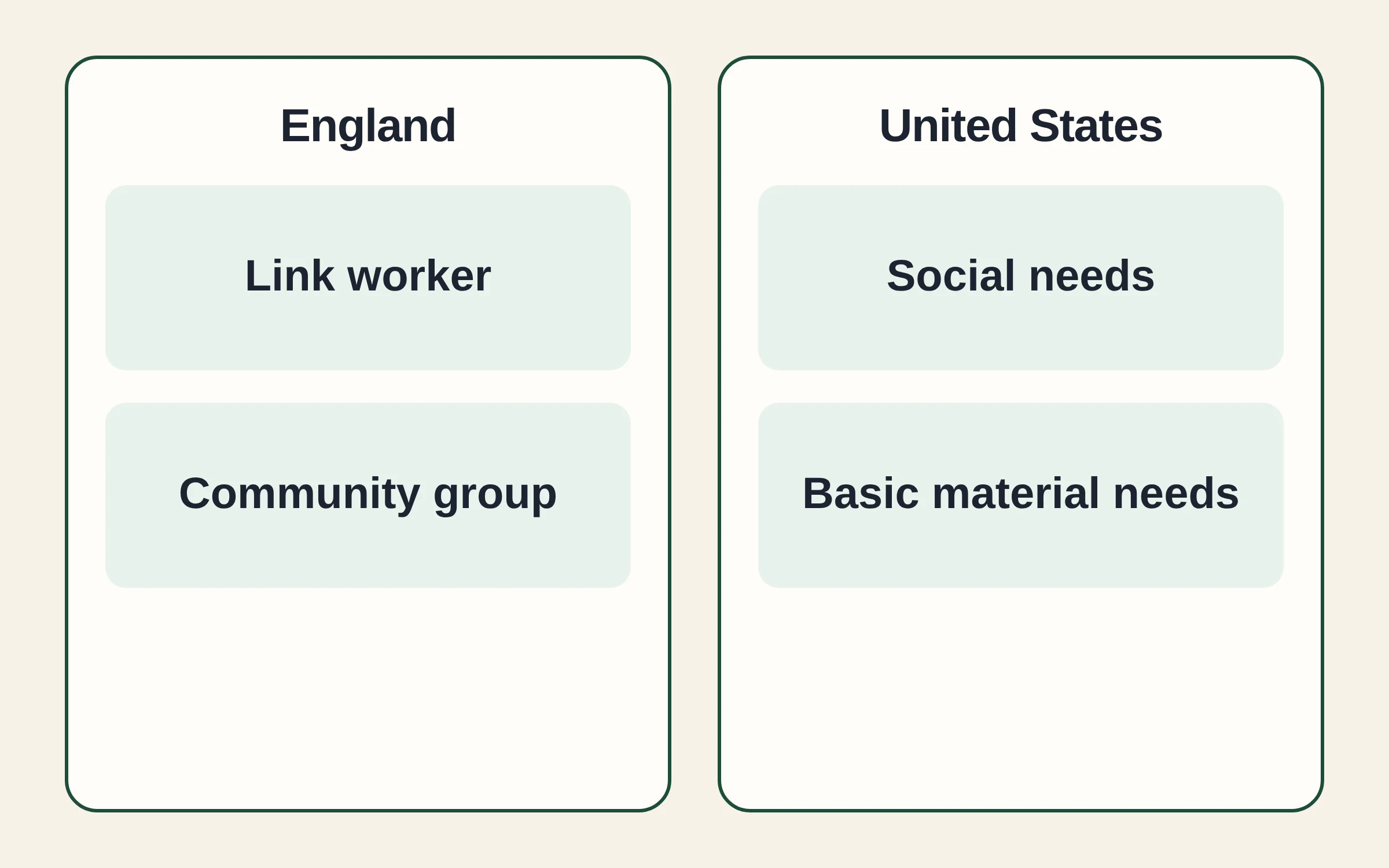
The migrant health guide says there is no standardised service model for social prescribing delivery, including for migrant populations. A comparison of schemes names twelve countries: Australia, Austria, Canada, England, Finland, Germany, Portugal, the Slovak Republic, Slovenia, the Netherlands, the United States, and Wales. England and Wales appear as separate entries. The United States is one of those countries. The English link-worker pattern is not the United States pattern.
Active signposting works best for people who are confident and skilled enough to find their own way to services after a brief intervention. That brief intervention is a different step from the link-worker handoff.
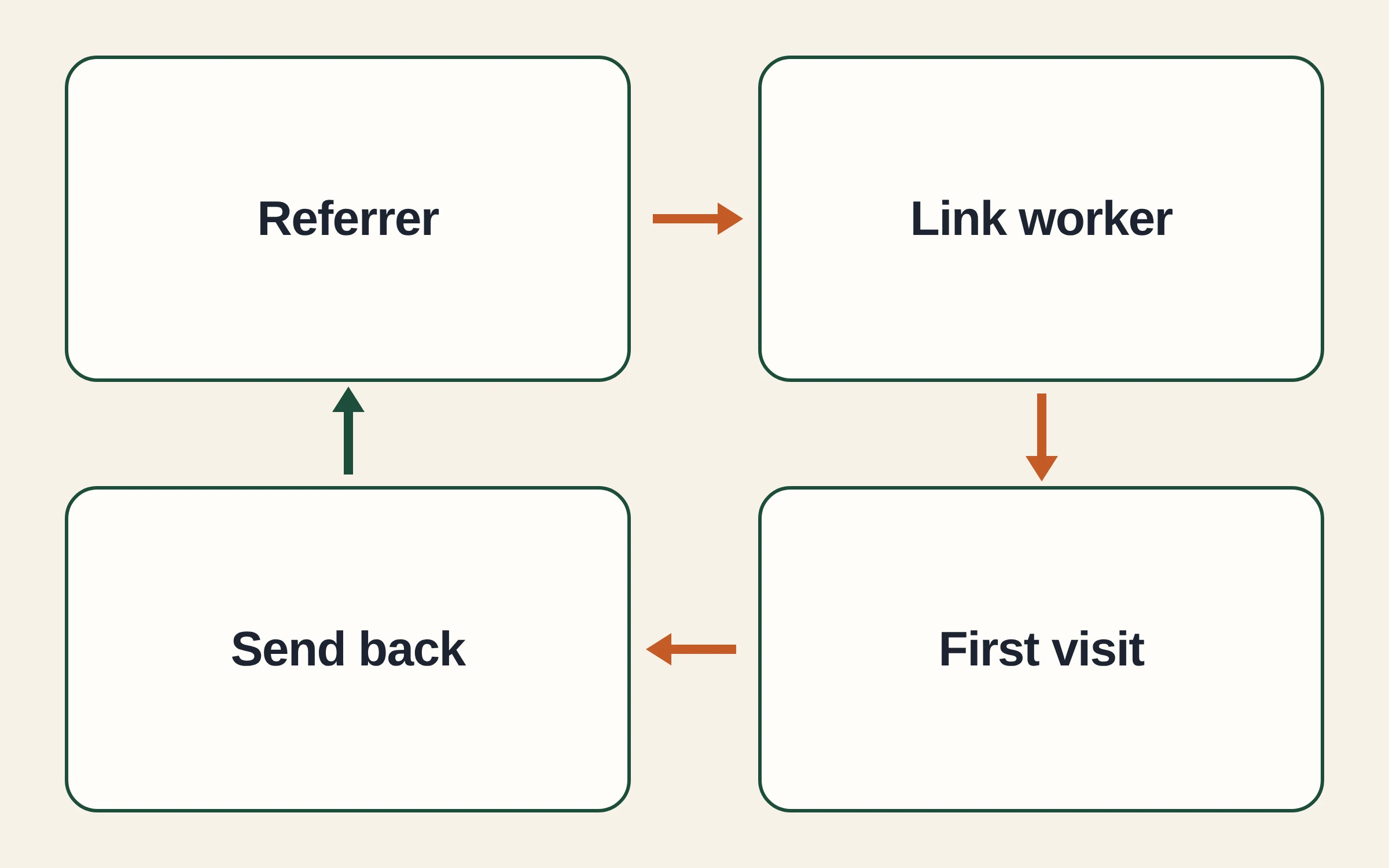
It may be necessary for link workers to accompany people to community groups for that first step, where people do not have the confidence to arrive alone.
How is social prescribing developing in the USA?
Social prescribing programs in the United States are more commonly called social needs or social care interventions. These programs usually involve a social risk assessment or screening, followed by efforts to connect patients with relevant social services or other resources. Staff may include nonmedical staff such as social workers, community health workers, and volunteer navigators.
Programs in the United States typically concentrate on connecting patients to resources that help meet basic material needs, such as food insecurity and housing instability. Interventions in the United States often use social risk screening tools. In England, interventions place less emphasis on standardized screening.
In the United States, a CultureRx pilot paper noted that social prescription was only then being piloted, though similar approaches had long been practiced. That paper describes social prescribing broadly as using community-based services to address non-clinical and subclinical needs, where providers can refer patients to resources ranging from housing and food assistance to job and skills training, volunteering, human-animal interaction, time in nature, and arts or culture activities. In a University of Florida account, when a health care provider identifies a patient who could benefit from social and cultural engagement, they refer them to a link worker whose role is to match them with an activity in their community.
The Centers for Medicare and Medicaid Services describes the Accountable Health Communities Model as screening of community-dwelling beneficiaries to identify certain unmet health-related social needs, referral to increase awareness of community services, navigation services to assist high-risk beneficiaries with accessing community services, and encouragement of alignment so community services are available and responsive. As of April, 2022, there were 28 organizations.
In 2024, journalist Julia Hotz published a book exploring examples of social prescriptions in two dozen countries. The United States example named in that book is a phone call program. The United Kingdom example named there is cycling lessons.
What are community health programs and how do non-clinical referrals connect to them?
Referral mechanisms, target groups, and services vary across settings. The process usually involves screening for non-medical needs and referrals to support services that are typically offered by community-based organizations. Typically, these are services that already exist in the community.
The Office for Health Improvement and Disparities lists volunteering, arts activities, group learning, gardening, befriending, cookery, healthy eating advice, and a range of sports. It also names joining local community groups, such as walking, singing, or gardening groups. The NHS England summary guide describes small grants for volunteer-led community groups that provide peer support and activities such as walking groups, choirs, and art classes.
The World Health Organization toolkit includes physical activity and nutrition, time in nature such as local parks and outdoor activities, music, arts and culture, and volunteering. The Western Pacific news item names exercise groups among the non-clinical services. Patient referral should not be passive and one-way.
Link workers collaborate with local partners to support community groups to be accessible and sustainable, and they help people to start new groups. The route, the pace, and the volunteer steps for starting a club are in how to start a walking club.
On the Office for Health Improvement and Disparities page, social prescribing is particularly useful for people who need more support with their mental health, who have one or more long-term conditions, who are lonely or isolated, or who have complex social needs that affect their wellbeing. The NHS England summary guide names a similar range: one or more long-term conditions, support with mental health, loneliness or isolation, and complex social needs which affect wellbeing.
The success of the pathway depends on the organizations that receive the person, and community services need to be available and responsive. People referred to those services are likely to be vulnerable and may need a more sensitive approach. For directory fields, hours, and recheck dates, see community services database fields and verification and how to keep a community support directory reliable.
What goes into a practical social prescribing referral template?
A walking group can keep a community referral handoff check. Each line is yes or no. The lines are not added into a score.
Community referral handoff check
- The need is non-clinical. If the need is clinical, or outside what the group offers, send it back to an appropriate service. Link workers should recognise when an individual requires support outside the link worker role and refer on.
- The activity already exists, and the group can say it is a walking group. It is not a clinic and not a counselling session. Community organizations lead the activity, not therapists.
- Referrers have been told who the activity is for. Find out whether local link workers have referral criteria, and make sure local health and care professionals and link workers know the service and its referral criteria.
- The person has been told which community group they will join, what the first visit is, and what they can expect of community support and services.
- The record includes what matters to the person: priorities, interests, values, and motivations.
- Someone from the group meets them, or the link worker comes the first time when they do not have the confidence to arrive alone.
- Needs outside the walk have a path back to the referrer.
- An England group can name which items from the NHS England safe-referral list it has arranged: appropriate insurance, safeguarding, lone working, first aid including mental health first aid, data protection, DBS checks, food safety, and working with vulnerable citizens. DBS checks on that list are a UK check.
- If the group uses the toolkit areas, the core implementation team defines the standards. Areas of consideration may include organizational health and safety policies, food safety, confidentiality, inclusivity, and effectiveness.
- For directory fields and recheck dates, use the two directory guides linked above.
Where the person is a migrant, the service can record preferences for language, culture, the sex of the link worker, and the format of service delivery.
What does current social prescribing research examine?
A 2016 review in The BMJ concluded that further, more robust testing was needed to determine how effective social prescribing was. Evidence in favour came from small trials that were open to a range of biases.
A study of social prescription programs at 23 GP surgeries in central London found a strong improvement in qualitative outcomes, such as making participants less isolated, while quantitative outcomes such as general health and wellbeing were largely unchanged.
A 2020 review found that social prescribing can help people develop a sense of belonging and confidence. For that to happen, link workers need the resources to develop extensive knowledge of local organisations and services, and enough time to build a relationship with their patients.
It has been suggested that social prescribing is unlikely to reduce health inequalities, and may risk exacerbating them.
Although little robust evidence exists regarding the effectiveness of social prescribing in England, a comparison of twelve countries finds that robust evidence on impact is scarce and highly context-specific, with some indications of cost-effectiveness and positive impact on well-being. There is a lack of high-quality research and evaluation on the effects of social prescribing for migrant populations in the UK.
The NICE pharmacy evidence committee were unable to recommend social prescribing specifically, because the concept is very complex and evidence on its effectiveness or acceptability within these settings is limited.
The World Health Organization says further evidence is needed to inform policies and programmes that address social isolation and loneliness, and it calls on Member States and academic partners to generate that evidence. Since 2020, the Western Pacific Healthy Ageing unit has led work on social prescribing and was the first WHO unit to formally introduce it to Member States. Evidence from Asian contexts has so far been limited, while social prescribing has expanded rapidly in Europe and North America. The Western Pacific series shares practical insights from Cambodia and the Lao People’s Democratic Republic.
Wikipedia’s closing summary says the momentum for social prescribing is likely to be sustained, even with the lack of evidence to support its growth, and that the scheme sees success when healthcare professionals fully accept it as a useful mechanism for improving health and wellbeing.