
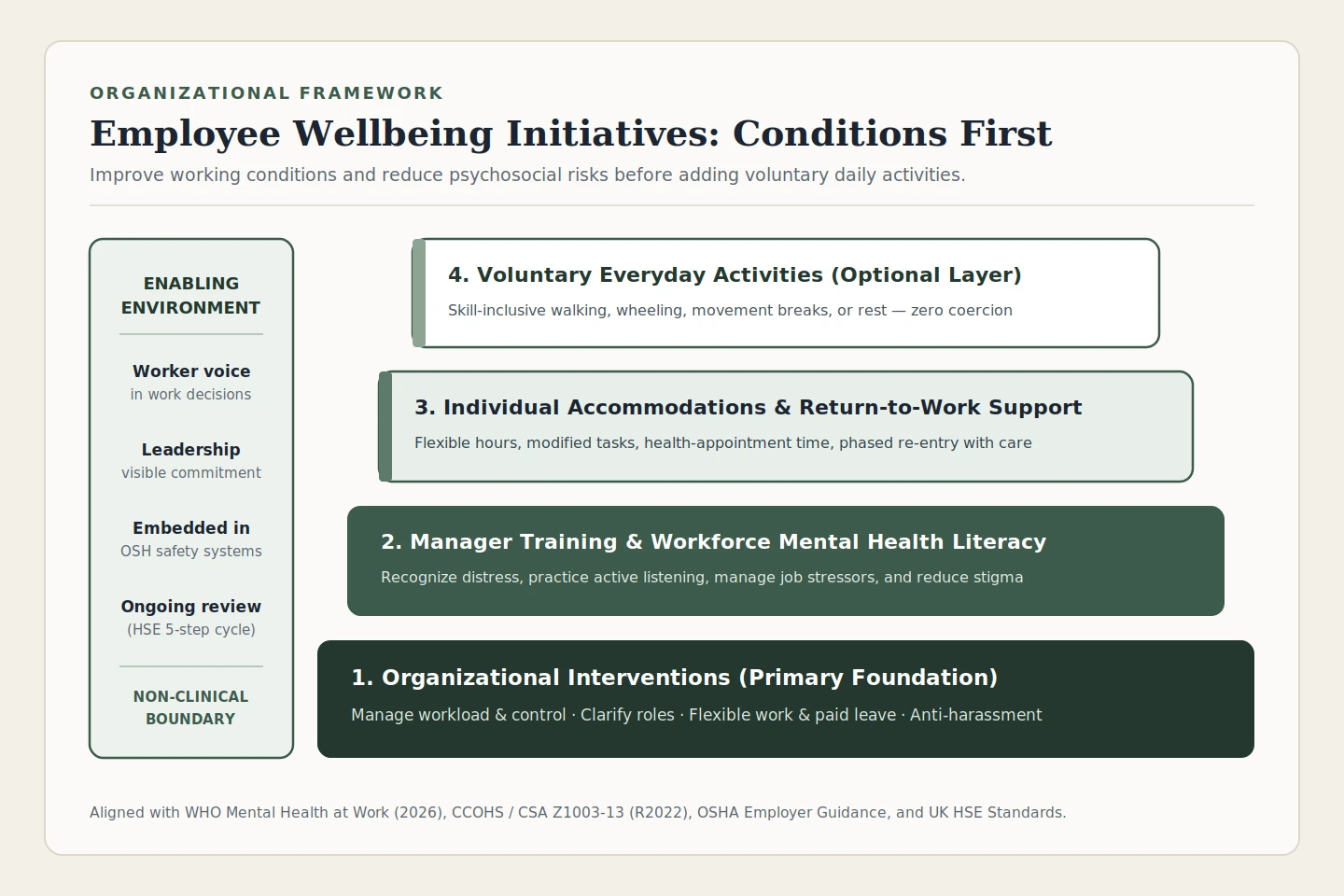
Employee Wellbeing Initiatives: Framework & Examples
Employee wellbeing initiatives work best when teams improve working conditions and psychosocial risks first, then add voluntary, non-clinical everyday activities.
Topic
Where a walking conversation at work can help, and where it is the wrong format.
Read the limits note before you suggest walking meetings as a wellbeing practice.
Limits of walking conversations at work explains confidentiality, adjustments, and routes that are not a walk. Low-barrier workplace wellness ideas covers NIOSH Total Worker Health controls, 25/50-minute calendar buffers, 1:6 shift float relief, and low-sensory decompression rooms. Inclusive corporate wellness challenge design covers capped daily consistency streaks, personal baseline delta ratios, 2024 Compendium activity block conversions, and 29 CFR Section 2590.702(f) rules. Employee wellbeing initiatives: framework and examples explains how to prioritize working conditions and psychosocial risk controls before layering voluntary, non-clinical daily team activities.
Employee wellbeing initiatives work best when teams improve working conditions and psychosocial risks first, then add voluntary, non-clinical everyday activities.
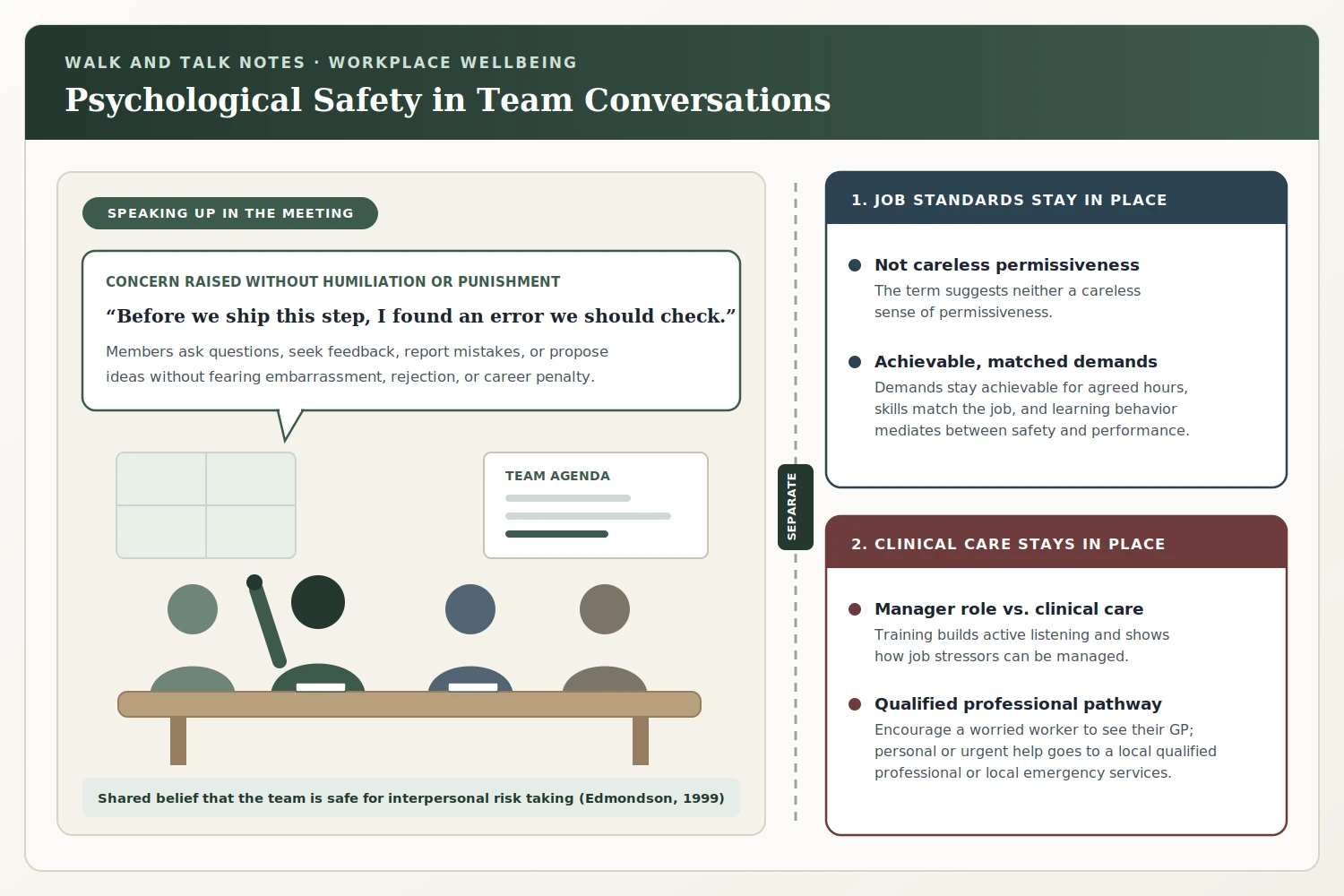
Psychological safety at work means speaking up with questions, concerns, or mistakes without humiliation, while keeping job standards and clinical boundaries.
Operational guide to designing an inclusive corporate wellness challenge using capped active-day streaks, personal baseline gain indexing, and 2024 Compendium activity conversions.
Operational guide to low-barrier workplace wellness ideas across office, remote, shift, and mobility-diverse teams using NIOSH Total Worker Health and ISO 45003 controls.
A walking conversation at work is optional and confidential.