Effective workplace wellness ideas replace performative step-count contests and unpaid after-hours classes with structural work-design controls: 25- and 50-minute calendar defaults, protected 15-minute paid recovery windows with 1-to-6 shift float relief, low-sensory decompression rooms under 150 lux and 40 dBA, and step-free midday strolls alongside seated courtyard options. Launching employee wellbeing initiatives around wearable leaderboards, biometric screenings, or lunchtime headquarters perks fails shift-based, remote, neurodivergent, and mobility-diverse workers while wasting budget on programs that only already-active staff use.
Organisers and operations leads planning inclusive workplace wellbeing need interventions that modify working conditions before asking individuals to manage fatigue on their own time. This operational guide applies the CDC and National Institute for Occupational Safety and Health (NIOSH) Total Worker Health (TWH) Hierarchy of Controls and ISO 45003:2021 psychosocial risk standards across four distinct work modes, building on the confidentiality and route boundaries established in limits of walking conversations at work and the broader notes in Workplace Wellbeing.
| Workforce Cohort / Work Mode | Primary Scheduling Control (NIOSH Level 1 and 2) | Physical, Sensory, and Route Specification (NIOSH Level 3) | Privacy, ADA / GDPR, and Non-Coercion Safeguard | Target Participation Parity Metric |
|---|---|---|---|---|
| Office and Hybrid Desk Staff | Organization-wide 25/50-min speedy meeting defaults (16.7% recovery buffer) plus a protected 15–20 min paid midday break block |
PROWAG R302 step-free outdoor loop (>= 1.22 m width, <= 5.0% running slope, 3.0–3.8 km/h at 2.5–2.8 METs) plus shaded ADA 903 courtyard benches |
Zero step tracking, zero attendance sheets, and camera-off permission on internal video calls | Baseline reference cohort EPR_office (45%–65% anonymous daily break utilization) |
| Remote and Distributed Staff | Local-timezone synchronized 15–20 min paid recovery status norm (No reply expected) and asynchronous update defaults across regions |
Optional audio-only walk window (camera strictly off) or offline balcony/window rest; local thermal cutoff 10°C–26.7°C (50°F–80°F) and EPA AQI <= 100 |
Zero GPS route logging, zero wearable app syncing, and explicit right to disconnect outside local core hours | EPR_remote >= 0.80 × EPR_office (Cross-Cohort Parity Ratio PR >= 0.80) |
| 24/7 Rotating Shift and Frontline Staff | Scheduled 1:6 Float-Relief Breaker rotation (1 relief operator covering 6 stations across a 90-min mid-shift window) plus forward shift rotation (>= 11 hr rest) |
Unlocked low-sensory decompression room within <= 2–3 min step-free walk (<= 150 lux, <= 40 dBA, 20–22°C), 15–20 mm nitrile floor mats, and 60–90 min task rotation |
Relief coverage logged by station ID rather than personal health records; night shift receives identical quiet room and water access | EPR_shift >= 0.80 × EPR_office (PR >= 0.80 across both day and night shifts) |
| Mobility-Diverse and Neurodivergent Staff | Self-selected micro-adjustments and ±30–60 min start/finish transit buffers granted without medical tribunal or diagnosis gatekeeping |
Co-equal stationary courtyard bench (430–485 mm seat height, backrest, armrests, 760 × 1,220 mm wheelchair pad) or reclining daybed in fragrance-free quiet room |
Written plain-language meeting agendas circulated >= 24 hr in advance; stepping away or remaining seated requires zero explanation |
100% structural route and room pass rate on quarterly accessibility check |
Why Performative Wellness Perks Fail: Empirical Evidence and the NIOSH Hierarchy
Most corporate wellness budgets are spent on Level 5 individual behavioral prompts: step-count contests, wearable app leaderboards, lunchtime seminars, mindfulness subscriptions, and biometric health risk assessments. Large-scale experimental and multi-employer studies demonstrate that this approach fails both clinically and operationally when underlying job demands remain untouched.
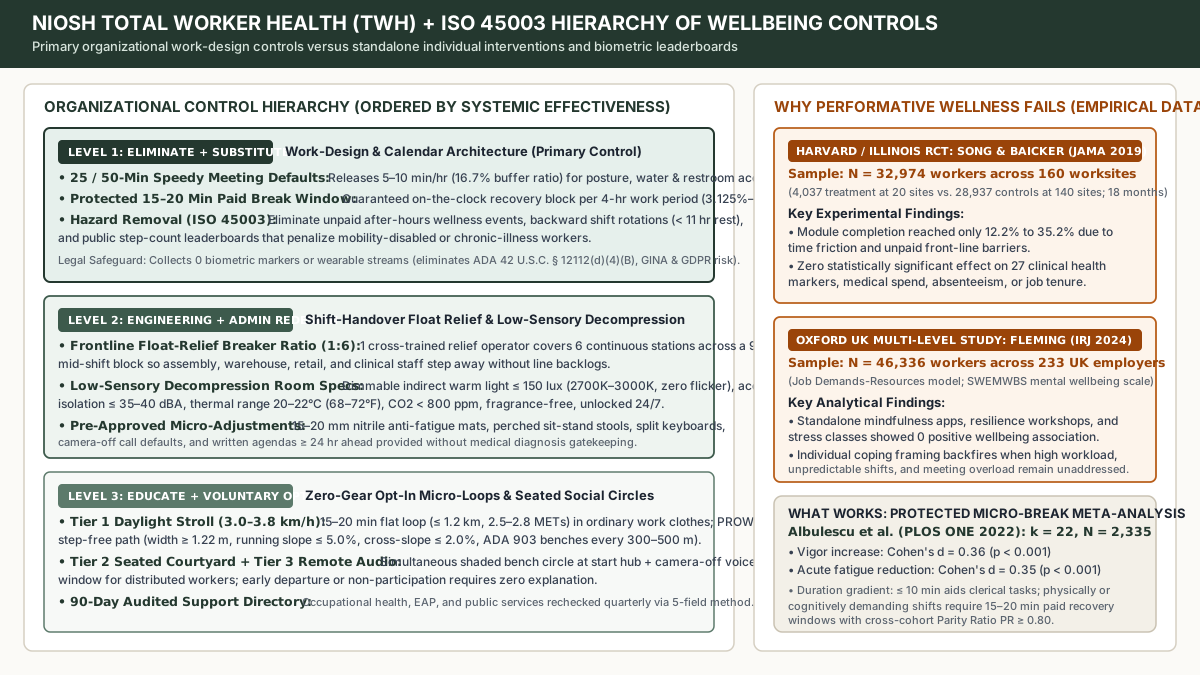
Empirical Failure Modes in Randomized and Multi-Employer Trials
Two landmark investigations expose the root cause of low participation and null outcomes in conventional employee wellbeing initiatives:
- The Harvard and Illinois Workplace Wellness Randomized Clinical Trial (Song & Baicker, JAMA 2019):
- Study design and sample: An 18-month cluster-randomized controlled trial across
160worksites of BJ’s Wholesale Club encompassingN = 32,974employees (4,037employees at20treatment worksites offered a multi-module wellness program versus28,937employees at140primary and secondary control worksites). - Participation ceiling and selection bias: Module completion across the treatment sites averaged only
12.2% to 35.2%, reflecting the time barrier faced by hourly retail and warehouse staff who cannot abandon floor stations. While self-reported regular exercise rose by8.3 percentage pointsand active weight management rose by13.6 percentage pointsamong survey respondents, the trial recorded zero statistically significant effects on 27 clinical health markers (including blood pressure, total cholesterol, body mass index, and HbA1c), healthcare spending, medical utilization, absenteeism, job tenure, or job performance. - Operational lesson: Earlier observational claims of 3-to-1 return on investment were artifacts of healthy-worker selection bias. Employees who enter competitive step challenges already possess lower baseline medical expenditures and higher physical mobility, whereas fatigued shift workers and disabled staff are systematically excluded.
- Study design and sample: An 18-month cluster-randomized controlled trial across
- The Oxford UK Multi-Level Study on Individual Mental Health Interventions (Fleming, Industrial Relations Journal 2024):
- Study design and sample: Cross-sectional multi-level analysis of
N = 46,336workers across233UK organisations from the Britain’s Healthiest Workplace dataset, evaluated using Job Demands-Resources (JD-R) theory and the Short Warwick-Edinburgh Mental Well-Being Scale (SWEMWBS). - Null and backfire effects: Standalone individual-level interventions, including mindfulness apps, resilience training, stress management classes, relaxation coaching, and time-management workshops, showed no positive statistical association with subjective mental wellbeing or job satisfaction compared with matched non-participants. Framing occupational exhaustion as an individual coping deficit while leaving high workload, back-to-back meeting density, and unpredictable shift rosters intact alienates staff.
- Study design and sample: Cross-sectional multi-level analysis of
Applying NIOSH Total Worker Health, ISO 45003, and ADA / GDPR Guardrails
To prevent these failure modes, the CDC / NIOSH Total Worker Health (TWH) Hierarchy of Controls, ISO 45003:2021 (Guidelines for managing psychosocial risks), and the World Health Organization (WHO) 2022 Guidelines on Mental Health at Work mandate that employers address organizational work design before offering optional personal activities:
- Level 1: Eliminate Psychosocial and Exclusionary Hazards: Remove unpaid after-hours “wellness” events, eliminate public step-count leaderboards that penalize wheelchair users or staff with chronic fatigue, and eliminate continuous 60-minute calendar booking defaults that erase hydration and restroom pauses.
- Level 2: Substitute Restorative Workflow Norms: Replace 30- and 60-minute meeting defaults with
25- and 50-minuteslots, substitute uncompensated break expectations with scheduled float-relief coverage on frontline floors, and replace backward-rotating shift rosters with forward-rotating schedules (Morning -> Afternoon -> Night) providing at least11 hoursof uninterrupted rest between shifts. - Level 3: Redesign Physical and Digital Environments (Engineering Controls): Configure shared calendar software to auto-release transition buffers, map step-free outdoor walking corridors with ADA rest seating every
300 to 500 meters, and construct unlocked low-sensory decompression rooms (<= 150 lux,<= 40 dBA) within a2- to 3-minutewalk of production and clinical stations. - Level 4 and Level 5: Educate Managers and Offer Voluntary Options: Train line supervisors on non-coercive invitation language and reasonable adjustments, then offer co-equal optional resources (zero-gear daylight walks, seated courtyard circles, date-checked support directories, and inclusive corporate wellness challenge design using capped active-day streaks and 2024 Compendium activity blocks).
Eliminating individual health tracking also resolves regulatory exposure under Title I of the Americans with Disabilities Act (ADA, 42 U.S.C. § 12112(d)(4)(B)), Title II of the Genetic Information Nondiscrimination Act (GINA), the UK Equality Act 2010, and GDPR / UK Data Protection Act 2018 special-category health data provisions. Under EEOC regulations (following the federal court vacatur of the 30% financial incentive rule in AARP v. EEOC), biometric blood draws, health risk assessments, and wearable data harvesting constitute disability-related inquiries that trigger strict voluntariness and data-minimization barriers. Low-barrier workplace wellness ideas collect zero biometric markers, step counts, or medical diagnoses.
Takeaway: Anchor employee wellbeing initiatives in NIOSH Levels 1 through 3 (calendar architecture, shift float-relief staffing, and low-sensory physical spaces) while collecting zero personal biometric or step-count data.
Cross-Cohort Scheduling Parity: 25/50-Minute Calendars and 1:6 Shift Float Relief
The primary engineering rule of inclusive workplace wellbeing is that a break only exists if the worker’s tasks are structurally paused or covered during that window. An unscheduled “take a break whenever you like” policy fails both salaried staff trapped in continuous video calls and hourly operators tied to a moving line.
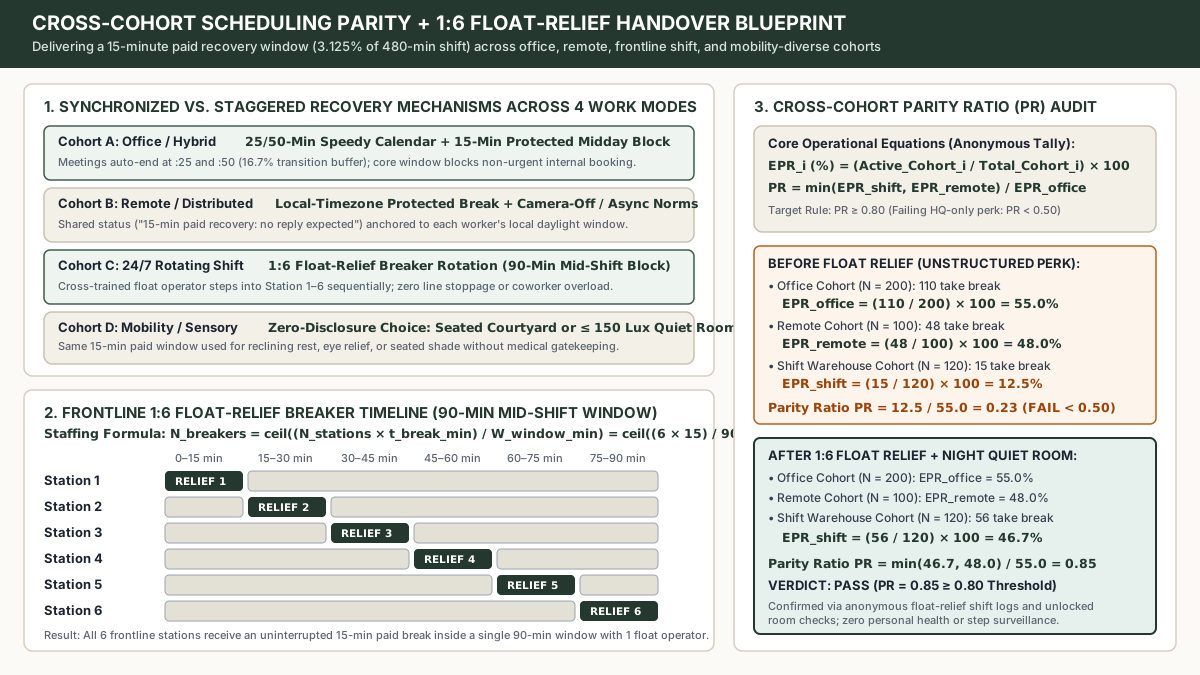
Calendar Buffer Ratio and Annualized Recovery Time Math
For office, hybrid, and remote staff whose schedules are governed by digital calendars, configure tenant-wide defaults in Google Workspace or Microsoft 365 to shorten 30-minute meetings to 25 minutes and 60-minute meetings to 50 minutes. Calculate the Meeting Recovery Buffer Ratio and Annualized Calendar Recovery Time using these equations:
Buffer_Ratio (%) = (Sum_Transition_Buffers_min / Scheduled_Meeting_Block_min) × 100
T_annual_recovered_hr = (N_meetings_day × t_buffer_min × D_workdays_yr) / 60
Where:
Sum_Transition_Buffers_min= Total transition minutes released per hour of scheduled meetings (10 minuteswhen converting either one 60-minute block to50 minutesor two 30-minute blocks to25 minuteseach).Scheduled_Meeting_Block_min= Gross calendar block (60 minutes), yielding a constantBuffer_Ratio = (10 / 60) × 100 = 16.7%.N_meetings_day= Average number of 1-hour equivalent meeting blocks per workday.t_buffer_min= Released buffer per block (10 minutes).D_workdays_yr= Active workdays per year (typically230 daysafter statutory holidays and annual leave).
Worked Example (Desk Cohort Calendar Recovery):
Suppose a hybrid project team averages N_meetings_day = 4 one-hour meeting blocks per day across D_workdays_yr = 230 workdays. Enforcing the 50-minute calendar ceiling (t_buffer_min = 10 minutes) releases 40 minutes per day of fragmented postural and visual recovery, which totals:
T_annual_recovered_hr = (4 × 10 × 230) / 60 = 153.3 hours per worker per year
Those 153.3 hours prevent continuous static spinal loading beyond 50 minutes and allow workers to hydrate, visit the restroom, and look away from backlit monitors before the next call begins.
Paid Micro-Break Share and Frontline Float-Relief Breaker Formula
While 5- to 10-minute hourly transition buffers prevent continuous screen strain, the Albulescu et al. (2022) meta-analysis (22 study samples, N = 2,335) demonstrates a clear duration gradient: cognitively or physically demanding shifts require a dedicated 15- to 20-minute paid recovery window per 4-hour work block to restore executive function and prevent cumulative end-of-shift exhaustion. Inside a standard 8-hour (480-minute) shift, the Paid Break Time Share is:
Paid_Break_Share (%) = (T_micro_break_min / T_total_shift_min) × 100
A single 15-minute on-the-clock recovery window represents (15 / 480) × 100 = 3.125% of paid shift time (4.17% for a 20-minute window). To guarantee that 24/7 rotating shift, assembly, warehouse, retail, hospitality, and clinical workers actually receive this 15-minute window without leaving their colleagues short-handed, calculate required relief staffing using the Float-Relief Breaker Staffing Formula:
N_breakers = ceil((N_stations × t_break_min) / W_window_min)
Where:
N_stations= Number of continuous frontline workstations requiring coverage.t_break_min= Paid recovery break duration per worker (15 minutes).W_window_min= Total mid-shift scheduling block allocated for rotating breaks (typically90 minutes, such as10:00–11:30on a day shift or02:00–03:30on a night shift).
Worked Example (Frontline 1:6 Float-Relief Rotation):
- For a
6-stationpacking or clinical unit (N_stations = 6) takingt_break_min = 15 minutebreaks inside aW_window_min = 90 minutemid-shift block:N_breakers = ceil((6 × 15) / 90) = ceil(90 / 90) = 1 float relief operator(1:6breaker ratio). - The float operator steps into Station 1 from
0–15 min, Station 2 from15–30 min, Station 3 from30–45 min, Station 4 from45–60 min, Station 5 from60–75 min, and Station 6 from75–90 min. - If a warehouse floor runs
N_stations = 16active stations across the same90-minutewindow:N_breakers = ceil((16 × 15) / 90) = ceil(240 / 90) = ceil(2.67) = 3 float relief operators.
Measuring Equity with the Cross-Cohort Parity Ratio (PR)
To verify that employee wellbeing initiatives do not become headquarters-only perks, compute the Effective Participation Rate (EPR_i) for each workforce cohort i using anonymous shift-relief tallies or facility logs, then evaluate the Cross-Cohort Parity Ratio (PR):
EPR_i (%) = (Active_Participants_Cohort_i / Total_Eligible_Headcount_Cohort_i) × 100
PR = min(EPR_shift, EPR_remote) / EPR_office
Apply these operational threshold rules:
- If
PR < 0.50(Failing Program): Indicates severe structural exclusion, such as a midday courtyard walk or headquarters class that frontline shift workers and remote staff cannot access. - If
0.50 <= PR < 0.80(Partial Access): Requires immediate float-relief staffing adjustments or remote timezone synchronization. - If
PR >= 0.80(Target Operational Parity): The lowest-participating cohort achieves at least80%of the utilization rate of daytime office staff (PR = 0.90–1.05represents full parity).
Worked Example (Pre- vs. Post-Float Relief Parity Audit):
Consider an employer with 200 daytime office staff, 100 distributed remote workers, and 120 rotating-shift warehouse operators:
- Baseline (Before Float Relief):
110office workers use the daily 15-minute break (EPR_office = (110 / 200) × 100 = 55.0%), and48remote workers use their local synchronized break (EPR_remote = (48 / 100) × 100 = 48.0%). On the warehouse floor, no float breaker is assigned, so only15workers manage to step away (EPR_shift = (15 / 120) × 100 = 12.5%). The resulting Parity Ratio isPR = min(12.5, 48.0) / 55.0 = 0.23(FAIL, well below the0.50failure floor). - After Adding 1:6 Float Relief and a Night-Shift Decompression Room: With float breakers assigned and an unlocked low-lux recovery room open at night,
56of the120warehouse workers use their 15-minute paid window (EPR_shift = (56 / 120) × 100 = 46.7%). The updated Parity Ratio rises toPR = min(46.7, 48.0) / 55.0 = 46.7 / 55.0 = 0.85(PASS, exceeding the>= 0.80threshold).
Takeaway: Pair 25/50-minute calendar defaults (16.7% buffer ratio) with 1:6 frontline float-relief staffing so your Cross-Cohort Parity Ratio reaches PR >= 0.80 across office, remote, and shift teams.
Three Co-Equal Midday Movement and Decompression Options
Once a 15- to 20-minute paid window is protected on the clock, how employees spend that time must remain completely voluntary and non-competitive. In their systematic review and meta-analysis of 22 independent study samples (N = 2,335), Albulescu et al. (2022) confirmed that short voluntary intra-workday micro-breaks significantly increase subjective vigor (Cohen's d = 0.36, p < 0.001) and reduce acute occupational fatigue (Cohen's d = 0.35, p < 0.001), provided workers control the activity themselves.
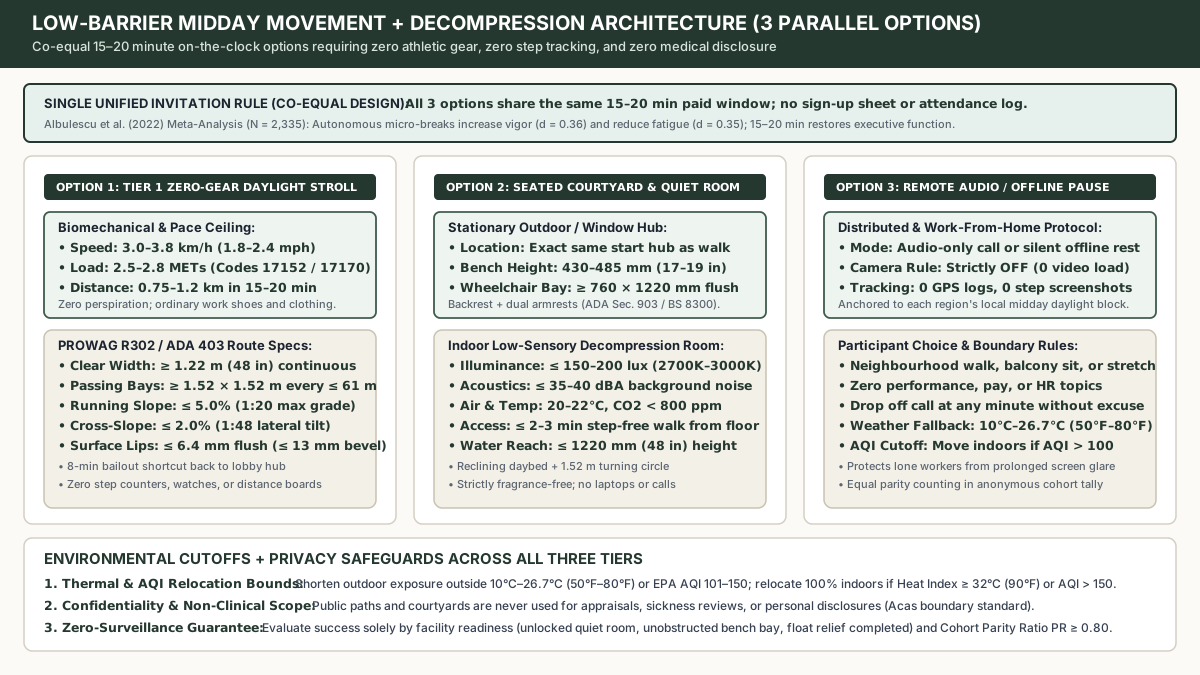
To prevent walking loops from turning into a fitness test that excludes people with mobility impairments, joint pain, or post-exertional malaise, publish three co-equal options in the exact same calendar invitation:
Option 1: Tier 1 Zero-Gear Daylight Stroll (3.0–3.8 km/h, 2.5–2.8 METs)
Design the outdoor walking option around ordinary work clothing and step-free accessibility rather than aerobic workouts:
- Pace and metabolic load ceiling: Cap walking speed at Tier A (
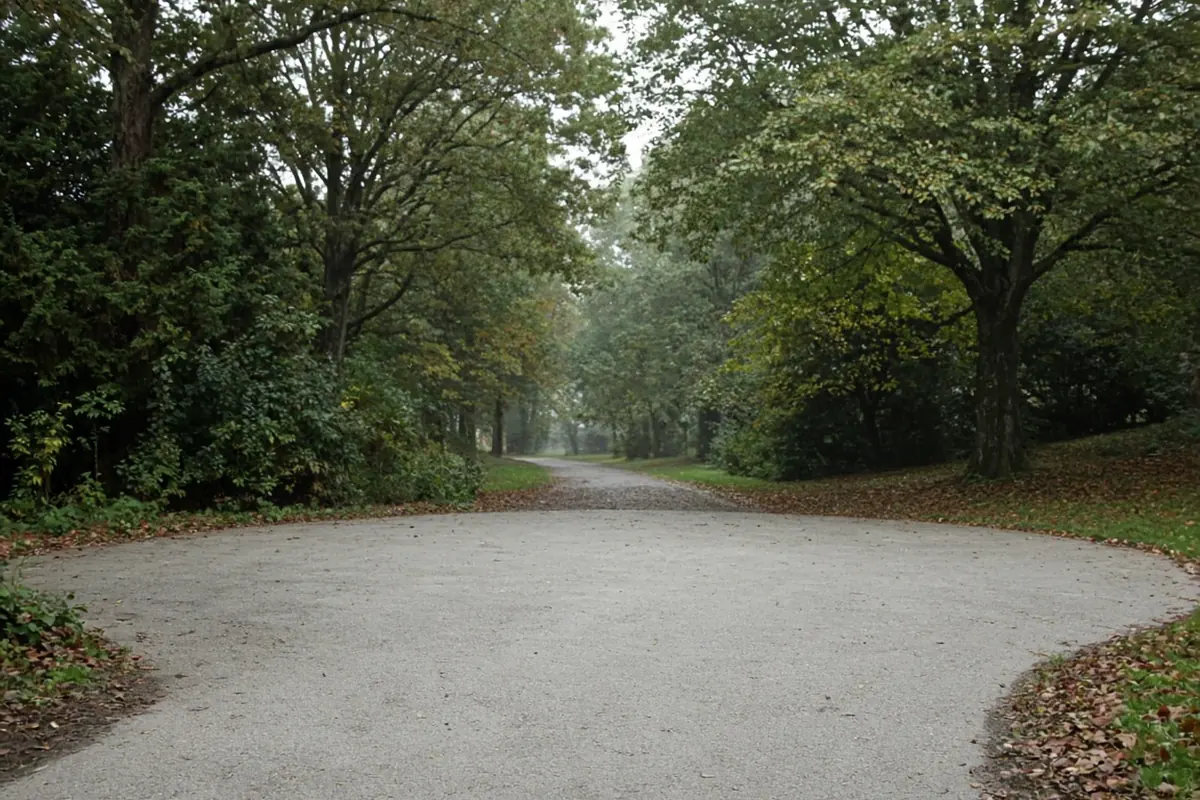
3.0–3.8 km/h/1.8–2.4 mph), which corresponds to2.5–2.8 METsin the 2024 Adult Compendium of Physical Activities (Codes17152and17170). Over a15- to 20-minutewindow, a gentle stroll covers0.75 to 1.2 km(0.45 to 0.75 miles). At<= 2.8 METs, participants converse in full sentences without breathlessness, never perspire, and never need athletic shoes or locker-room changes. If employees want to form a longer lunchtime or after-work group with multiple speed waves and volunteer back-markers, follow the multi-tier setup in how to start a walking club. - PROWAG R302 and ADA Section 403 route geometry: Before listing any office perimeter loop, measure the path against the physical standards in how to organise an inclusive walk: continuous clear tread width
>= 1.22 m(48 in;1.52–1.80 mpreferred for two-abreast wheelchair and walker conversation),>= 1.52 × 1.52 m(60 × 60 in) level passing spaces every<= 61 m(200 ft), longitudinal running slope<= 5.0%(1:20), lateral cross-slope<= 2.0%(1:48), firm slip-resistant paving with vertical lip transitions<= 6.4 mm(1/4 in), and an8-minutemid-loop shortcut back to the building entrance. - Confidentiality boundary: Keep midday strolls purely social or quiet. As detailed in limits of walking conversations at work, never use an outdoor walk for performance appraisals, return-to-work sickness interviews, disciplinary discussions, or private disclosures that passersby can overhear.
Option 2: Stationary Shaded Courtyard Bench and Window Tea Circle
Every outdoor walk invitation must anchor its starting hub at an accessible Stationary Courtyard or Indoor Atrium Circle so colleagues who prefer sitting share the exact same break space and social connection:
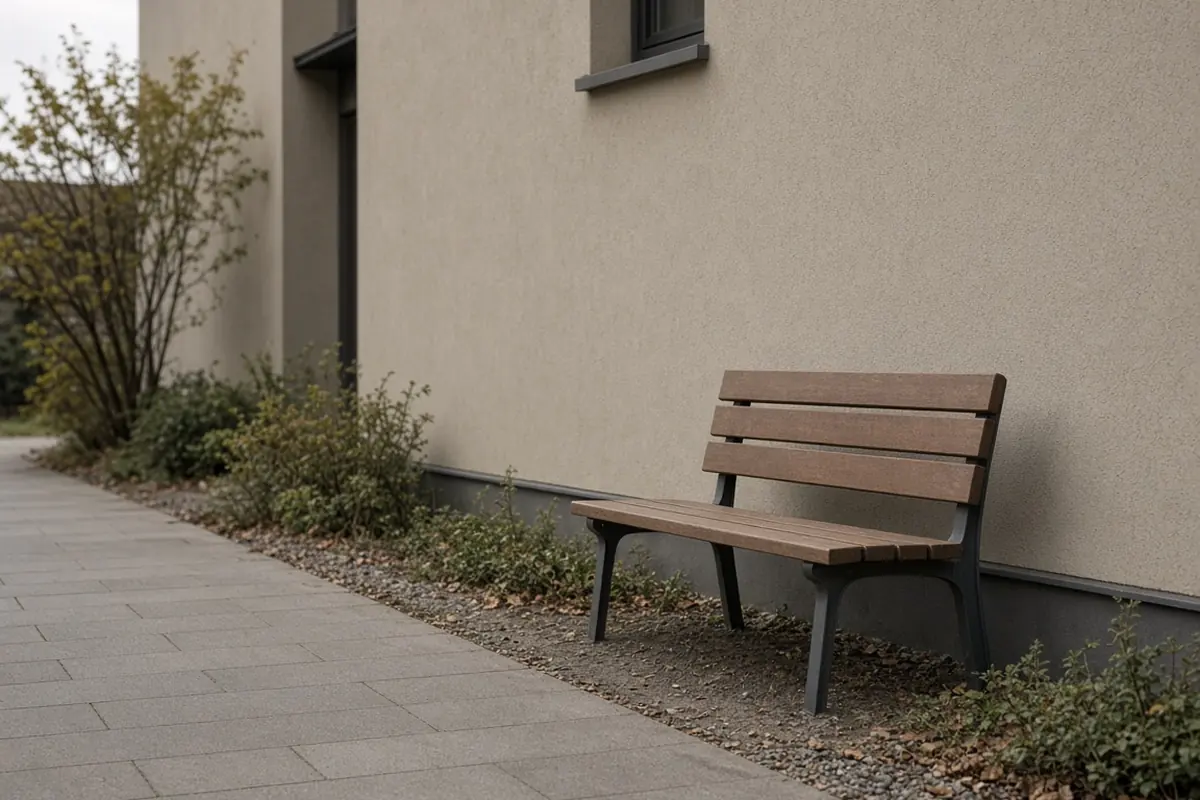
- ADA Section 903 and BS 8300 seating ergonomics: Provide shaded benches or courtyard chairs with a seat surface height of
430–485 mm(17–19 in), seat depth of510–610 mm(20–24 in), full backrest support, and dual sturdy armrests to assist sit-to-stand transitions. - Flush wheelchair companion bays: Ensure at least one
>= 760 × 1,220 mm(30 × 48 in) firm, level ground space sits flush beside the bench outside the pedestrian travel lane so a wheelchair or rollator user sits shoulder-to-shoulder with seated colleagues. - Indoor meeting-room check: When bad weather moves the seated circle indoors, verify step-free door widths (
>= 815 mm/32 inclear opening), clear seating aisles, and drinking water dispenser height (<= 1,220 mm/48 in) using our accessibility checklist for a community event.
Option 3: Remote Audio-Only Walk and Offline Balcony Pause
For distributed and work-from-home staff, video-call “virtual coffee breaks” compound screen fatigue because workers remain locked in front of a webcam:
- Strictly camera-off, zero-screen protocol: Offer an optional dial-in audio channel (with video cameras disabled by default) for remote colleagues who want casual voice conversation while strolling their own street or sitting on a porch, paired with explicit permission to take the
15–20 minutescompletely offline in silence. - Environmental and AQI cutoffs: Apply the
T-2 houroutdoor safety bounds across all sites. Shorten or move outdoor walks indoors whenever ambient temperatures fall below10°C(50°F) or exceed26.7°C(80°F), or when the US EPA Air Quality Index (AQI) reaches101–150. Cancel outdoor walking and use indoor concourses or quiet rooms whenever the Heat Index reaches>= 32°C(90°F) or AQI exceeds150.
Takeaway: Present a 3.0–3.8 km/h step-free stroll, a stationary ADA 903 courtyard bench circle, and a camera-off remote pause as co-equal choices in the same 15–20 minute paid window.
Low-Sensory Decompression Rooms and No-Diagnosis Micro-Adjustments
Performative workplace perks often center on high-stimulation “game rooms” equipped with ping-pong tables, arcade consoles, or open-plan television lounges. Those spaces generate 65–75 dBA of reverberant noise and visual clutter, failing night-shift workers, migraine sufferers, autistic or ADHD employees, and frontline staff recovering from loud production or clinical floors.
Engineering Specifications for a 24/7 Low-Sensory Decompression Room
Repurpose an underused small meeting room or storage bay located within a 2- to 3-minute step-free walk of both desk zones and frontline shift stations into an unlocked, non-bookable Low-Sensory Decompression Room:
| Environmental / Ergonomic Parameter | Target Engineering Specification | Operational Purpose and Failure Mode Prevented |
|---|---|---|
| Illuminance and Spectrum | Dimmable indirect warm LED lighting <= 150–200 lux (2700K–3000K correlated color temperature; zero overhead fluorescent ballast flicker) |
Prevents photophobia, visual migraine triggers, and circadian melatonin suppression during night-shift recovery breaks. |
| Acoustic Isolation | Ambient background sound level <= 35–40 dBA (wall panels with Noise Reduction Coefficient NRC >= 0.75, acoustic door perimeter seals, and drop-bar threshold) |
Blocks corridor and machinery noise; paired with a strict room rule prohibiting phone calls, keyboards, speaker audio, and conversation. |
| Thermal Comfort and Indoor Air Quality | Temperature 20–22°C (68–72°F), relative humidity 40%–60%, ventilation maintaining CO2 < 800 ppm, and 100% fragrance-free policy |
Eliminates synthetic air fresheners, essential oil diffusers, and stale air (CO2 > 1,200 ppm) that trigger asthma, nausea, or cognitive grogginess. |
| Seating, Daybed, and Clear Floor Geometry | Armchairs (430–485 mm seat height), at least 1 wipeable reclining rest chair or daybed, >= 1.52 m (60 in) wheelchair turning circle, and water reach <= 1,220 mm (48 in) |
Allows orthostatic intolerance (such as POTS), back pain, or chronic fatigue workers to elevate legs or recline privately without lying on a locker-room floor. |
Pre-Approved Micro-Adjustments Without Diagnosis Gatekeeping
Under both ISO 45003:2021 and the WHO (2022) Mental Health at Work Guidelines, waiting for an employee to experience a health crisis and submit formal medical documentation before adjusting their workstation creates unnecessary delay and stigma. Maintain a pre-approved menu of low-cost physical and scheduling micro-adjustments that any worker can request directly from their line manager or facilities desk without disclosing a medical diagnosis:
- Frontline and Shift-Floor Ergonomic Controls:
- Install
15–20 mmclosed-cell nitrile rubber anti-fatigue matting combined with height-adjustable perched sit-stand stools at packing, cashier, inspection, and laboratory stations so workers alternate between standing and supported sitting without losing reach clearance. - Enforce
60- to 90-minutetask rotation between high-repetition manual stations and lower-load monitoring or replenishment roles to prevent localized musculoskeletal overload. - Replace backward shift rotations (
Night -> Afternoon -> Morning) with forward-rotating shift schedules (Morning -> Afternoon -> Night) and enforce a hard minimum of>= 11 hoursof uninterrupted rest between consecutive shifts to prevent circadian jetlag.
- Install
- Office, Hybrid, and Neurodivergent Workflow Controls:
- Provide anti-glare monitor screens, split ergonomic keyboards, sit-stand desk converters, and passive or active noise-attenuating headphones from standard office supply stock.
- Circulate written plain-language meeting agendas at least
24 hoursin advance and permit written asynchronous contributions for staff who process complex information more effectively in writing. - Offer
±30- to 60-minutestart and finish time buffers around core hours so employees can avoid peak public transit crush or manage morning stiffness and medication routines without penalty. When managers discuss these options, they should follow the person-first, non-diagnostic phrasing in respectful language for mental health conversations.
Takeaway: Replace noisy game rooms with a <= 150 lux, <= 40 dBA decompression room and provide anti-fatigue seating, 60–90 minute task rotation, and 24-hour advance meeting agendas without requiring medical proof.
Zero-Surveillance Facility Audits and 90-Day Support Directories
An inclusive workplace wellbeing program measures the reliability of the environment rather than surveilling the bodies of its workforce. Instead of tracking employee weight, heart rate, or wearable step streaks, run a quarterly Zero-Surveillance Infrastructure Audit coupled with a 90-Day Rechecked Support Directory.
Quarterly Structural Audit Checklist
Every 90 days, a joint facilities and worker representative team (including at least one rotating-shift operator and one remote worker) checks five auditable operational metrics:
- Calendar Buffer Compliance: Sample anonymized tenant calendar metadata to confirm that
>= 85%of internal 30- and 60-minute meetings are booked as25- or 50-minuteslots and that core midday break blocks remain free of routine status meetings. - Frontline Float-Relief Completion Rate: Check shift supervisor relief logs across day, evening, and night shifts to confirm that
1:6float-relief rotations occurred on schedule and thatPR = min(EPR_shift, EPR_remote) / EPR_office >= 0.80. - Decompression Room Readiness: Inspect the quiet recovery room with a handheld lux meter and sound-level meter to confirm
<= 150–200 luxwarm lighting,<= 35–40 dBAambient noise, an unlocked door across all shifts, working drinking water at<= 1,220 mmreach height, and zero storage clutter inside the1.52 mturning circle. - Outdoor Loop and Courtyard Bench Integrity: Walk the midday perimeter route to confirm zero new vertical pavement lips above
6.4 mm, clear1.22 mwidth, unobstructed760 × 1,220 mmwheelchair bays beside courtyard benches, and unlocked accessible restrooms at the lobby hub. - 90-Day Support Directory Recheck: Audit every internal and external support listing (Occupational Health, Employee Assistance Programme, trade union or staff representatives, and public mental health or crisis lines) using the five-field check protocol in how to keep a community support directory reliable:
- Organisation Name (exact legal or public service title)
- Geographic and Workforce Coverage Area (which sites, countries, or shift contractors are eligible)
- Specific Service Offered (for example: confidential occupational health referral, 24/7 crisis telephone line, or ergonomic workstation assessment)
- Official Primary Source URL (linked directly to the provider’s official domain, never copied from unchecked third-party flyers)
- Date Last Checked (rechecked every
90 days; remove or flag any entry whose phone number, eligibility rule, or URL cannot be confirmed on the check date)
Takeaway: Audit facility readiness, float-relief completion (PR >= 0.80), and 5-field support directory accuracy every 90 days while collecting zero personal health or activity data from employees.