An inclusive corporate wellness challenge replaces uncapped raw step-count leaderboards with three equitable scoring architectures: a Capped Daily Consistency Streak (5 credits/week ceiling at 15 minutes/day), a Personal Baseline Delta Ratio (S_i,w = round(min(1.35, A_i,w / B_i) × 100)), and a 2024 Compendium Multi-Modal Activity Block Matrix (1 Activity Block = 15 minutes = 1,500 step-equivalents). Launching a workplace contest around unadjusted pedometer totals fails beginners with 60% to 75% Week-2 dropout, records zero steps for manual wheelchair users, undercounts cane or rollator gait by 30% to 60%, and wastes budget while exposing employers to compliance risk under 29 CFR § 2590.702(f) and Title I of the Americans with Disabilities Act (ADA).
Before introducing any optional team challenge, employers should establish the on-the-clock scheduling buffers, 1:6 frontline shift float-relief rotations, and low-sensory recovery rooms detailed in low-barrier workplace wellness ideas, alongside the voluntary participation and route privacy boundaries in limits of walking conversations at work and our Workplace Wellbeing hub. Once paid break access exists across office, remote, and rotating-shift cohorts, applying inclusive step challenge rules and workplace walking challenge alternatives ensures every colleague can participate without medical disclosure or wearable surveillance.
| Challenge Scoring Model | Primary Mathematical Formula | Week-4 Bottom-Quartile Retention (R_Q1) |
Wheelchair, Mobility-Aid, and Chronic Fatigue Inclusion | Wearable Tracker Dependency | 29 CFR § 2590.702(f) & ADA Title I Posture |
|---|---|---|---|---|---|
| Uncapped Raw Step Leaderboard (Legacy Baseline) | Total_i = sum(Steps_i,t) across 28 days (no daily or weekly cap) |
25%–40% (60%–75% beginner attrition by Day 10 due to > 110,000-step outlier gap) |
Fails: Logs 0 steps for manual wheeling, undercounts rollator gait by 30%–60%, and penalizes flare-up rest days |
High: Requires wrist accelerometer or smartphone pedometer syncing | High Risk: Triggers health-contingent activity rules without built-in Reasonable Alternative Standard (RAS) |
| Model 1: Capped Daily Consistency Streak | d_i,t = 1 if Active_Min >= 15; W_i,w = min(5, sum d_i,t) (<= 20 credits over 4 weeks) |
>= 80% (neutralizes marathoner volume hoarding; preserves beginner parity) |
Full Parity: 15 min of walking, wheeling, seated stretching, or quiet pacing earns 1 Credit; 2 built-in rest days/week |
Zero: Self-logged daily "1 Credit" tick on intranet or paper card |
Compliant by Design: Universal self-selected modalities satisfy RAS with zero medical notes |
| Model 2: Personal Baseline Delta Ratio | S_i,w = round(min(1.35, A_i,w / B_i) × 100) with floor B_min = 2,500 step-eq |
75%–85% (rewards +15% to +35% personal gain regardless of starting fitness) |
Full Parity: Evaluates A_i,w / B_i using active minutes or converted blocks; 1.35 ceiling prevents overuse injury |
Optional: Works with self-timed minutes, activity blocks, or optional pedometers | Compliant by Design: Relative improvement ratio + 1.35 cap + RAS notice prevents health-factor bias |
| Model 3: 2024 Compendium Activity Block Matrix | Blocks_i,t = Duration_Min / 15 (1 Block = 15 min = 1,500 step-equivalents) |
>= 80% when paired with 5 blocks/week cap or >= 75% team unlock meter |
Full Parity: Maps 2024 Adult (MET) & Wheelchair (MET_WC) Compendium codes (90149, 90105, 17302, 02101, 07075) |
Zero: Time-based 15-min block conversion overrides pedometer step undercounting |
Compliant by Design: Embeds restorative pacing and PT mobility directly into primary scoring table |
Why Raw Step-Count Leaderboards Fail: Statistical Skew, Sensor Blindness, and Legal Exposure
Most commercial wellness platforms default to a single mechanic: employees sync a smartwatch or smartphone pedometer, and an intranet table ranks individuals or teams by cumulative raw steps over 4 weeks. Clinical trials, biomechanical validation studies, and federal benefits regulations demonstrate three structural failures in that model.
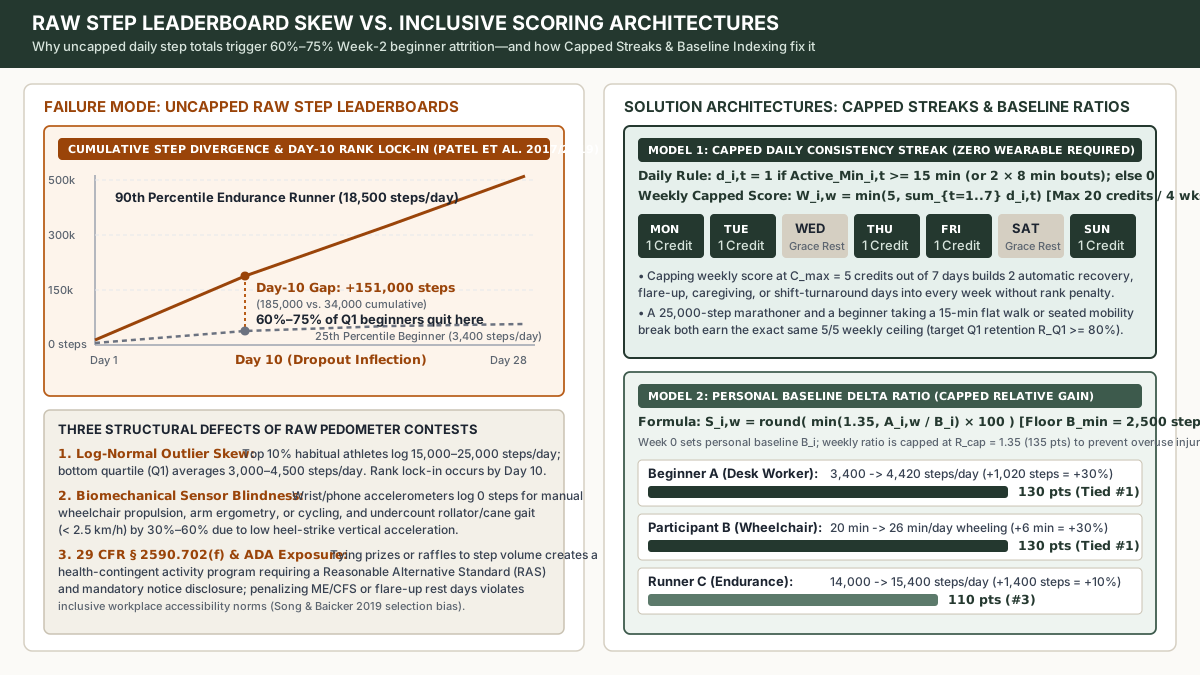
1. Log-Normal Outlier Skew and Day-10 Beginner Attrition
In an unstratified workforce, habitual daily step counts follow a heavily right-skewed log-normal distribution rather than a symmetric bell curve:
- The 90th percentile endurance tail: Roughly
10%of employees are habitual distance runners, recreational athletes, or dog walkers who routinely log15,000 to 25,000 steps/day(105,000 to 175,000 steps/week) before any challenge begins. - The 25th percentile beginner cohort: Sedentary desk workers, caregivers with constrained leisure hours, and employees managing chronic pain or fatigue average
3,000 to 4,500 steps/day(21,000 to 31,500 steps/week). - Day-10 mathematical lock-in: By Day 10 (early Week 2 of a 28-day contest), a 90th-percentile participant averaging
18,500 steps/dayhas accumulated185,000 steps, whereas a 25th-percentile beginner averaging3,400 steps/dayhas accumulated34,000 steps. The resulting151,000-stepchasm is mathematically impossible for a beginner to close without attempting dangerous mileage spikes that cause plantar fasciitis, shin splints, or Achilles tendinopathy. - Empirical dropout and selection bias: Gamification randomized clinical trials led by Patel et al. (JAMA Internal Medicine 2017; STEP UP RCT, JAMA Internal Medicine 2019,
N = 602employees across40U.S. states) and the multi-worksite trial by Song & Baicker (JAMA 2019,N = 32,974across160worksites) show that unadjusted competitive formats suffer60% to 75%Week-2 attrition among bottom-quartile (Q1) beginners unless loss-aversion grace days, supportive social structures, and realistic personal thresholds replace raw volume rankings. Left uncapped, a corporate step contest functions as a closed prize pool for already-active staff.
2. Biomechanical Sensor Blindness and Assistive-Gait Undercounting
Consumer wrist-worn triaxial accelerometers and smartphone pedometers do not measure physical effort or metabolic expenditure; they detect vertical and anteroposterior center-of-mass oscillations during rapid bipedal heel strike:
- Zero-step recording for upper-body and non-ambulatory movement: Standard pedometers record
0 stepsduring manual wheelchair push-rim propulsion, handcycling, seated upper-body arm ergometry, stationary or recumbent cycling, rowing, aquatic therapy, and seated resistance-band circuits. - 30% to 60% undercounting for slow or assistive gait: Employees who walk with a cane, crutch, rollator, or prosthetic limb, or who ambulate at a gentle assistive speed below
2.5 km/h(< 0.7 m/s), generate lower vertical heel-strike acceleration than consumer firmware detection thresholds require. Validation studies consistently document30% to 60%step undercounting at slow walking speeds, meaning a mobility-aid user expending3.5 to 4.5 METsof effort receives less than half the step credit of a fast walker on the exact same corridor. - Post-exertional malaise (PEM) and flare-up penalties: Workers living with Myalgic Encephalomyelitis / Chronic Fatigue Syndrome (ME/CFS), Long COVID, multiple sclerosis, fibromyalgia, endometriosis, or rheumatoid arthritis rely on energy pacing (alternating gentle movement days with deliberate rest days to prevent multi-day post-exertional crashes). Continuous 7-day cumulative step totals penalize medically necessary pacing days.
3. Regulatory Exposure Under 29 CFR § 2590.702(f), ADA Title I, and GDPR
Treat regulatory compliance as a core engineering constraint of program design:
- HIPAA / ACA Tri-Agency Rules (
29 CFR § 2590.702(f)): Enforced jointly by the U.S. Department of Labor (EBSA), HHS, and the IRS,29 CFR § 2590.702(f)(1)(iv)establishes that any workplace walking or fitness challenge that ties a reward (including gift cards, cash prizes, raffle entries of material value, extra PTO hours, or health-plan discounts) to performing an activity is classified as a health-contingent, activity-only wellness program rather than a participatory program. Every activity-only program must satisfy five mandatory criteria under29 CFR § 2590.702(f)(3):- Frequency of Opportunity (
§ 2590.702(f)(3)(i)): Eligible individuals must be given an opportunity to qualify for the reward at least once per year. - Size of Reward (
§ 2590.702(f)(3)(ii)): Total rewards must remain within statutory bounds and non-coercive under EEOC voluntary standards. - Reasonable Design (
§ 2590.702(f)(3)(iii)): The challenge must have a reasonable chance of improving health or preventing disease, must not be overly burdensome, must not be a subterfuge for discriminating based on a health factor, and must not use a highly suspect method. - Uniform Availability and Reasonable Alternative Standard (RAS) (
§ 2590.702(f)(3)(iv)): The full reward must be available to all similarly situated individuals. Specifically, the program must provide a Reasonable Alternative Standard (or waive the standard) for any individual for whom it is “unreasonably difficult due to a medical condition” to attempt or achieve the walking goal, or for whom it is “medically inadvisable” to attempt. - Mandatory Disclosure Notice (
§ 2590.702(f)(3)(v)): All promotional emails, intranet banners, and registration forms describing the challenge terms must include clear disclosure language stating that a Reasonable Alternative Standard is available and explaining how any participant can select it without penalty.
- Frequency of Opportunity (
- EEOC ADA Title I (
42 U.S.C. § 12112(d)(4)(B)), UK Equality Act 2010, and GDPR Article 9: Under Title I of the ADA (29 CFR § 1630.14(d)) and Sections 20–21 of the UK Equality Act 2010, employers must provide equal access to workplace perks and benefits of employment without subjecting disabled workers to invasive medical inquiries. Requiring an employee to submit a physician’s note or disclose a diagnosis to HR just to join a team wellness contest creates administrative friction and triggers special-category health data obligations under GDPR Article 9 and the UK Data Protection Act 2018. Architecting the challenge rules so that seated movement, wheelchair propulsion, and restorative rest earn equal credit by default (Universal Design) satisfies29 CFR § 2590.702(f)and ADA Title I upfront with zero medical disclosures.
Takeaway: Eliminate uncapped step leaderboards that cause 60%–75% Week-2 beginner dropout, exclude wheelchair and mobility-aid users, and violate 29 CFR § 2590.702(f) Reasonable Alternative Standard mandates.
Three Inclusive Scoring Architectures and Mathematical Formulas
To replace raw pedometer contests, select one of three mathematical scoring models (or combine Model 1 with Model 3) so beginners, endurance athletes, manual wheelchair users, and rotating-shift staff compete on equal footing.
Model 1: Capped Daily Consistency Streak (5 Credits/Week Ceiling)
Model 1 shifts the unit of measurement from cumulative step volume to daily movement consistency with built-in recovery grace days. It is the preferred architecture for mixed-ability, multi-site, shift-based, and zero-wearable workplaces:
d_i,t = 1 if Active_Min_i,t >= 15 (in 1 × 15 min or 2 × 8 min bouts); else d_i,t = 0
W_i,w = min(C_max, sum d_i,t), where C_max = 5 credits/week
Total_Score_i = sum W_i,w <= 20 credits (across 4 weeks)
Where:
d_i,t= Binary daily credit (0or1) earned by participantion daytfor completing at least15 minutesof any self-paced movement, mobility, or restorative activity (continuous or split into two8-minutemicro-breaks).W_i,w= Weekly capped credit score for participantiin weekw.C_max = 5= Weekly credit ceiling out of7calendar days.
Why Model 1 Works Operationally:
- Zero volume hoarding: An ultra-marathoner who runs
25,000 stepson Saturday earnsd_i,Sat = 1 credit, the exact same daily credit as a desk beginner taking a15-minutestep-free midday stroll or a wheelchair user completing15 minutesof seated shoulder mobility. - Two automatic weekly grace days (
7 - C_max = 2): Capping the weekly score at5 creditsout of7 daysgives every participant2penalty-free recovery days every week for chronic illness flare-ups, menstrual or migraine rest, caregiving duties, religious observance, or night-shift turnarounds without falling behind the top score of20 credits.
Worked Example (4-Week Capped Consistency Comparison):
- Participant 1 (Endurance Runner): Runs
6 days/week(90,000 steps/week). In each of Weeks 1 through 4, raw active days equal6, which caps atW_1,w = min(5, 6) = 5 credits/week. Four-week total:5 + 5 + 5 + 5 = 20 credits (100%). - Participant 2 (Worker with ME/CFS or Rheumatoid Arthritis): Completes
15 minutesof gentle seated resistance-band and breathing mobility on Monday, Tuesday, Thursday, Friday, and Sunday (5 active days), taking Wednesday and Saturday as full pacing rest days (0 active minutes). In each week,W_2,w = min(5, 5) = 5 credits/week. Four-week total:5 + 5 + 5 + 5 = 20 credits (100%). Both colleagues finish tied with a perfect score.
Model 2: Personal Baseline Delta Ratio (Capped Relative Improvement Indexing)
When an organization wants quantitative progress tracking that rewards incremental effort, Model 2 indexes each participant against their own Week 0 personal baseline (B_i) rather than against other people’s bodies:
B_i = max( B_min, (1 / N_0) × sum A_i,0,t )
S_i,w = round( min( R_cap, A_i,w / B_i ) × 100 )
Where:
A_i,0,t= Daily activity units (step-equivalents, active minutes, or Activity Blocks) logged by participantiacrossN_0 = 5 to 7normal days during Week 0 (Calibration Week).B_min = 2,500 step-equivalents/day(or15 active minutes/day) = Protective baseline floor that prevents division by near-zero numbers if a participant was ill or unrecorded during Week 0.A_i,w= Participanti’s mean daily activity units during challenge weekw.R_cap = 1.35(or1.50) = Weekly relative gain ceiling, capping the maximum weekly score at135 points(+35%over personal baseline) or150 points(+50%over baseline).
Worked Numerical Example (Beginner vs. Wheelchair User vs. Marathon Runner):
Compare three colleagues during Week 2 using R_cap = 1.35 (135 points maximum):
- Participant A (Sedentary Desk Beginner): Records a Week 0 baseline of
B_A = 3,400 steps/day. During Week 2, Participant A adds one15-minutemidday walk (+1,020 steps/dayat a gentle cadence of68 steps/min), raising their Week 2 daily average toA_A,2 = 4,420 steps/day.S_A,2 = round(min(1.35, 4,420 / 3,400) × 100) = round(min(1.35, 1.30) × 100) = 130 points(+30%personal gain).
- Participant B (Manual Wheelchair User): Records a Week 0 baseline of
B_B = 20 active minutes/dayof upper-body wheeling and arm ergometry (2,000 step-equivalents, evaluated directly in active minutes:B_B = 20 min). During Week 2, Participant B adds6 minutes/dayof corridor wheeling, reachingA_B,2 = 26 active minutes/day.S_B,2 = round(min(1.35, 26 / 20) × 100) = round(min(1.35, 1.30) × 100) = 130 points(+30%personal gain, tied for 1st place with Beginner A).
- Participant C (Habitual Marathon Runner): Records a Week 0 baseline of
B_C = 14,000 steps/day. During Week 2, Participant C increases daily mileage by+1,400 raw steps/day(more raw steps added than Beginner A’s+1,020 steps), averagingA_C,2 = 15,400 steps/day.S_C,2 = round(min(1.35, 15,400 / 14,000) × 100) = round(min(1.35, 1.10) × 100) = 110 points(+10%personal gain, 3rd place).
- Why the
R_cap = 1.35ceiling is mandatory: WithoutR_cap = 1.35, a participant could sandbag during Week 0 (B_min = 2,500) and log12,500 stepsin Week 1 for a500-pointrunaway score, or a beginner might double their weekly volume (+100%) and sustain an overuse injury. SettingR_cap = 1.35rewards sustainable+15% to +35%habit building while capping extreme volume spikes.
Model 3: 2024 Adult and Wheelchair Compendium Multi-Modal Activity Block Matrix
Model 3 replaces “steps” entirely with universal 15-Minute Activity Blocks (1 Activity Block = 15 minutes = 1,500 step-equivalents), grounded in three peer-reviewed physiological references:
- The 2024 Adult Compendium of Physical Activities (Herrmann et al., Journal of Sport and Health Science 2024): Standardizes adult metabolic equivalents (
1 MET = 1.0 kcal/kg/hourresting oxygen uptake). - The 2024 Wheelchair Compendium of Physical Activities (Conger et al., Journal of Sport and Health Science 2024): Standardizes wheelchair metabolic equivalents (
1 MET_WC = 0.992 kcal/kg/hourseated resting baseline across11activity categories and69specific wheelchair codes) to reflect the biomechanics and reduced active muscle mass of upper-extremity propulsion. - Ambulatory Cadence Equivalency (Tudor-Locke et al., British Journal of Sports Medicine 2018): Establishes
100 steps/minuteas the heuristic threshold for moderate ambulatory cadence, yielding exactly100 steps/min × 15 min = 1,500 step-equivalentsper15-minuteActivity Block:
Blocks_i,t = Duration_Min / 15
Step_Eq_i,t = Duration_Min × Rate_per_Min
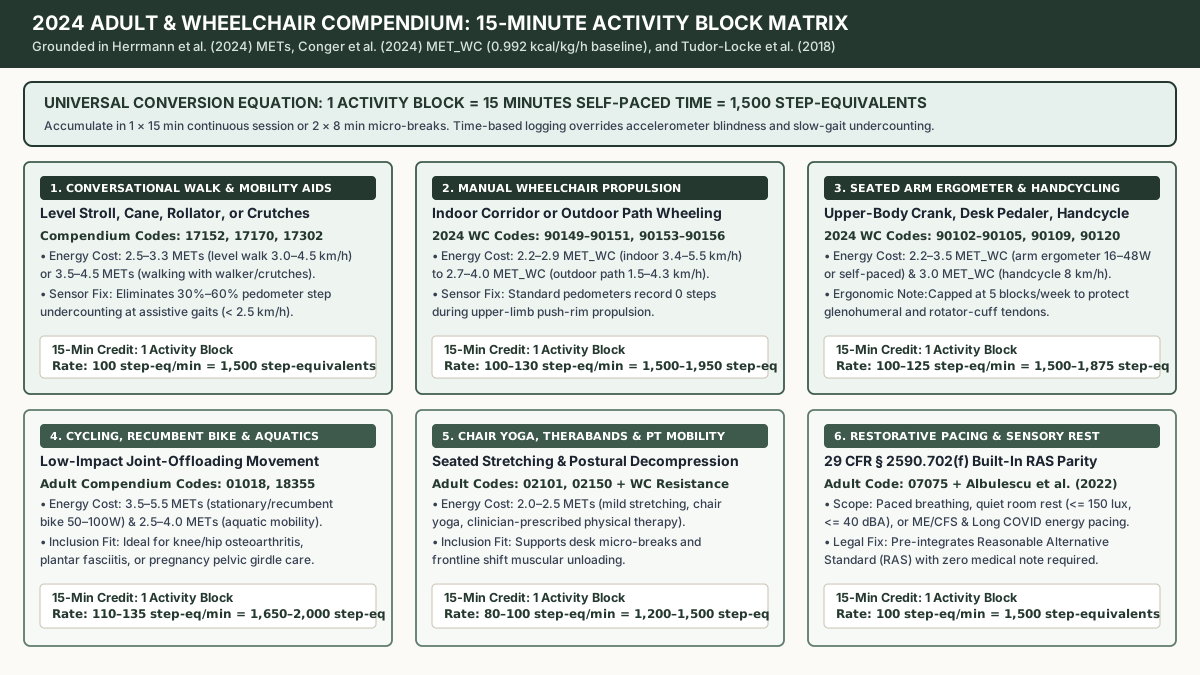
Publish the following six-category conversion table directly inside your challenge guide so participants can convert any movement or restorative break without asking permission:
| Modality Category | 2024 Adult (MET) & Wheelchair (MET_WC) Compendium Codes |
Energy Expenditure Range | Step-Equivalent Conversion Rate | 15-Minute Block Credit |
|---|---|---|---|---|
| 1. Conversational Level Walk, Cane, Rollator, or Crutches | Adult Codes 17152 & 17170 (level walk 3.0–4.5 km/h) and Code 17302 (walking with walker or crutches) |
2.5–3.3 METs (stroll) / 3.5–4.5 METs (assistive aid) |
100 step-eq / min (time credit overrides 30%–60% slow-gait pedometer undercount) |
1 Activity Block (1,500 step-equivalents) |
| 2. Manual Wheelchair Propulsion (Indoor or Outdoor Wheeling) | 2024 Wheelchair Compendium Codes 90149–90151 (indoor wheeling 3.4–5.5 km/h) & Codes 90153–90156 (outdoor path 1.5–4.3 km/h) |
2.2–2.9 MET_WC (indoor) / 2.7–4.0 MET_WC (outdoor path) |
100–130 step-eq / min (replaces 0-step wrist accelerometer error) |
1 Activity Block (1,500–1,950 step-equivalents) |
| 3. Seated Upper-Body Ergometer, Desk Pedaler, & Handcycling | 2024 Wheelchair Compendium Codes 90102–90105, 90109 (arm ergometry 16–48W or self-paced) & Code 90120 (handcycle 8 km/h) |
2.2–3.5 MET_WC (arm crank) / 3.0 MET_WC (handcycle) |
100–125 step-eq / min (capped at 5 blocks/week to protect rotator-cuff tendons) |
1 Activity Block (1,500–1,875 step-equivalents) |
| 4. Stationary Cycling, Recumbent Bike, & Aquatic Therapy | Adult Code 01018 (stationary/recumbent bike 50–100W) & Code 18355 (water aerobics / aquatic mobility) |
3.5–5.5 METs (cycling) / 2.5–4.0 METs (aquatic therapy) |
110–135 step-eq / min (joint-offloading option for knee/hip OA or pregnancy) |
1 Activity Block (1,650–2,000 step-equivalents) |
| 5. Chair Yoga, Seated Resistance Bands, & PT Mobility | Adult Codes 02101 & 02150 (mild stretching, chair yoga, therapeutic mobility) & Wheelchair seated band circuit |
2.0–2.5 METs (postural unloading & neuromuscular mobility) |
80–100 step-eq / min (1:1 time parity in Activity Block challenges) |
1 Activity Block (1,200–1,500 step-equivalents) |
| 6. Restorative Pacing, Breathing, & Low-Sensory Decompression | Adult Code 07075 (restorative rest / meditation) & Albulescu et al. (2022) 15-min cognitive recovery window |
1.0–1.5 METs (autonomic down-regulation & PEM pacing) |
100 step-eq / min under 29 CFR § 2590.702(f) Universal Design RAS parity |
1 Activity Block (1,500 step-equivalents) |
Takeaway: Combine Model 1 (5 credits/week cap with 2 automatic grace days) and Model 3 (15-minute Activity Blocks across all 6 Compendium categories) or use Model 2 (S_i,w = round(min(1.35, A_i,w / B_i) × 100)) to guarantee multi-modal equity.
Cooperative Team Milestones and Anti-Surveillance Governance
Even when individual scoring is capped, publishing a ranked “Top 50 Employees” or “Bottom 5 Teams” leaderboard creates peer pressure when a colleague takes sick leave or experiences a chronic illness flare-up. Replace competitive rank tables with a Cooperative Team Milestone Meter and track program health using the Week-4 Bottom-Quartile Retention Ratio (R_Q1).
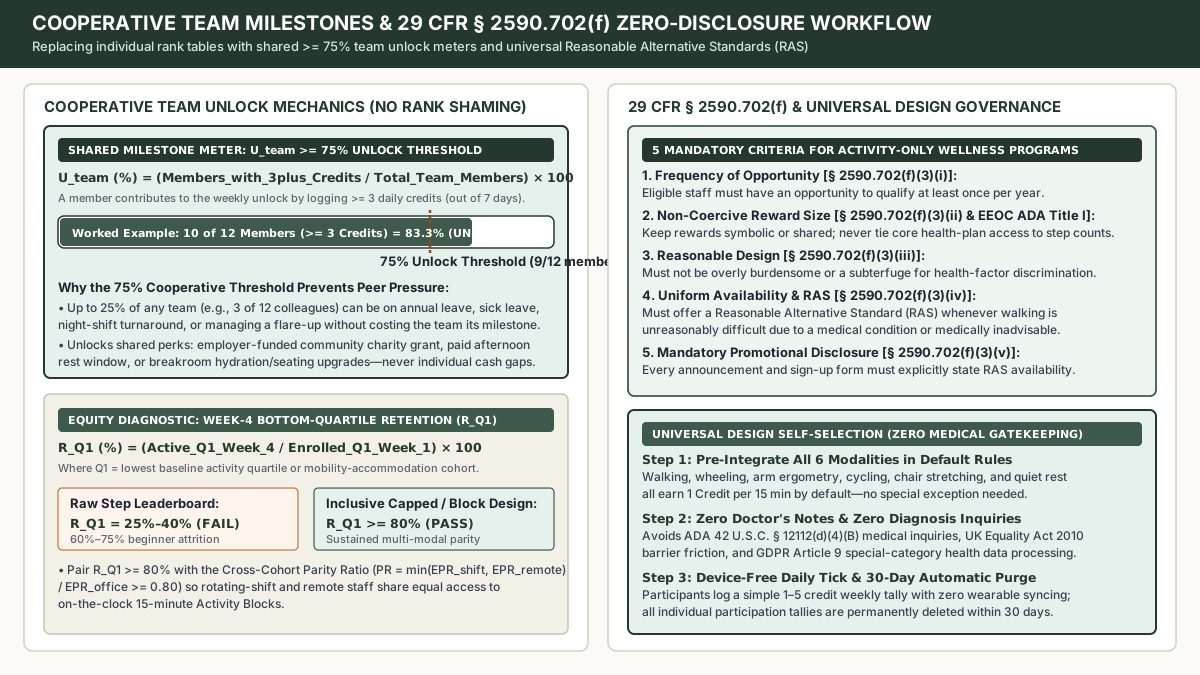
Cooperative Team Unlock Rate (U_team >= 75%)
Instead of pitting teams against each other in a zero-sum tournament, set a shared cooperative threshold where any team (or the entire organization) unlocks a collective milestone whenever at least 75% of its members log 3 or more active credits during week w:
U_team,w (%) = ( N_3plus_w / N_team ) × 100
Milestone_Unlocked_w = TRUE if U_team,w >= 75.0%
Worked Example (12-Person Cross-Functional Team):
Suppose a 12-person department (N_team = 12) participates in a 4-week challenge during Week 3:
8colleagues log4 to 5Activity Credits each via midday walks, cycling, or desk stretching.2colleagues log3Activity Credits each via manual wheelchair propulsion and seated resistance-band routines.1colleague is on scheduled annual leave (0 credits), and1colleague is resting through a migraine flare-up (1 credit).- Calculation:
N_3plus_3 = 8 + 2 = 10 members. U_team,3 = (10 / 12) × 100 = 83.3% >= 75.0%(MILESTONE UNLOCKED).- Because the threshold requires
>= 75.0%(9 of 12members) rather than100%, up to25%of any team (3 of 12colleagues) can be on leave, traveling, or resting without costing their teammates the weekly milestone or facing social pressure to log activity while unwell. - Non-coercive shared rewards: Tie the
>= 75%team unlock to shared organizational perks, such as an employer-funded grant to a local community food bank or accessible park trust, an extra paid afternoon rest window, or upgraded breakroom hydration and seating amenities.
Auditing Inclusion with the Bottom-Quartile Retention Ratio (R_Q1 >= 80%)
To verify that your challenge design actually retains beginners and mobility-diverse staff rather than only serving habitual athletes, compute the Week-4 Bottom-Quartile Retention Ratio (R_Q1) alongside the Cross-Cohort Parity Ratio (PR = min(EPR_shift, EPR_remote) / EPR_office >= 0.80) defined in low-barrier workplace wellness ideas:
R_Q1 (%) = ( Q1_active_wk4 / Q1_enrolled_wk1 ) × 100
Where:
Q1_enrolled_wk1= Number of participants in the lowest baseline activity quartile (or self-selected non-ambulatory / accommodation modalities) who logged at least1 creditin Week 1.Q1_active_wk4= Number of those sameQ1participants who still log>= 3 creditsduring Week 4.
Operational Diagnostic Benchmarks:
- If
R_Q1 < 50%(Failing Challenge Design): Indicates severe rank lock-in, pedometer exclusion, or uncompensated shift-time barriers (typical of raw step leaderboards whereR_Q1 = 25%–40%). - If
50% <= R_Q1 < 80%(Partial Retention): Indicates that while scoring is capped, rotating-shift or remote workers lack protected on-the-clock break coverage (PR < 0.80). - If
R_Q1 >= 80%(Target Inclusive Benchmark): Confirms that beginners, mobility-diverse staff, and shift workers remain engaged through Week 4 at nearly the same rate as habitual exercisers.
Takeaway: Replace individual rank tables with a U_team >= 75% cooperative unlock meter and audit Week-4 bottom-quartile retention (R_Q1 >= 80%) alongside shift/remote participation parity (PR >= 0.80).
Route Accessibility, Zero-Wearable Privacy, and Copy-Paste Rulebook Templates
When teams choose to organize optional group walks or kick-off gatherings during a corporate wellness challenge, physical route geometry and internal communications must follow strict accessibility and privacy standards:
- Step-Free Route Geometry (
PROWAG R302/ADA Section 403): Before designating any workplace walking loop, verify the physical measurements in how to organise an inclusive walk: continuous clear width>= 1.22 m(48 in;>= 915 mm/36 inabsolute minimum pinch point),>= 1.52 × 1.52 m(60 × 60 in) passing spaces every<= 61 m(200 ft), running slope<= 5.0%(1:20), cross-slope<= 2.0%(1:48), firm slip-resistant paving, and shaded rest seating (430–485 mmseat height with armrests and flush760 × 1,220 mmwheelchair companion bays) every300 to 500 meters. - Multi-Tier Pace Waves and Event Room Checks: If employees organize an optional lunchtime walking club, separate speeds into Tier A (
3.0–3.8 km/hconversational stroll at2.5–2.8 METs) and Tier B (4.0–4.8 km/h), assign a volunteer back-marker sweep so nobody walks alone at the rear, and use non-medical Pocket ICE cards as detailed in how to start a walking club. For indoor kick-off or wrap-up socials, tick through step-free doorways, clear seating aisles, captioning, and water dispenser reach height (<= 1,220 mm/48 in) using our accessibility checklist for a community event. - Respectful Language and Verified Support Directories: Keep all challenge emails free of weight-loss, calorie-burn, body-mass-index, or ableist idioms by following the person-first communication rules in respectful language for mental health conversations. When listing Employee Assistance Programme (EAP), Occupational Health, or disability accommodation contacts at the bottom of your challenge page, verify all five fields (organisation name, coverage area, service scope, primary URL, and 90-day last-checked date) using how to keep a community support directory reliable.
Copy-Paste Inclusive Challenge Rulebook & 29 CFR § 2590.702(f) Notice Template
Copy and adapt the following plain-English text block directly into your intranet announcement, registration page, and kick-off email to establish Universal Design scoring and satisfy 29 CFR § 2590.702(f)(3)(v) notice disclosure requirements:
Inclusive Workplace Wellbeing Challenge Rules & Reasonable Alternative Notice
1. Voluntary Participation & Paid Break Time: Participation in this 4-week workplace wellbeing challenge is completely voluntary and open to all office, hybrid, remote, and rotating-shift staff. You are encouraged to use your protected 15-minute paid midday or mid-shift break window. Choosing not to participate, or stepping back at any point, carries zero impact on performance reviews, shift assignments, or workplace standing.
2. Universal 15-Minute Activity Block Scoring (5 Credits/Week Ceiling): To ensure fairness across all fitness levels, work schedules, and mobility modalities, this challenge does not rank raw step totals. Every 15-minute block of self-paced movement or restorative recovery (completed continuously or in two 8-minute breaks) counts equally as 1 Activity Credit, capped at 1 Credit per day and 5 Credits per week (giving everyone 2 built-in rest days each week). Qualifying 15-minute Activity Blocks include:
- Conversational walking (indoors or outdoors, at any pace, including with a cane, walker, or rollator)
- Manual wheelchair propulsion, handcycling, or seated upper-body ergometry
- Stationary cycling, recumbent biking, swimming, or aquatic mobility
- Chair yoga, seated resistance-band exercises, postural stretching, or physical therapy routines
- Quiet low-sensory room decompression, paced breathing, or chronic-fatigue energy pacing rest
3. Reasonable Alternative Standard (29 CFR Section 2590.702(f) & Workplace Accessibility Disclosure): Our goal is a challenge where every colleague can earn full credit safely and comfortably. In accordance with
29 CFR § 2590.702(f)and workplace accessibility standards, if any movement modality in this challenge is unreasonably difficult due to a medical condition or medically inadvisable for you to attempt, you may automatically count any personal wellness, mobility, or restorative rest routine of your choice (or a clinician-recommended alternative) for full daily credit (up to 5 Credits/week). You do not need to submit a doctor’s note, disclose a diagnosis, or request special permission to use an alternative modality; if you would like assistance tailoring an option or requesting a workplace adjustment, contact[Insert Occupational Health / HR Accessibility Contact & URL, Last Checked: YYYY-MM-DD].4. Zero Wearable Requirement & 30-Day Data Deletion: No employee is required to purchase, wear, or connect a smartwatch, fitness tracker, or smartphone health app. Self-logged daily credits (1 to 5 credits per week) carry identical weight to device-synced entries, no GPS routes or biometric metrics are collected, and all individual challenge logs are permanently deleted within 30 days of challenge completion.
Takeaway: Publish the copy-paste 29 CFR § 2590.702(f) Reasonable Alternative disclosure and 6-category Activity Block rules on every challenge sign-up page, require zero wearables or doctor’s notes, and purge individual logs within 30 days.