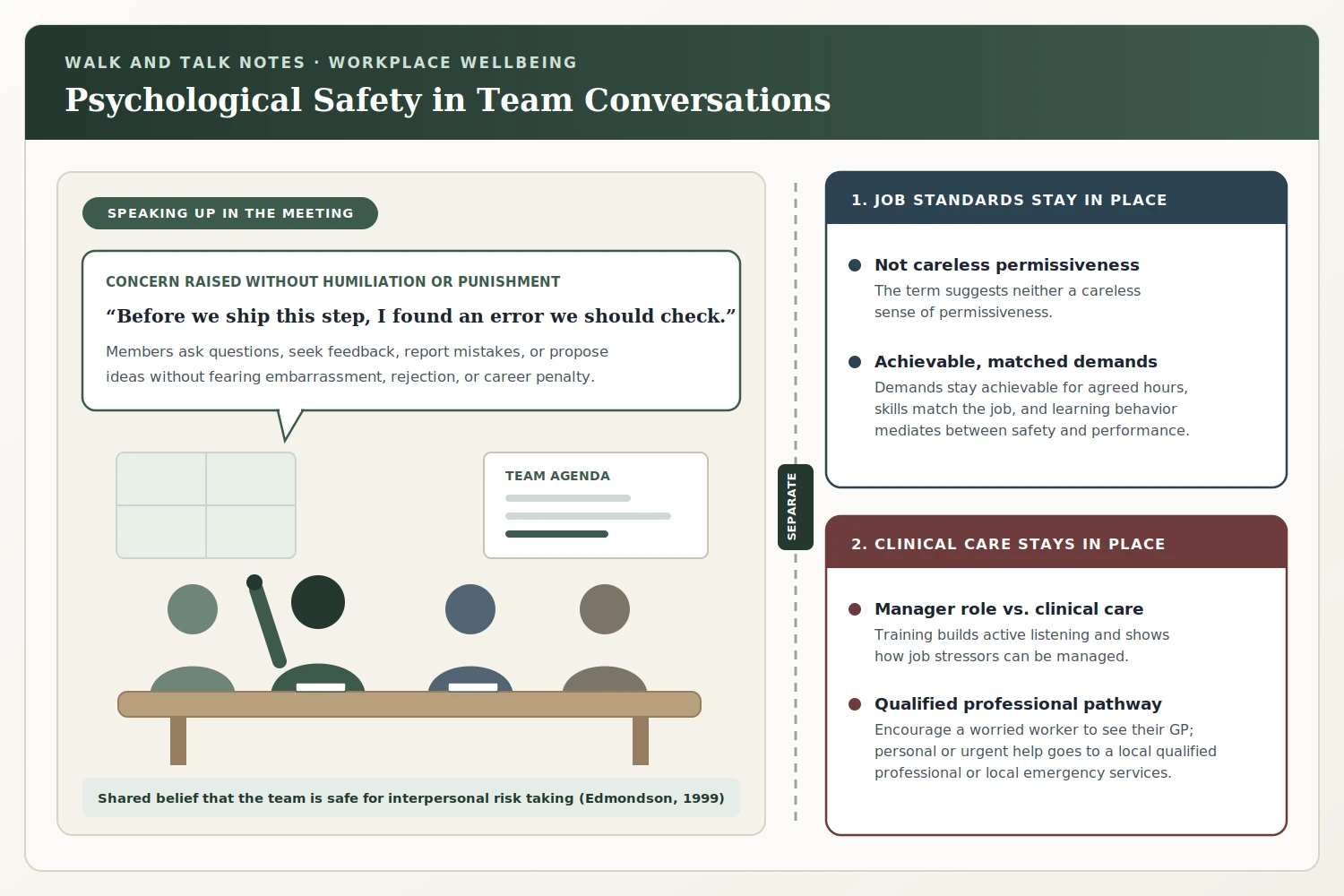
Psychological safety is the belief that one will not be punished or humiliated for speaking up with ideas, questions, concerns, or mistakes, as summarized on Wikipedia’s overview of psychological safety. In Amy Edmondson’s 1999 paper on learning behavior in work teams, team psychological safety is defined as a shared belief that the team is safe for interpersonal risk taking, meaning team members believe they can take risks without being shamed by other team members. Edmondson notes that the term is meant to suggest not a careless sense of permissiveness, but a sense of confidence that the team will not embarrass, reject, or punish someone for speaking up.
In workplace conversations, the Canadian Centre for Occupational Health and Safety (CCOHS) states that psychological safety is demonstrated when employees feel able to put themselves on the line, ask questions, seek feedback, report mistakes and problems, or propose a new idea without fearing negative consequences to themselves, their job, or their career. WHO manager training builds open communication, active listening, and an understanding of how job stressors can be managed, while a worried worker is encouraged to see their GP. This guide belongs to our Workplace Wellbeing notes alongside limits of walking conversations at work and the workplace peer-support boundaries note.
What does psychological safety at work mean in team conversations?
Schein and Bennis, in 1965, defined psychological safety as an atmosphere where one can take chances without fear and with sufficient protection, building a climate that encourages provisional tries and tolerates failure without retaliation, renunciation, or guilt. Rather than describing private trust between a pair of colleagues, psychological safety focuses on a belief about a group norm emerging from the group’s common experiences and perceptions regarding the expected consequences of taking interpersonal risks within social norms that define accepted in-group behaviours and interactions.
When team members are motivated at work and want to share an idea for improving performance, they frequently do not speak up because they fear that they will be harshly judged. Employees speak up more when they feel psychologically safe and are motivated to improve their team or company.
Edmondson emphasizes that team psychological safety is not the same as group cohesiveness. Separately, Wikipedia lists a clear team structure where members understand their role on the team and strong relationships between cohesive team members among conditions that support team functioning.
At the organizational level, CCOHS states that a psychologically safe and healthy workplace actively promotes emotional well-being among employees while taking all reasonable steps to minimize threats to employee mental health. CCOHS groups workplace psychosocial factors across Balance, Civility and Respect, Clear Leadership and Expectations, Engagement, Growth and Development, Involvement and Influence, Organizational Culture, Protection of Physical Safety, Psychological Competencies and Demands, Psychological Protection, Psychological and Social Support, Recognition and Reward, and Workload Management, noting that the same factors are used in CSA Z1003-13 (R2022), Psychological health and safety in the workplace - Prevention, promotion, and guidance to staged implementation.
What are concrete examples of psychological safety in meetings?
In day-to-day meetings, CCOHS identifies concrete speaking-up behaviours: employees ask questions, seek feedback, report mistakes and problems, or propose a new idea without fearing negative consequences to themselves, their job, or their career. Edmondson’s 1999 study in Administrative Science Quarterly (Volume 44, Issue 2, pages 350-383) illustrates how team members judge those moments in practice: whether making a mistake on the team is often held against you, whether it is safe to take a risk on the team, and whether no one on the team would deliberately act in a way that would undermine your efforts.
In hospital units summarized on Wikipedia, members believing they will not be punished for reporting mistakes were correlated with higher rates of errors being detected. Across Edmondson’s study of 51 work teams in a manufacturing company, team psychological safety is associated with learning behavior, whereas team efficacy is not associated when controlling for team psychological safety, and learning behavior mediates between team psychological safety and team performance.
Alongside benefits, empirical literature summarized on Wikipedia examines drawbacks of psychological safety. In research on team ethics, teams whose members are more utilitarian were more likely to engage in unethical behavior like cheating, and this effect was even more pronounced in teams with higher levels of psychological safety. Another study summarized on Wikipedia found that higher psychological safety was associated with lower motivation.
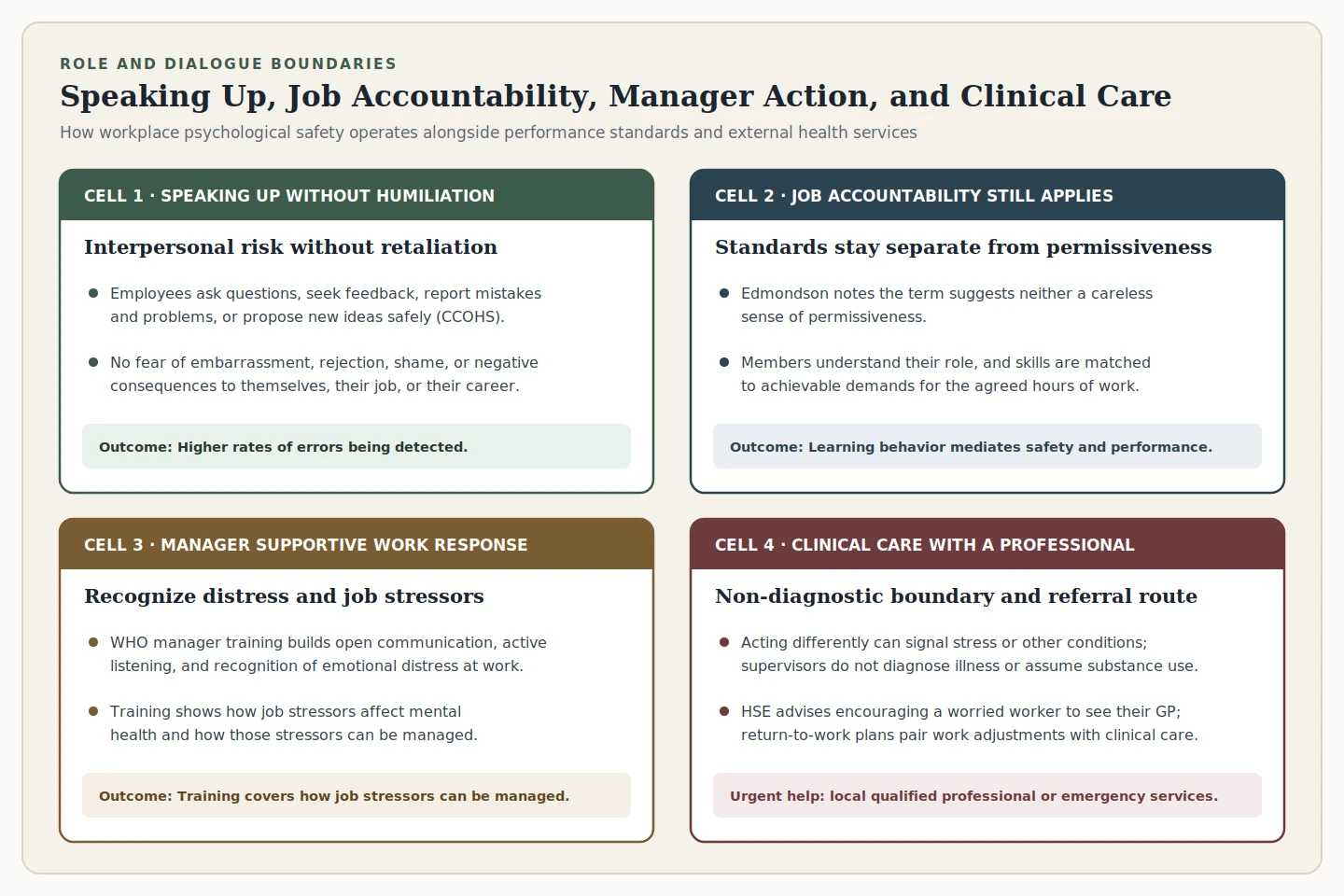
| Workplace Domain | Operational Meaning in Team Dialogue | Primary Boundary |
|---|---|---|
| Speaking up safely | Employees ask questions, seek feedback, report mistakes and problems, or propose a new idea without fearing negative consequences to themselves, their job, or their career. | Protects candid reporting and questions from humiliation or retaliation. |
| Job accountability | Edmondson states the term suggests neither a careless sense of permissiveness, while learning behavior mediates between team psychological safety and team performance. | The job standard stays because this is not a careless sense of permissiveness. |
| Manager workplace action | WHO manager training builds open communication, active listening, recognition of emotional distress, and understanding of how job stressors can be managed. | Manager training covers recognition, listening, and how job stressors can be managed. |
| Clinical care route | HSE advises worried managers to encourage a worker showing stress signs to see their GP while taking action if something wrong at work caused the problem. | Diagnosis and clinical treatment remain with qualified health professionals. |
What does a lack of psychological safety look like?
CCOHS reports that when employees are not psychologically safe, they experience demoralization, a sense of threat, disengagement, and strain, and they perceive workplace conditions as ambiguous and unpredictable. Disrespectful conduct erodes that safety directly, and one example of disrespectful behaviour is bullying.
In the CCOHS glossary, harassment means any behaviour that demeans, embarrasses, humiliates, annoys, alarms, or verbally abuses a person and that is known or would be expected to be unwelcome, while bullying means repeated, unreasonable, or inappropriate behaviour directed towards an employee or group of employees that creates a risk to health and safety. Exposure to workplace bullying is associated with psychological complaints, depression, burnout, anxiety, aggression, psychosomatic complaints, and musculoskeletal health complaints. Bullying not only affects those directly involved, but also affects bystanders, as they experience higher stress levels.
On the UK Health and Safety Executive (HSE) signs of stress page (updated 2024-06-04), signs of stress in a team include arguments, higher staff turnover, more reports of stress, more sickness absence, decreased performance, and more complaints and grievances. At an individual level, HSE notes that if workers start acting differently, it can be a sign they are stressed: a person may take more time off, arrive for work later, or be more twitchy or nervous, or show mood swings, withdrawal, loss of motivation, commitment, and confidence, or increased emotional reactions such as being more tearful, sensitive, or aggressive. The Occupational Safety and Health Administration (OSHA) workplace stress page similarly notes that workplace stress and poor mental health can negatively affect workers across job performance, productivity, work engagement and communication, and physical capability and daily functioning.
How can team leads foster safety without blurring boundaries?
Wikipedia notes that two aspects of leadership have been shown to be particularly instrumental in creating a psychologically safe team: participatory management and inclusive management. In Edmondson’s discussion, shared beliefs that well-intentioned interpersonal risks will not be punished stay separate from the point that the term is meant to suggest neither a careless sense of permissiveness.
CCOHS describes a supportive workplace as a setting where co-workers and supervisors are supportive of employees’ psychological and mental health concerns and respond appropriately as needed. In the World Health Organization (WHO) mental health at work fact sheet (dated 15 September 2026), manager training for mental health helps managers recognize and respond to supervisees experiencing emotional distress, builds interpersonal skills like open communication and active listening, and fosters better understanding of how job stressors affect mental health and can be managed.
The WHO guidelines on mental health at work (published 28 September 2022, 134 pages, ISBN 9789240053052) cover organizational interventions, manager training and worker training, individual interventions, return to work, and gaining employment, and the accompanying policy brief by WHO and the International Labour Organization, Mental health at work: policy brief, provides a pragmatic framework for implementing the WHO recommendations. WHO explains that return-to-work programmes combine work-directed care, such as reasonable accommodations or phased re-entry to work, with ongoing clinical care to support workers in meaningfully returning to work after an absence associated with mental health conditions while reducing mental health symptoms.
OSHA states that mental health challenges can include clinical mental illness and substance use disorders as well as temporary emotions like stress, grief, and feeling sad and anxious that are not part of a diagnosable condition. CCOHS advises supervisors not to assume that an employee has problematic substance use, while noting that ignoring warning signs will make the situation worse if someone is struggling.
HSE states that if managers are worried that a worker is showing signs of stress, they should encourage them to see their GP because those signs can be symptoms of other conditions, and if there is something wrong at work that caused the problem, managers should take action. HSE also notes that employers could review policies on bullying, harassment, and discrimination, and check that their first aid needs assessment considers physical and mental health needs. Role limits and escalation protocols for trained workplace peer supporters are detailed in the workplace peer-support boundaries note, and privacy limits for side-by-side outdoor check-ins are covered in limits of walking conversations at work.
How do teams assess psychological safety with a questionnaire?
Edmondson’s 1999 paper provides the complete team psychological safety survey in its Appendix, evaluated at the group level of analysis (N = 51) on a 7-point scale from “very inaccurate” to “very accurate.” The team survey items are:
- “If you make a mistake on this team, it is often held against you.” (reverse scored)
- “Members of this team are able to bring up problems and tough issues.”
- “People on this team sometimes reject others for being different.” (reverse scored)
- “It is safe to take a risk on this team.”
- “It is difficult to ask other members of this team for help.” (reverse scored)
- “No one on this team would deliberately act in a way that would undermine my efforts.”
- “Working with members of this team, my unique skills and talents are valued and utilized.”
Teams should keep Edmondson’s speaking-safety survey distinct from workplace stress-risk audits. On the HSE causes of stress at work page (updated 2024-06-04), HSE states that there are six main areas that can lead to work-related stress if they are not managed properly: demands, control, support, relationships, role, and change. On the HSE Management Standards demands page, demands cover issues such as workload, work patterns, and the work environment. Under that standard, employees indicate that they are able to cope with the demands of their jobs and systems are in place locally to respond to any individual concerns, the organisation provides employees with adequate and achievable demands in relation to the agreed hours of work, and people’s skills and abilities are matched to the job demands.
What are common signs of an unhealthy work environment?
WHO states that decent work is good for mental health, whereas poor working environments — including discrimination and inequality, excessive workloads, low job control, and job insecurity — pose a risk to mental health. In its broader psychosocial hazard inventory, WHO notes that risks to mental health at work can include under-use of skills or being under-skilled for work, excessive workloads or work pace, understaffing, long, unsocial, or inflexible hours, lack of control over job design or workload, unsafe or poor physical working conditions, organizational culture that enables negative behaviours, limited support from colleagues or authoritarian supervision, violence, harassment or bullying, discrimination and exclusion, an unclear job role, under- or over-promotion, job insecurity, inadequate pay, poor investment in career development, and conflicting home and work demands.
Preventing mental health conditions at work is about managing psychosocial risks in the workplace. WHO defines organizational interventions as measures that assess, and then mitigate, modify, or remove workplace risks to mental health.
CCOHS notes that a large workload — having too much to do and not enough time to do it — is often described by employees as being the biggest workplace stressor. Increased demands without opportunities for control result in physical, psychological, and emotional fatigue and increase stress and strain, whereas CCOHS notes that even when there are high demands, if employees also have high decision-making ability, they are described as able to thrive.
CCOHS defines job burnout as a state of physical, emotional, and mental exhaustion caused by long-term exposure to demanding work situations. Burnout has three main characteristics: exhaustion, meaning the depletion or draining of mental resources; cynicism, meaning indifference or a distant attitude towards one’s job; and lack of professional efficacy, meaning the tendency to evaluate one’s work performance negatively, resulting in feelings of insufficiency and poor job-related self-esteem. HSE similarly flags relationship strain when workers are having trouble with relationships at work or are being bullied.
Team-meeting speaking-safety self-check and referral boundary
Use the self-check below to review speaking-up norms before or after a team meeting while keeping workplace accountability and external clinical pathways distinct.
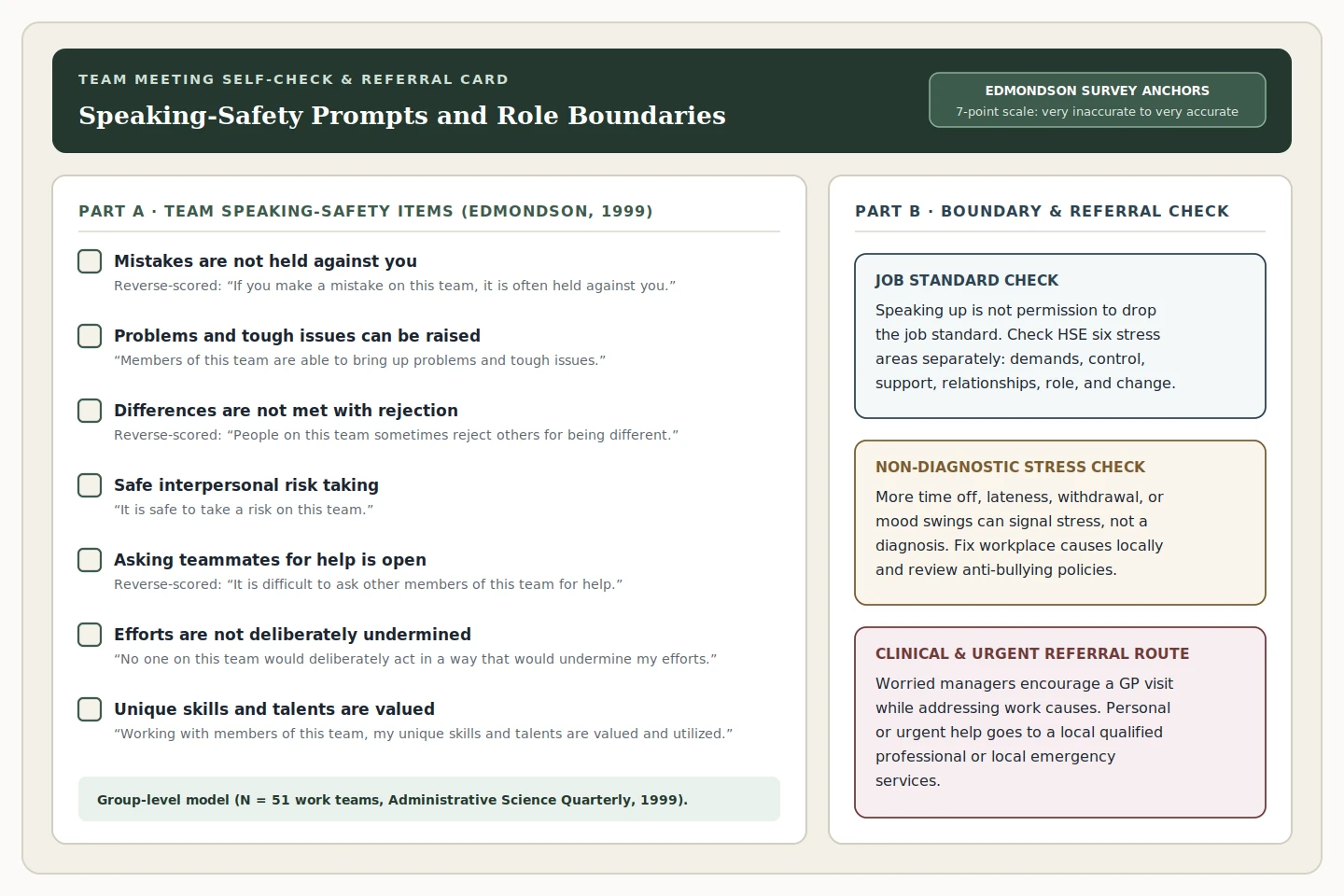
- Mistakes in discussion: Check whether making a mistake on this team is held against the person.
- Tough issues and questions: Check whether members of this team are able to bring up problems and tough issues openly.
- Risk taking and help-seeking: Check whether it is safe to take a risk on this team, and whether asking other members of this team for help feels difficult or brings rejection for being different.
- Mutual respect for effort: Check that no one on this team would deliberately act in a way that would undermine another person’s efforts.
- Job accountability boundary: Keep clear that speaking up safely is not a careless sense of permissiveness toward dropping job standards or role expectations.
- Non-diagnostic stress check: Treat shifts in attendance, mood, or behaviour as possible signs of stress rather than a workplace medical diagnosis, and address workplace causes locally.
- Professional and urgent support route: Encourage a worried worker to see their GP when stress signs appear. If you need personal or urgent help, contact a local qualified professional or your local emergency services.
For related workplace guidance on voluntary outdoor check-ins, scheduling buffers, and inclusive team norms, browse our Workplace Wellbeing collection.