
Running a compliant mental health first aid at work program requires enforcing four operational governance boundaries: restricting peer supporters to the five-step non-clinical ALGEE signposting protocol, separating direct line managers from confidential peer rosters under ISO 45003:2021, isolating anonymized utilization tallies from HR personnel records under GDPR Article 9 and ADA 42 USC Section 12112(d)(3)(B), and capping interactions at 30 to 45 minutes alongside a four-tier warm-handoff referral directory. Deploying trained volunteers without written workplace peer support boundaries fails both distressed employees and peer supporters when conversations drift into amateur psychotherapy, unlogged crisis handoffs, GDPR data leaks, or overheard disclosures on public office walkways.
HR leads, occupational health coordinators, and workplace peer program organisers need concrete operational protocols that define exactly where peer listening ends and where clinical care, occupational health assessment, and line-management adjustments begin. This governance guide establishes the institutional rules for workplace Mental Health First Aid (MHFA), building on the person-first terminology in respectful language for mental health conversations, the outdoor privacy limits in limits of walking conversations at work, the verification standard in how to keep a community support directory reliable, and the wider guides in Mental Health Literacy.
| Governance Dimension | Workplace MHFAider (Peer Supporter) | Line Manager (ISO 45003 Clause 5.3) | HR and Occupational Health (OH) | Clinical Care (EAP, GP, NHS, Psychiatrist) |
|---|---|---|---|---|
| Primary Institutional Scope | Initial non-clinical peer listening, acute crisis recognition, and warm signposting via the 5-step ALGEE framework |
Work design, task allocation, psychosocial hazard control, absence management, and implementing agreed adjustments | Statutory accommodations (ADA Title I / UK Equality Act 2010 § 20), fitness-for-work reviews, and formal grievances |
Diagnostic assessment (ICD-11 / DSM-5-TR), structured psychotherapy, crisis stabilization, and pharmacology |
| Session Cadence and Duration Ceiling | 30–45 min seated cap (or 15–30 min step-free walking check-in) plus max 1–2 brief (10–15 min) bridge check-ins per episode |
Recurring 1-to-1 work check-ins, return-to-work meetings, and quarterly or annual appraisal reviews | Episode-driven case management, structured occupational health consultations, and periodic adjustment reviews | Structured clinical treatment course (6–8 EAP counseling sessions or 8–20 NHS Talking Therapies CBT sessions) |
| Confidentiality and Escalation Rule | Held confidential except for 4 imminent life/safety duty-of-care triggers (988 / 999 / 000 + Safeguarding Lead) |
Carries institutional duty to report workplace risks, attendance issues, and formal adjustment requests to HR | Governed by occupational health consent rules and statutory safeguarding duties | Protected clinical privilege (HIPAA 45 CFR Part 160/164 or NHS Caldicott Principles) |
| Recordkeeping and Data Firewall | Zero identifiable notes; records only a 6-field anonymized statistical tally with k >= 10 cohort floor |
Operational notes on agreed workload or schedule modifications (stored with zero diagnostic labels) | Segregated Confidential Medical File (42 U.S.C. § 12112(d)(3)(B) / GDPR Art. 9(2)(h)) locked outside HR folders |
Protected clinical electronic health record completely inaccessible to the employer |
| Conflict-of-Interest Exclusion | Never paired with direct reports or staff in active disciplinary/grievance proceedings; <= 2–3 cases/month cap |
Must explicitly declare managerial hat upfront; warm-transfers direct reports to an independent cross-team MHFAider | Evaluates accommodation requests neutrally; does not serve as informal peer confidant | External or firewalled clinical provider with zero line-reporting authority over the employee |
Non-Clinical Role Boundaries and the ALGEE Action Plan at Work
Mental Health First Aid (MHFA) was developed in 2000 in Canberra, Australia, by Betty Kitchener AM (a nurse and health educator with lived experience of recurrent major depression) and Professor Anthony Jorm (a mental health literacy researcher at the Centre for Mental Health Research, Australian National University). Administered globally through Mental Health First Aid International and national bodies including MHFA England, the National Council for Mental Wellbeing (MHFA USA), and the Mental Health Commission of Canada, MHFA is defined as the initial help offered to a person developing a mental health condition, experiencing a worsening of an existing mental health condition, or experiencing a mental health crisis, provided until appropriate professional help is received or the crisis resolves.
In an occupational setting, the dominant failure mode of peer support programs is boundary creep: a well-intentioned colleague mistakes a two-day MHFA certificate for a license to diagnose burnout, mediate team disputes, or hold recurring weekly counseling sessions. Just as a physical workplace first aider applies a sterile dressing and calls paramedics rather than performing surgery in a conference room, a workplace MHFAider operates strictly as a non-clinical signposting bridge.
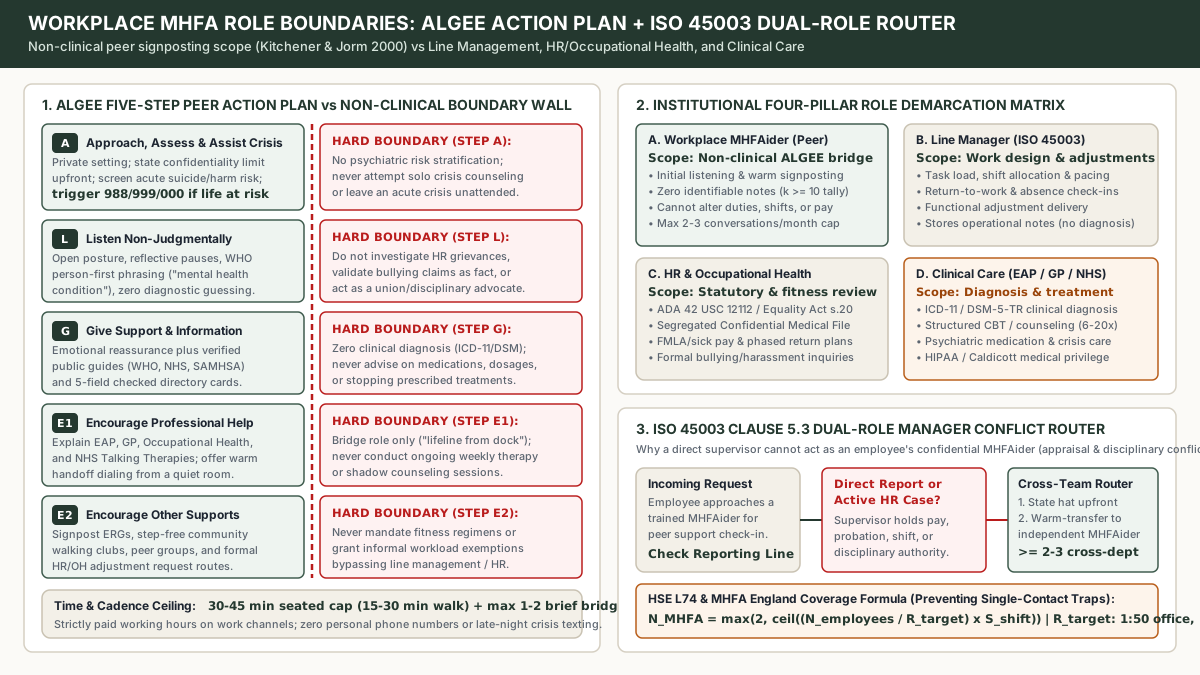
Executing the Five-Step ALGEE Action Plan Within Hard Workplace Boundaries
Every workplace MHFA interaction follows the five-step ALGEE action plan, paired with an explicit prohibition wall at each step:
- Step A: Approach, Assess, and Assist with Any Crisis:
- Workplace execution: Arrange a private, time-protected moment during paid working hours in a neutral setting (a sound-insulated indoor room or, for low-acuity check-ins, an optional step-free outdoor route). State the upfront confidentiality and duty-of-care contract before the employee shares personal details. Assess directly for immediate crisis indicators: active suicidal intent or plan, non-suicidal self-injury requiring urgent medical care, acute panic attack, severe dissociation, or psychosis.
- Hard operational boundary: The MHFAider never conducts a clinical psychiatric risk stratification and never attempts to counsel a colleague through a life-threatening crisis alone. Whenever imminent risk to life or physical safety is present, Step A immediately triggers the mandatory crisis escalation protocol.
- Step L: Listen and Communicate Non-Judgmentally:
- Workplace execution: Maintain an unhurried posture, allow natural pauses, reflect back the colleague’s own words, and use the broader World Health Organization (WHO) phrase “mental health condition” or “psychological distress” when not quoting a person’s self-described diagnosis, following the standards in respectful language for mental health conversations.
- Hard operational boundary: Listening non-judgmentally does not mean validating workplace grievances as established fact, investigating bullying or harassment allegations, promising HR outcomes, or acting as a trade union or disciplinary representative.
- Step G: Give Support and Information:
- Workplace execution: Offer calm reassurance that mental health conditions are common and treatable, and share verified, date-checked public information resources (such as the employer’s Employee Assistance Programme [EAP] intake card, the occupational health self-referral guide, or official WHO, NHS, or SAMHSA public fact sheets).
- Hard operational boundary: Never name or guess a clinical diagnosis (such as telling a colleague “You have clinical depression, ADHD, or PTSD”), never recommend or comment on psychiatric medications or dosages, and never suggest altering or stopping prescribed medical treatment.
- Step E1: Encourage Appropriate Professional Help:
- Workplace execution: Explain the specific professional pathways available to the worker, including 24/7 EAP short-term counseling, primary care General Practitioners (GPs) or Primary Care Physicians (PCPs), occupational health physicians, NHS Talking Therapies, or licensed psychologists, and offer a warm handoff to initiate contact.
- Hard operational boundary: The MHFAider acts as a bridge from the dock rather than jumping into the water. Once professional care is accessed or declined, the MHFAider does not hold ongoing weekly therapy or emotional check-in sessions.
- Step E2: Encourage Other Supports:
- Workplace execution: Help the colleague identify self-directed coping strategies, family or community peer networks, inclusive step-free walking groups (how to start a walking club), low-sensory workplace recovery spaces (low-barrier workplace wellness ideas), or formal workplace reasonable adjustment channels through HR and Occupational Health.
- Hard operational boundary: Never prescribe mandatory lifestyle regimens (such as forced pedometer targets or mindfulness apps) and never grant informal workload reductions or shift exemptions that bypass line management and statutory accommodation procedures.
Resolving the ISO 45003 Line-Manager Dual-Role Conflict
Under ISO 45003:2021 (Occupational health and safety management - Psychological health and safety at work - Guidelines for managing psychosocial risks, Clauses 5.3 and 6.1.2) and UK Health and Safety Executive (HSE) and Acas workplace mental health guidance, a severe institutional conflict of interest arises when an employee’s direct line manager also attempts to act as that employee’s confidential Mental Health First Aider. Because a line supervisor holds direct authority over performance appraisals, probation sign-off, shift allocation, promotion, and disciplinary procedures, an employee cannot disclose vulnerability without risking perceived career penalty, nor can the manager suppress information that affects operational safety or statutory employer notice.
Enforce three structural routing rules to eliminate dual-role conflicts:
- Rule 1 (Zero Direct-Report Pairing): A trained MHFAider is barred from serving as the designated MHFA peer contact for any worker in their direct or dotted-line reporting chain, or for any colleague involved in an active grievance, capability, or performance-improvement process they oversee.
- Rule 2 (Cross-Departmental and Cross-Shift Roster): Publish an internal MHFA directory listing at least
2 to 3independent MHFAiders across different departments and shift patterns so every worker can select a peer supporter outside their own business unit. - Rule 3 (Explicit Upfront Hat-Switching Disclosure): When a line manager holds MHFA training to improve their general mental health literacy and a direct report approaches them in distress, the manager must state their institutional capacity in the first sentence: “Because I am your line manager, I can discuss workload adjustments, absence support, and occupational health referrals with you in my managerial role. If you want a strictly confidential peer conversation that stays completely outside line management, I will connect you right now with an independent Mental Health First Aider from another team.”
Takeaway: Restrict workplace MHFAiders to the five non-clinical steps of ALGEE and prohibit direct line managers from serving as confidential peer supporters for their own reporting chain under ISO 45003 Clause 5.3.
Confidentiality, Mandatory Duty-of-Care Escalation, and GDPR / ADA Data Firewalls
Trust in a workplace peer support network collapses immediately if employees suspect that speaking to an MHFAider creates a shadow HR dossier, or conversely if an MHFAider promises “100% absolute secrecy” and then panics when a colleague discloses an active suicide plan. Operational governance requires a transparent upfront confidentiality contract, a binary decision tree separating protected confidences from mandatory escalation triggers, and a strict data firewall aligned with GDPR Article 9 and ADA Title I (42 U.S.C. § 12112(d)(3)(B)).
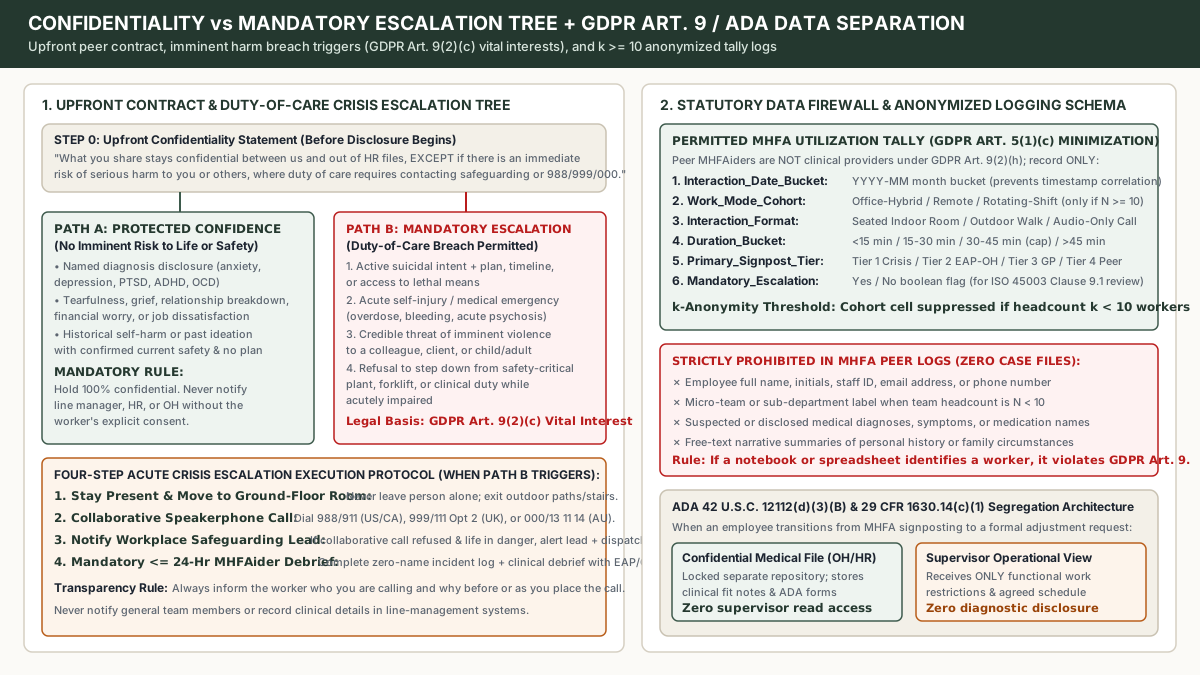
The Upfront Confidentiality Contract
Before an employee begins sharing personal information, the MHFAider must state the exact scope and limit of workplace confidentiality in plain English. Stating the duty-of-care exception upfront prevents any sense of betrayal if an acute safety risk emerges midway through the conversation:
Standard Workplace MHFA Opening Script: “Before we talk, I want to be clear about how Mental Health First Aid works here. What you share with me stays confidential between us and is never written into your HR or performance file. The only exception is if I believe there is an immediate risk of serious harm to you or to someone else. In that situation, my duty of care means I must contact our safeguarding lead or emergency services to keep you safe, and I will tell you as I do it.”
Protected Confidences vs. Mandatory Duty-of-Care Escalation Triggers
Apply this binary classification rule during every workplace peer conversation:
| Disclosure Category | Specific Workplace Examples | Permitted MHFAider Action | Prohibited Action |
|---|---|---|---|
| Path A: Protected Confidences (Confidentiality Strictly Held) | • Disclosing a clinical diagnosis (depression, generalized anxiety, PTSD, bipolar disorder, OCD, ADHD, eating disorder) without imminent life risk • Tearfulness, bereavement grief, relationship breakdown, financial stress, or caregiving exhaustion • Historical self-harm or past suicidal ideation where the colleague confirms current safety and zero active plan • Workload overwhelm, job dissatisfaction, or intent to resign |
Listen non-judgmentally (ALGEE Step L), provide verified directory options (Tier 2 EAP/OH or Tier 3 GP), and hold the conversation 100% confidential. |
Never notify the line manager, HR, or Occupational Health without the worker’s explicit, informed permission. |
| Path B: Mandatory Escalation Triggers (Duty-of-Care Breach Required) | 1. Active Suicidal Intent: Stated intent to die paired with a specific plan, timeline, or access to lethal means 2. Acute Life-Threatening Emergency: Ongoing severe self-injury, overdose, unconsciousness, or acute psychosis/delirium preventing physical self-care 3. Imminent Harm to Others: Credible threat of physical violence toward a named coworker, client, child, or vulnerable adult 4. Safety-Critical Duty Impairment: Worker operating heavy plant, forklifts, high-voltage gear, commercial vehicles, or clinical care while acutely impaired and refusing to step down |
Immediately execute the 4-Step Crisis Escalation Protocol (988 / 911 / 999 / 000 + Designated Workplace Safeguarding Lead), informing the worker transparently as the call is placed. |
Never promise secrecy over a life threat, never leave the person unattended, and never attempt solo crisis containment. |
Four-Step Acute Crisis Escalation Execution Protocol
When any of the four Path B triggers occur, the MHFAider stops standard signposting and executes four sequential steps:
- Step 1 (Stay Present and Secure the Environment): Never leave a person in acute suicidal or medical crisis alone. If the disclosure occurs outdoors during a walking check-in, stop immediately at a safe spot away from road traffic or guide the colleague into the nearest ground-floor private room away from stairwells, balconies, or machinery hazards.
- Step 2 (Initiate Collaborative Crisis Calling): Ask the colleague to place a speakerphone call together from the private room to the statutory crisis lifeline or emergency dispatch (
988or911in the United States and Canada;999orNHS 111Option 2 in the United Kingdom;000or13 11 14in Australia) or to contact their pre-designated In Case of Emergency (ICE) contact. - Step 3 (Engage the Designated Workplace Safeguarding Lead): If the colleague refuses collaborative calling and imminent danger to life or physical safety remains, inform the colleague clearly and immediately contact the on-duty Workplace Safeguarding Lead (or Occupational Health Crisis Officer) and emergency dispatch (
911/999/000), supplying exact building entrance, floor, and access coordinates. - Step 4 (Complete Mandatory 24-Hour Post-Incident Debrief): Within
24 hoursof any mandatory escalation, the MHFAider logs an anonymized incident tally and attends a mandatory clinical debrief with the EAP counselor or occupational health supervisor to prevent secondary traumatic stress.
Statutory Data Privacy: GDPR Article 9, ADA Section 12112(d)(3)(B), and k >= 10 Logging
Improper note-taking is the single largest legal failure mode in poorly governed workplace MHFA programs. Under Regulation (EU) 2016/679 (GDPR) Article 9(1) and the UK Data Protection Act 2018, any information concerning a worker’s mental health is Special Category Personal Data. Processing is prohibited unless both a general lawful basis (Article 6) and a specific Article 9(2) condition apply:
- Vital Interests (
GDPR Article 9(2)(c)): Permits sharing necessary emergency information with paramedics or safeguarding leads only when an acute crisis renders the individual physically or legally incapable of giving consent or places life in imminent danger. - Occupational Medicine (
GDPR Article 9(2)(h)): Permits processing for the assessment of working capacity only when conducted by or under the responsibility of a health professional subject to statutory professional confidentiality (such as an Occupational Health physician or nurse). Peer MHFAiders are not clinical professionals under Article 9(2)(h). Consequently, under the Data Minimization Principle (GDPR Article 5(1)(c)), workplace MHFAiders must keep zero identifiable case files, zero names, and zero diagnostic notes.
In the United States, Title I of the Americans with Disabilities Act (42 U.S.C. § 12112(d)(3)(B)) and EEOC Enforcement Guidance (29 CFR § 1630.14(c)(1)) mandate that any medical or mental health documentation obtained by an employer (for example, when an employee moves from an initial MHFA signpost to a formal reasonable accommodation request) must be collected on separate forms and stored in separate confidential medical files locked away from general HR personnel and performance folders. Line supervisors are informed only of necessary functional work restrictions and accommodations, never the underlying mental health condition. Similar data minimization rules apply across employee wellness programs, as detailed in inclusive corporate wellness challenge design.
To allow the employer to monitor aggregate psychosocial risk trends under ISO 45003:2021 Clauses 6.1.2 and 9.1 without identifying any individual worker, MHFAiders record only a Six-Field Anonymized Utilization Tally subject to a strict k-Anonymity threshold (k >= 10):
k_anonymity = min(Headcount_Cohort_c) >= 10
If any department, shift, or site cohort contains fewer than 10 employees (k < 10), the cohort label is automatically rolled up into a broader work-mode bucket (Office-Hybrid, Remote, or Rotating-Shift) so timestamps and team size can never be cross-referenced to deduce who spoke with an MHFAider.

- Six Permitted Anonymized Log Fields: (1)
Interaction_Month(YYYY-MMbucket), (2)Work_Mode_Cohort(Office-Hybrid/Remote/Rotating-Shiftwithk >= 10), (3)Interaction_Format(Seated Room/Outdoor Walk/Audio Call), (4)Duration_Bucket(<15 min/15–30 min/30–45 min/>45 min), (5)Primary_Signpost_Tier(Tier 1/Tier 2/Tier 3/Tier 4/Info Only), and (6)Mandatory_Escalation_Triggered(Yes/No). - Strictly Prohibited Log Fields: Employee name, initials, employee ID, email, phone number, sub-team name when
N < 10, symptoms, suspected or disclosed diagnoses, medication names, or free-text narrative notes.
Takeaway: State the duty-of-care exception before disclosure begins, escalate immediately on the four imminent-harm triggers (GDPR Art. 9(2)(c)), and enforce zero identifiable peer notes using a six-field anonymized tally with k >= 10 cohort protection.
Walking Check-Ins vs. Private Indoor Rooms, Time-Boxing, and Staffing Math
Side-by-side walking conversations are a signature format of low-barrier workplace support when used within clear physical and acoustic limits. Sitting face-to-face across a formal meeting table can mimic a performance appraisal or disciplinary hearing, elevating autonomic arousal and eye-contact anxiety. By contrast, a gentle 15- to 30-minute side-by-side stroll aligns visual focus forward (“co-pilot geometry”), normalizes natural pauses in speech, and lowers the threshold for discussing early workload fatigue or everyday stress.
However, as established in limits of walking conversations at work, an outdoor path is neither a clinic nor a soundproof room. A workplace MHFA program must define exact environmental preconditions for outdoor walking check-ins, five mandatory triggers requiring an immediate pivot into a seated indoor room, hard session duration caps, and auditable staffing ratios.
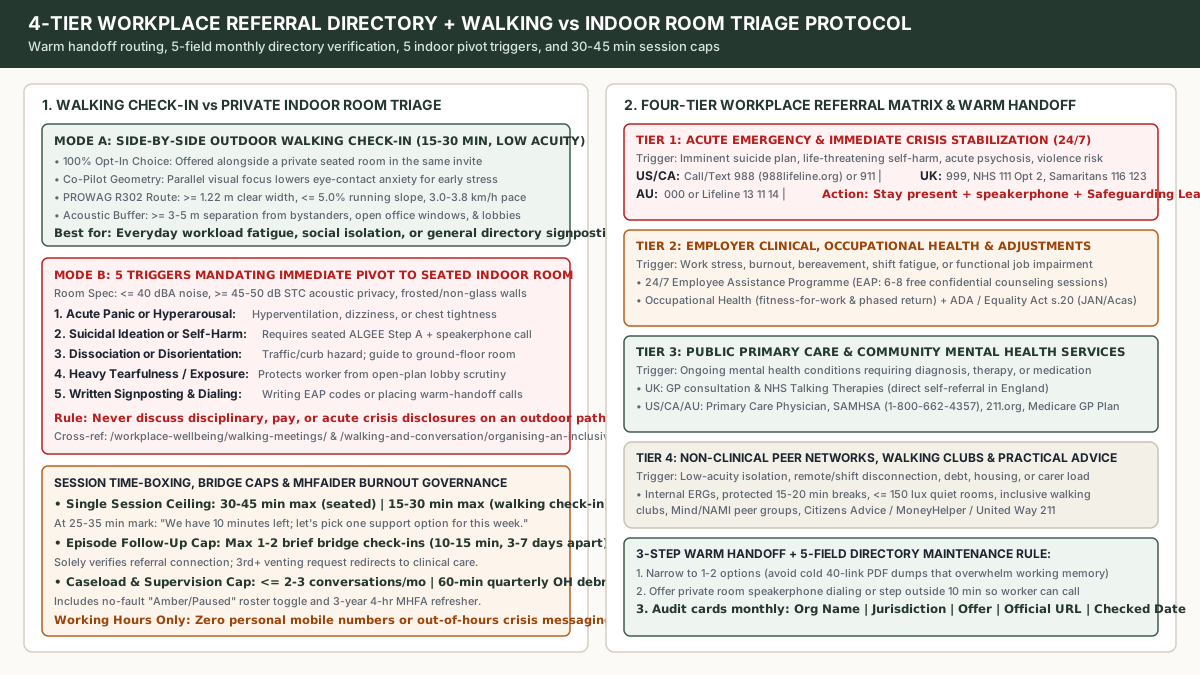
Environmental Preconditions and Five Mandatory Indoor Pivot Triggers
When an employee reaches out for an initial low-acuity peer check-in, always offer a private seated indoor room and a step-free outdoor walking loop as co-equal options in the calendar invitation so declining a walk requires zero physical or medical explanation. For colleagues who select the outdoor walk, pre-verify the loop against the physical measurements in how to organise an inclusive walk and accessibility audit checklist for outdoor events and routes: continuous clear width >= 1.22 m (48 in), longitudinal running grade <= 5.0% (1:20), cross-slope <= 2.0%, pace capped at 3.0–3.8 km/h (2.5–2.8 METs), ADA Section 903 rest benches every 100–150 m, and an acoustic buffer of >= 3 to 5 meters away from open office windows, smoking shelters, shuttle stops, and narrow footpaths.
An MHFA conversation must never start outdoors, or must immediately transition indoors into a private, seated, sound-insulated room (<= 40 dBA background noise, >= 45–50 dB Sound Transmission Class [STC] wall and door isolation, and non-glass or frosted-glass partitions outside team sightlines), whenever any of these five indoor transition triggers occur:
- Acute Panic or Autonomic Hyperarousal: Rapid breathing, dizziness, chest tightness, trembling, or sensory overwhelm requiring immediate seated grounding and privacy.
- Suicidal Ideation or Self-Harm Disclosure: Any statement of wanting to die, feeling trapped, or self-injury requires uninterrupted seated crisis assessment (
ALGEEStep A) and a secure room for collaborative speakerphone dialing (988/999/000). - Dissociation, Confusion, or Agitation: Spatial disorientation, unresponsiveness, or perceptual disturbance where walking near kerbs, vehicle lanes, or uneven paving creates an immediate physical safety hazard.
- Heavy Tearfulness or Visual Exposure: When a colleague becomes visibly distressed and returning across an open-plan reception lobby, security turnstile, or crowded corridor would expose them to coworker scrutiny.
- Written Signposting and Warm-Handoff Dialing: Reviewing multi-tier directory cards, writing down an EAP access code, or placing a confidential warm-handoff telephone call.

Session Time-Boxing and Episode Caps to Prevent Pseudo-Counseling
Without explicit duration boundaries, peer check-ins easily stretch past 90 minutes, exhausting both workers and drifting into amateur therapy. Enforce four time-boxing rules:
- Single-Session Duration Ceiling (
30–45 Minutes): Cap seated MHFA conversations at30 to 45 minutesmaximum (15 to 30 minutesfor a low-acuity outdoor walking check-in). Beyond45 minutes, cognitive fatigue rises sharply and signposting focus degrades. - Ten-Minute Closing Bridge Prompt: At the
25- to 35-minutemark, the MHFAider uses a structured closing transition: “We have about ten minutes left in our slot today. Let’s use these last few minutes to pick one practical support option from the directory, such as calling the EAP line or booking a GP appointment, that feels manageable for you this week.” - Episode Follow-Up Ceiling (
Max 1–2 Bridge Check-Ins): Limit follow-up contact to at most1 to 2brief bridge check-ins (10 to 15 minuteseach, scheduled3 to 7 working daysapart) per distress episode. The sole purpose of a bridge check-in is to confirm whether the colleague connected with the signposted resource or needs an alternative referral tier. If an employee requests a third or fourth extended venting session without engaging professional support, the MHFAider reinforces the peer boundary and redirects to Tier 2 or Tier 3 clinical services. - Working Hours and Official Channel Boundary: All workplace MHFA interactions occur during paid working hours using official company communication channels. MHFAiders never share personal mobile numbers or personal social-media accounts for evening or weekend messaging; out-of-hours support belongs exclusively to 24/7 clinical lifelines and the employer’s 24/7 EAP telephone service.
MHFAider Staffing Ratio Formula and Burnout Prevention Governance
Under the UK Health and Safety (First-Aid) Regulations 1981 (Approved Code of Practice L74, updated by the HSE to incorporate mental health into employer First-Aid Needs Assessments) and MHFA England / Association of Mental Health First Aiders Workplace Standards, MHFA headcount must scale with workforce size, psychosocial hazard load, and shift structure so that annual leave, night shifts, and line-manager conflict exclusions never leave workers with only one contact option.
Calculate the required number of trained workplace MHFAiders (N_MHFA) and monitor monthly peer supporter workload using these equations:
N_MHFA = max(2, ceil((N_employees / R_target) × S_shift_multiplier))
Caseload_Utilization (%) = (Active_Monthly_Signpostings / (N_MHFA × C_max_monthly)) × 100
Where:
N_employees= Total eligible headcount at the site or work-mode cohort.R_target= Target employees per trained MHFAider:50(1:50baseline ratio) for low-to-moderate hazard daytime office or hybrid sites;20 to 25(1:20to1:25high-coverage ratio) for high-psychosocial-load frontline, healthcare, customer-crisis, warehouse, or multi-shift operations.S_shift_multiplier= Shift topology multiplier:1.0for single-shift daytime operations;1.4for two-shift operations;1.5to1.6for 24/7 rotating three-shift operations to ensure night and weekend shift parity (matching the shift equity rules in low-barrier workplace wellness ideas).max(2, ...)= Minimum pair rule: even a micro-site of< 50staff must maintain at least2trained MHFAiders so an employee is never forced to approach their own supervisor.C_max_monthly= Maximum safe monthly caseload per MHFAider (3active signposting conversations per month, or<= 2.0 hours/monthof direct peer support time). IfCaseload_Utilizationexceeds80%, the organization must either train additional MHFAiders or investigate systemic workload hazards under ISO 45003.
Worked Example (Multi-Shift Warehouse and Office Employer):
Consider an employer operating a 150-person hybrid headquarters (N_office = 150, single daytime shift S_shift = 1.0, standard baseline R_target = 50) and a 180-person 24/7 rotating three-shift logistics center (N_warehouse = 180, 24/7 multiplier S_shift = 1.5, high-coverage target R_target = 25):
- Office Cohort MHFA Staffing:
N_MHFA_office = max(2, ceil((150 / 50) × 1.0)) = max(2, ceil(3.0)) = 3 trained MHFAiders - 24/7 Warehouse Cohort MHFA Staffing:
N_MHFA_warehouse = max(2, ceil((180 / 25) × 1.5)) = max(2, ceil(7.2 × 1.5)) = max(2, ceil(10.8)) = 11 trained MHFAiders(distributed as4on day shift,4on swing shift, and3on night shift). - Monthly Caseload Audit: Across the
14total MHFAiders (3 + 11), maximum safe monthly capacity atC_max_monthly = 3conversations each is14 × 3 = 42 conversations/month. When anonymized monthly logs record18signposting conversations across the company,Caseload_Utilization = (18 / 42) × 100 = 42.9%(PASS, well below the80%compassion-fatigue warning threshold).
To protect MHFAiders from secondary burnout, pair this staffing math with three mandatory governance controls:
- Quarterly 60-Minute Clinical Supervision: Hold a mandatory
60-minutequarterly group debrief led by an occupational health clinician or EAP specialist to review anonymized boundary scenarios and screen peer supporters for compassion fatigue. - No-Fault “Amber / Paused” Roster Status: Allow any MHFAider experiencing personal bereavement, peak project load, or personal health challenges to toggle their directory status to
Temporarily Unavailablewith zero explanation required, routing incoming requests to fellow MHFAiders. - Three-Year Accreditation Refresher: Require every active workplace MHFAider to complete a
4-houraccredited refresher course every36 months(3 years) in line with MHFA England and National Council for Mental Wellbeing standards.
Takeaway: Transition outdoor walking check-ins indoors immediately upon any of the five clinical or privacy triggers, cap sessions at 30–45 minutes with at most 1–2 bridge follow-ups, and size rosters using N_MHFA = max(2, ceil((N_employees / R_target) × S_shift_multiplier)).
Four-Tier Workplace Referral Directory and Warm Handoff Protocol
A workplace MHFA program is only as reliable as the directory it points to. Handing a distressed worker an outdated intranet PDF containing 40 unverified phone numbers (“cold signposting”) fails because acute emotional distress impairs working memory and executive decision-making. Instead, workplace MHFAiders use a structured Four-Tier Referral Matrix paired with a Three-Step Warm Handoff and the monthly Five-Field Directory Verification Method established in how to keep a community support directory reliable.

The Four-Tier Workplace Referral Matrix
Organize every site’s MHFA signposting card into four distinct acuity tiers, ensuring that every entry specifies its exact geographic jurisdiction:
| Referral Tier and Acuity Level | Trigger Presentation in Conversation | Verified Public and Statutory Pathways (By Jurisdiction) | MHFAider Warm-Handoff Action Protocol |
|---|---|---|---|
| Tier 1: Acute Emergency and Immediate Crisis Stabilization (24/7 Immediate) | Active suicidal intent or plan, life-threatening self-injury, overdose, acute psychosis/delirium, or imminent violence risk | • US & Canada: Emergency Dispatch (911), 988 Suicide & Crisis Lifeline (call or text 988; https://988lifeline.org/), Crisis Text Line (text HOME to 741741)• United Kingdom: Emergency Services ( 999), NHS 111 (dial 111 and select Option 2 for 24/7 urgent mental health crisis team; https://www.nhs.uk/), Samaritans (call 116 123 free 24/7; https://www.samaritans.org/)• Australia: Emergency Services ( 000), Lifeline Australia (call 13 11 14; https://www.lifeline.org.au/) |
Stay with the colleague in a safe ground-floor room; initiate collaborative speakerphone call or execute mandatory escalation to Emergency Dispatch + Workplace Safeguarding Lead. |
| Tier 2: Employer Clinical, Occupational Health, and Adjustments (24–72 Hr Intake) | Work-related stress, burnout, bereavement, shift exhaustion, or functional difficulty performing job tasks without imminent life risk | • Employee Assistance Programme (EAP): 24/7 confidential intake line offering 6–8 free short-term counseling sessions and legal/financial triage outside HR visibility• Occupational Health (OH): Clinical fitness-for-work assessment and phased return-to-work schedule design • Statutory Adjustments: ADA Title I interactive process (Job Accommodation Network [JAN]; https://askjan.org/) or UK Equality Act 2010 § 20 (Acas; https://www.acas.org.uk/reasonable-adjustments/mental-health-adjustments) |
Offer to dial the 24/7 EAP intake line together from the private room, or step outside for 10 minutes so the colleague can use the quiet room to call privately. |
| Tier 3: Public Primary Care and Community Mental Health (1–4 Week Clinical Route) | Ongoing or recurring mental health conditions requiring formal diagnosis (ICD-11 / DSM-5-TR), evidence-based psychotherapy, or medication review |
• United Kingdom (England): Primary care GP consultation and NHS Talking Therapies for anxiety and depression (direct self-referral without seeing a GP first; https://www.nhs.uk/mental-health/talking-therapies-medicine-treatments/talking-therapies-and-counselling/nhs-talking-therapies/)• United States: Primary Care Physician (PCP), SAMHSA National Helpline ( 1-800-662-4357; https://findtreatment.gov/), and United Way 211 (dial 211; https://www.211.org/)• Australia: GP Mental Health Treatment Plan (Medicare Better Access) and Medicare Mental Health ( 1800 595 212) |
Share the direct official URL, explain the self-referral versus GP-referral distinction, and point out company paid medical-appointment leave policies. |
| Tier 4: Non-Clinical Peer Networks, Walking Clubs, and Practical Support (Ongoing Low-Barrier) | Low-acuity situational stress, remote or night-shift isolation, caregiving pressure, debt/housing worry, or desire for ordinary social connection | • Internal Workplace Supports: Neurodiversity, carer, and disability ERGs; protected 15–20 min midday breaks and <= 150 lux quiet rooms (low-barrier workplace wellness ideas)• Community Walking & Peer Groups: Step-free community walking clubs (how to start a walking club), accessible community rooms (accessibility checklist for a community event), Mind local branches (UK), NAMI peer groups (US) • Debt & Housing Triage: Citizens Advice / MoneyHelper (UK), United Way 211 (US/CA) |
Provide the verified directory card and state clearly that community walks and peer ERGs are ordinary social spaces rather than clinical therapy. |
Executing the Three-Step Warm Handoff Protocol
To bridge the gap between an initial peer conversation and actual professional intake without crossing into clinical case management, train every MHFAider on the Three-Step Warm Handoff:
- Step 1 (Narrow to One or Two Verified Pathways): Instead of overwhelming a tired colleague with every link on the intranet, select the
1 or 2most relevant options from the four-tier matrix based on the colleague’s own words (for example, pairing the Tier 2 24/7 EAP counseling line with the Tier 3 NHS Talking Therapies self-referral page). - Step 2 (Offer In-Room Connection Support): Lower the executive-function barrier to making the first call by offering two concrete choices: “Would it help if we dialed the EAP intake number together right now on speakerphone to get your reference number, or would you like me to step outside the room for ten minutes so you can sit here in private and call them yourself?”
- Step 3 (Book One 10-Minute Bridge Check-In): Before ending the session, schedule a single
10-minutebridge check-in3 to 5 working dayslater with an explicit boundary: “Let’s check in for ten minutes on Thursday afternoon just to confirm that the referral link worked and that you reached the right team.”
Monthly Five-Field Directory Verification Audit
In accordance with how to keep a community support directory reliable, a workplace MHFA coordinator must audit the internal signposting sheet on the first working day of every month (30-day recheck cycle). Every directory row must display five mandatory fields:
- Official Organisation Name (copied verbatim from the provider’s official domain).
- Exact Geographic and Workforce Coverage (explicitly labeling England-only NHS routes, US-only
988/211routes, and whether shift contractors or family members are covered under the employer’s EAP contract). - Specific Service Offer and Operating Hours (such as
24/7 crisis telephone and text lineor6 free short-term counseling sessions per issue). - Direct Official Source URL (linking straight to the primary public page or internal EAP portal).
- Date Last Checked and Named Reviewer (removing or updating any number or URL that fails verification on the check date).
For broader guidance on structuring safe, non-coercive workplace conversations and accessible routes, explore all notes in Mental Health Literacy and Workplace Wellbeing.
Takeaway: Route workplace signposting through the four-tier acuity matrix using a three-step warm handoff, and audit every directory entry every 30 days across all five verification fields.