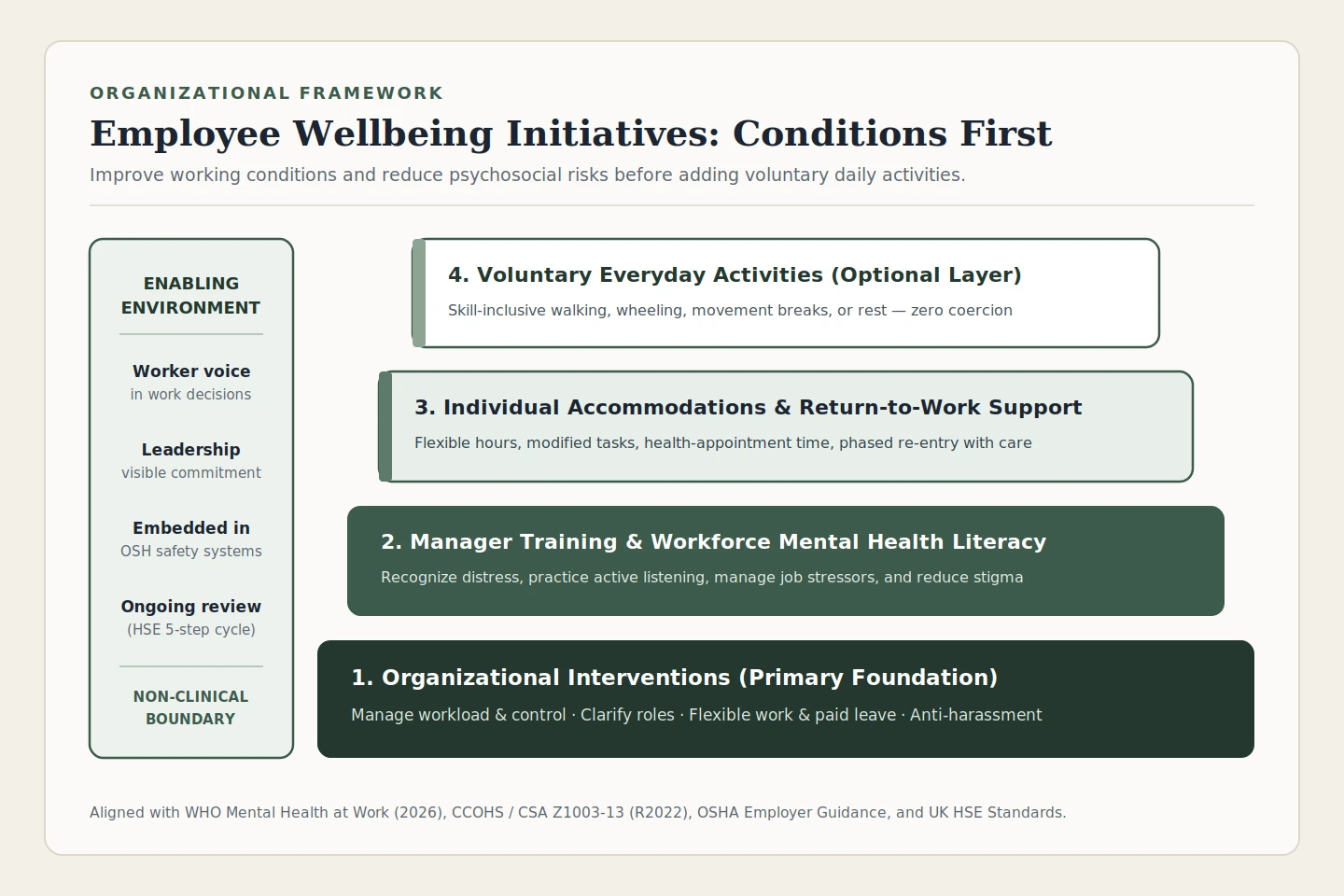
Employee wellbeing initiatives are structured workplace actions that improve working conditions and reduce psychosocial risks first—through manageable workloads, clear roles, flexible arrangements, and supportive management—before layering voluntary, non-clinical daily options such as movement breaks or mental health literacy. Grounding programs in day-to-day job design protects workers more reliably than standalone wellness perks or mandatory participation campaigns.
Public-health and occupational-safety agencies consistently place organizational work conditions at the base of workplace wellness programs. In its mental health at work fact sheet, the World Health Organization (WHO) recommends employers prevent work-related mental health conditions by implementing organizational interventions that directly target working conditions and environments. This framework sits at the center of our Workplace Wellbeing collection, connecting structural priorities with downstream guides on low-barrier workplace wellness ideas and psychological safety at work.
What do employee wellbeing initiatives include in practice?
In practice, effective employee wellbeing initiatives span four WHO action pillars: preventing work-related mental health conditions by managing psychosocial risks, protecting and promoting mental health through training and voluntary individual options, supporting workers with mental health conditions through accommodations and return-to-work programmes, and creating an enabling environment with worker participation and leadership commitment.
Too many workplace wellness programs start at the top layer—launching a one-off challenge or talk—while leaving heavy workloads, unclear roles, and rigid schedules untouched. The Occupational Safety and Health Administration (OSHA) employer guidance frames the proper order clearly: alleviate or remove stressors in the workplace to the greatest extent possible, build coping and resiliency supports, and ensure that people who need help know where to turn.
| Initiative Layer | Primary Target | Concrete Workplace Actions | Participation and Boundary Rule |
|---|---|---|---|
| Organizational interventions | Working conditions and environments | Assess and mitigate psychosocial risks, offer flexible working arrangements, clarify job roles, and enforce anti-harassment frameworks | Applies across the workplace as a management responsibility rather than an individual coping burden |
| Manager and literacy training | Everyday supervision and team awareness | Train managers to recognize distress, listen actively, and manage job stressors; train workers in mental health literacy to reduce stigma | Managers address workplace stressors and listen openly without diagnosing health conditions |
| Accommodations and return to work | Workers navigating health needs or absences | Adapt hours, task timelines, assignments, health-appointment time, and phased re-entry combined with ongoing clinical care | Tailored to individual capacities, needs, and preferences while clinical care stays with health professionals |
| Voluntary daily activities | Sedentary strain and personal stress skills | Offer optional leisure-based physical activity such as walking, wheeling, or diet and movement options like WHO SEARO Be the Change | Strictly optional, skill-inclusive, and free from attendance penalties or performance pressure |
What is employee wellbeing in the workplace and what shapes it?
Employee wellbeing in the workplace reflects how decent work supports mental and physical health through livelihood, purpose, confidence, positive relationships, community inclusion, and structured routines—versus how poor working conditions erode health through excessive workloads, low job control, discrimination, unclear roles, and job insecurity.
Global and workplace scale of occupational strain
WHO estimates that 16% of working-age adults had a mental disorder in 2023 and that an estimated 12 billion working days are lost globally every year to depression and anxiety. Poor working environments—including discrimination and inequality, excessive workloads, low job control, and job insecurity—directly pose a risk to mental health.
Survey figures summarized on the OSHA workplace stress overview reflect how strongly job conditions affect workers: 76% of workers reported experiencing at least one symptom of a mental health condition in the past year, and 84% of employees said workplace conditions adversely impacted their mental wellbeing. On OSHA’s employer guidance page, American Psychological Association survey findings show that more than 85% of employees surveyed in 2021 reported actions from their employer would help their mental health, and 50% reported that a lack of paid time off or sick leave has a negative impact on stress levels at work.
Psychosocial factors that shape daily work experience
Occupational safety agencies map the specific workplace conditions that shape employee wellbeing. On the UK Health and Safety Executive (HSE) causes of stress page, six main areas can lead to work-related stress if not managed properly: demands, control, support, relationships, role, and change. HSE also emphasizes that stress affects people differently, and factors such as skills, experience, age, or disability influence how a worker copes.
The Canadian Centre for Occupational Health and Safety (CCOHS) expands this picture through 13 organizational psychosocial risk factors used in Guarding Minds at Work and the Canadian standard CSA Z1003-13 (R2022): Balance, Civility and Respect, Clear Leadership and Expectations, Engagement, Growth and Development, Involvement and Influence, Organizational Culture, Protection of Physical Safety, Psychological Competencies and Demands, Psychological Protection, Psychological and Social Support, Recognition and Reward, and Workload Management.
Two mechanisms highlighted by CCOHS explain why working conditions outweigh standalone perks:
- Workload paired with job control: Employees often describe a large workload—having too much to do and not enough time to do it—as the biggest workplace stressor, and both task volume and available resources such as time, equipment, and support matter. Even when demands are high, CCOHS notes that employees with high decision-making ability can thrive, whereas increased demands without control produce physical, psychological, and emotional fatigue.
- Presenteeism under thin staffing: CCOHS notes that presenteeism happens when employees come to work despite illness or extreme stress—often because there is no back-up plan for their tasks, work will pile up while they are away, or they worry about job insecurity.
What are practical examples of employee wellbeing initiatives?
Practical employee wellbeing initiatives range from structural adjustments—such as flexible schedules, fair workload pacing, and harassment-prevention frameworks—to manager listening training, individualized work accommodations, and voluntary movement options during sedentary workdays. Organizing examples by tier prevents teams from confusing optional perks with core risk prevention.
| Wellbeing Tier | Practical Team Examples | Primary Source Basis | Related Detailed Guide |
|---|---|---|---|
| Working conditions | Flexible working arrangements, review of workload and task resources, clear role expectations, and workplace violence and harassment frameworks | WHO organizational interventions; CCOHS Workload Management and Balance; OSHA employer guidance | Low-barrier workplace wellness ideas |
| Team dialogue and manager capacity | Manager training on recognizing emotional distress, active listening, open communication, and managing job stressors; worker mental health literacy sessions | WHO manager and worker training recommendations | Psychological safety at work |
| Individual adjustments and peer boundaries | Flexible hours, extra time for tasks, modified assignments, time off for health appointments, supportive supervisor check-ins, and phased return-to-work plans | WHO reasonable accommodations and return-to-work programmes | Mental health first aid at work boundaries |
| Voluntary daily movement and social options | Optional walking or wheeling breaks, inclusive non-competitive movement options, and diet and physical-activity choices modeled on WHO SEARO Be the Change | WHO healthy workplace and physical activity guidance | Inclusive corporate wellness challenge design |
When teams add outdoor walking options to this menu, keeping the right format boundary matters. Optional daylight strolls work well for informal decompression, whereas performance appraisals, sensitive health discussions, and confidential complaints belong in private indoor settings, as outlined in limits of walking conversations at work.
How do you build a workplace wellbeing strategy instead of one-off perks?
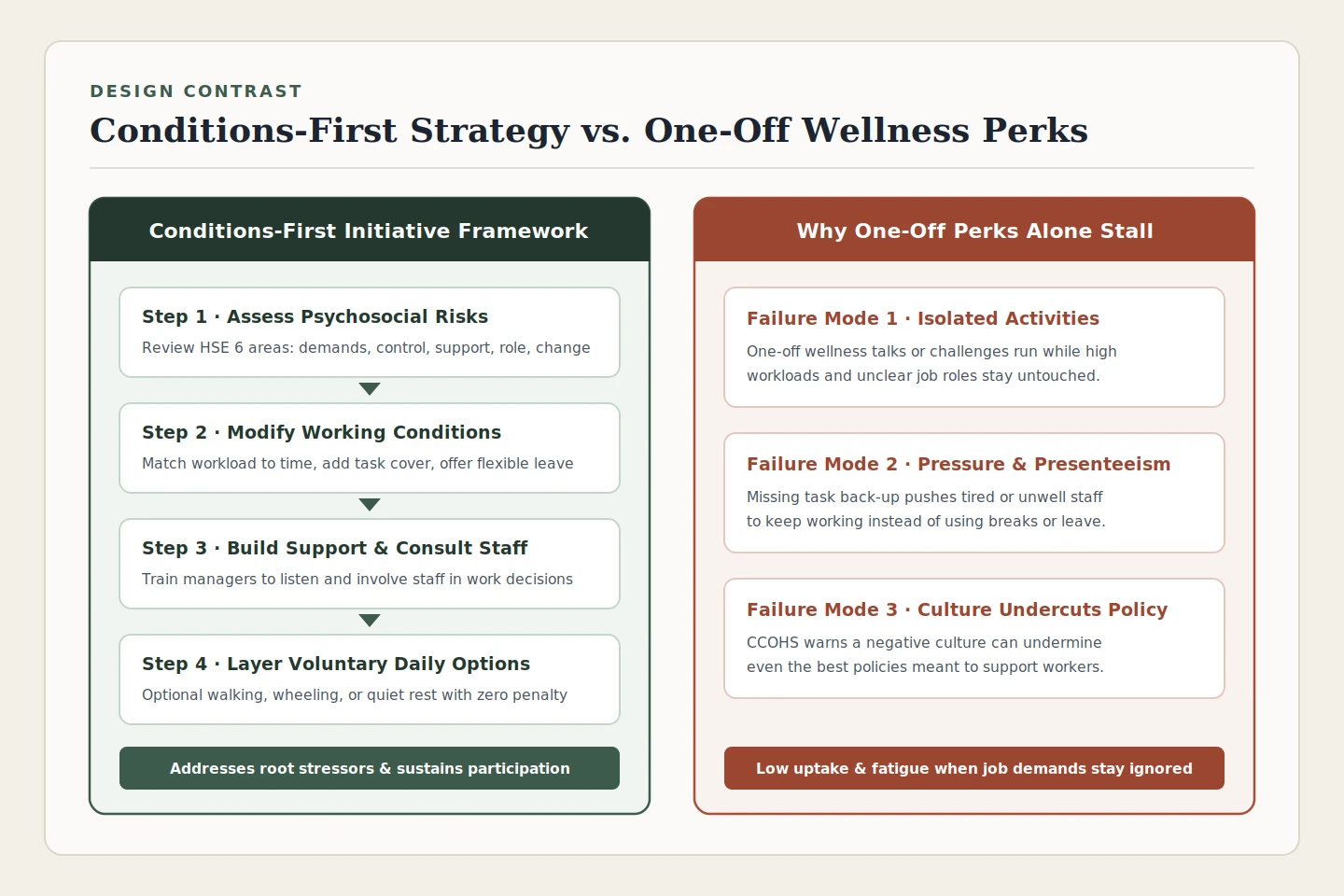
Building a workplace wellbeing strategy requires managing psychosocial risks as a recurring operational cycle—identifying workplace hazards, consulting workers directly, embedding commitments into existing occupational safety and health systems, and reviewing results—rather than running disconnected one-off wellness events while underlying work pressures persist.
The UK HSE Management Standards organize workplace stress prevention into five repeatable risk-management steps: Step 1 identifies the risk factors, Step 2 determines who can be harmed and how, Step 3 evaluates the risks, Step 4 records the findings, and Step 5 monitors and reviews progress over time. Treating employee wellbeing through this standard safety cycle keeps initiatives tied to real job conditions.
WHO complements that cycle by outlining what creates an enabling environment for lasting workplace change:
- Meaningful worker participation: WHO states that action on mental health at work should involve workers, their representatives, and persons with lived experience of mental health conditions in decision-making.
- Integration into existing safety systems: Embedding mental health into established occupational safety and health systems prevents wellbeing from sitting in an isolated side silo.
- Leadership commitment and culture alignment: CCOHS warns that culture sets the tone for an organization and that a negative culture can undermine the effectiveness of the best programs, policies, and services intended to support the workforce.
- Dedicated resources and evidence-based review: Establishing clear budgets, extending access to lower-resourced operations, and reviewing whether adjustments actually reduce workload and schedule friction keeps the strategy practical.
How can small teams improve employee wellbeing at work without a large budget?
Small teams can improve employee wellbeing without a large budget by pairing free public occupational-health frameworks with zero-cost workflow fixes: clarifying job roles, removing unnecessary blockers, planning task back-up coverage so sick leave is usable, and offering schedule flexibility across varied caregiving responsibilities.
WHO specifically notes that enabling change includes making mental health and employment services available to lower-resourced enterprises. Small employers and team leads do not need commercial software suites to start effectively. Two free, authoritative starting points already cover assessment and manager preparation:
- OSHA free workplace stress tools: OSHA provides Getting Started Guides for Senior Managers and Front-line Supervisors, Mental Health Checklists, Workplace Stress Sample Survey Questions to determine whether workplace adjustments can reduce stress, and Myth Buster Fact Sheets to help reduce stigma.
- Free CSA Z1003-13 (R2022) and Guarding Minds at Work framework: CCOHS notes that Guarding Minds at Work is a free evidence-based strategy and that the CSA Z1003-13 (R2022) standard is available free from the CSA Group website for staged implementation.
Alongside those free frameworks, OSHA and CCOHS highlight four zero-budget operational habits small teams can apply immediately:
- Ask what blocks daily work: Follow OSHA’s guidance to identify factors making it harder for workers to get their jobs done and determine what practical adjustments can be made.
- Build simple task back-up plans: Because CCOHS identifies missing task back-up and fear of returning to piled-up work as key drivers of presenteeism, cross-covering essential duties lets employees actually take sick leave or paid time off without penalty.
- Protect work-life flexibility: CCOHS notes that greater workplace flexibility helps employees manage differing family, caregiving, age, and personal demands while reducing work-life conflict.
- Match workload with decision-making input: Giving staff genuine voice in how tasks are sequenced and paced raises control alongside job demands.
What low-barrier wellbeing activities work best for everyday teams?
Low-barrier wellbeing activities work best for everyday teams when they counter prolonged sitting or standing with optional, skill-inclusive movement—such as brief walking, cycling, or wheeling breaks—alongside quiet rest choices that require no athletic gear, zero public leaderboards, and zero medical disclosure from participants.
On its healthy workplace overview, WHO South-East Asia Regional Office notes that working-age adults spend most of their waking hours at work and increasingly adopt sedentary lifestyles—working behind computer screens, sitting at desks, or standing in one position for long durations across both service and manufacturing sectors. In 2016, the WHO South-East Asia Regional Office launched the Be the Change (BTC) workplace health initiative to offer employees varied options in diet and physical activity to improve physical and mental well-being and address sedentary lifestyles.
The WHO physical activity fact sheet underscores why everyday, accessible workplace movement matters:
- Scale of inactivity: Nearly one third (31%) of adults globally (1.8 billion adults) do not meet the global recommendation of at least 150 minutes of moderate-intensity physical activity per week, a share projected to rise to 35% by 2030.
- Benefits of walking and everyday movement: WHO defines physical activity as any bodily movement produced by skeletal muscles that requires energy expenditure—including walking, cycling, and wheeling at any level of skill during leisure, transport, or work. In adults, regular physical activity helps prevent and manage cardiovascular diseases, cancer, and diabetes, reduces symptoms of depression and anxiety, enhances brain health, and improves overall well-being.
- Risks of prolonged sedentary time: Higher amounts of sedentary behaviour in adults are associated with increased all-cause mortality, cardiovascular disease mortality, cancer mortality, and incidence of cardiovascular disease, cancer, and type-2 diabetes.
- Low-barrier design rule: WHO guidelines emphasize that any amount of physical activity is better than none, all physical activity counts, and all age groups should limit sedentary time, while the WHO Global action plan on physical activity recommends increasing physical activity opportunities in workplaces and ensuring access to walking and cycling.
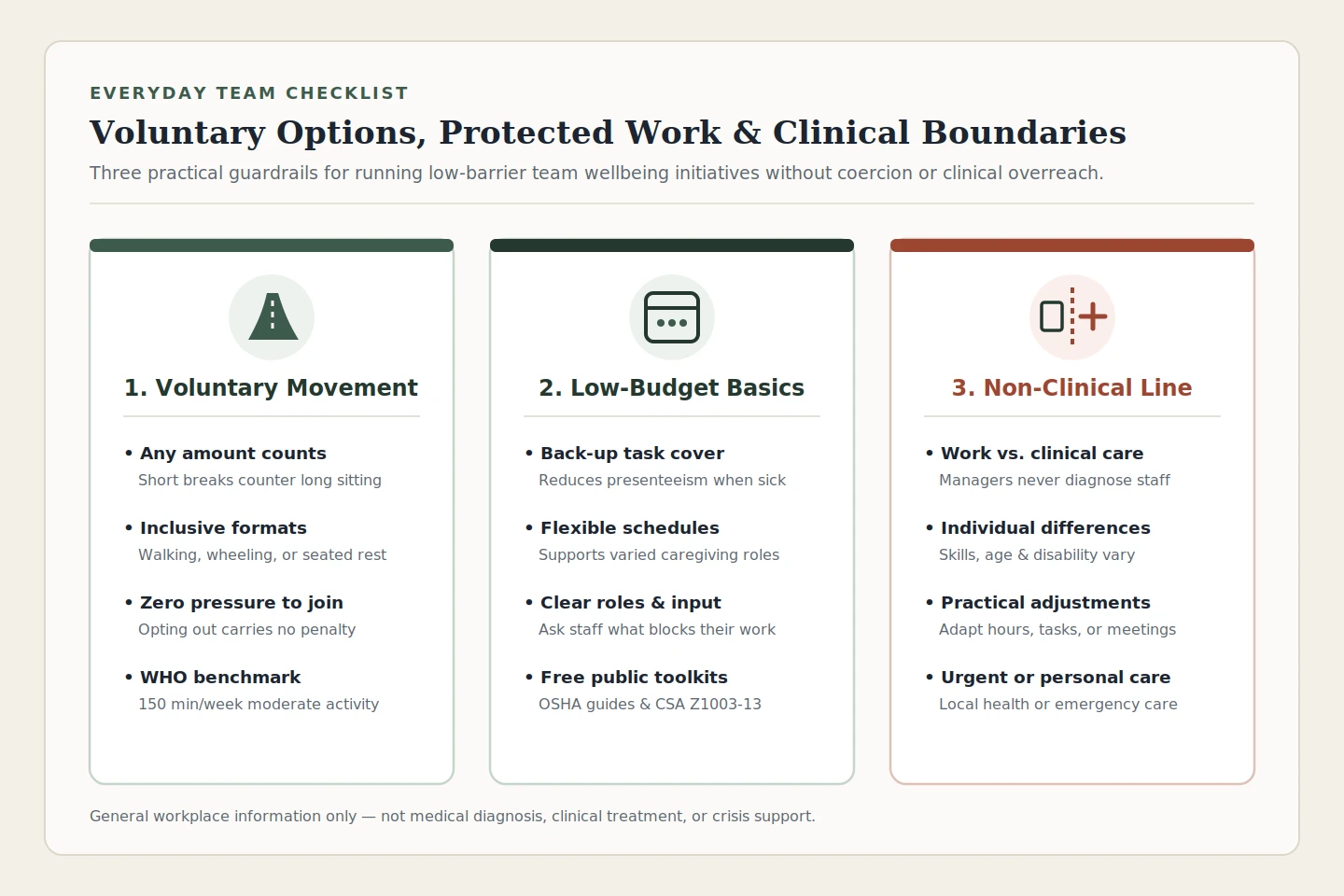
Team priority and voluntary participation check
Before launching or refreshing any workplace wellbeing activity, review these six non-clinical guardrails with your team:
- Conditions checked first: Confirm that workload, role clarity, leave access, and harassment protections are actively reviewed under an ongoing cycle such as the five HSE Management Standards steps rather than masked by optional perks.
- Workers consulted directly: Invite staff and worker representatives to flag daily job blockers before choosing new activities.
- Participation strictly voluntary: Keep walking breaks, movement sessions, and wellness options free from mandatory attendance, step quotas, or penalties for opting out.
- Accessible across abilities: Include walking, wheeling, and seated rest as equally respected choices, recognizing that skills, age, and disability shape what works for each person.
- Adjustments kept practical: Use reasonable accommodations—such as flexible hours, modified assignments, or time for health appointments—to adapt work conditions without turning supervisors into clinicians.
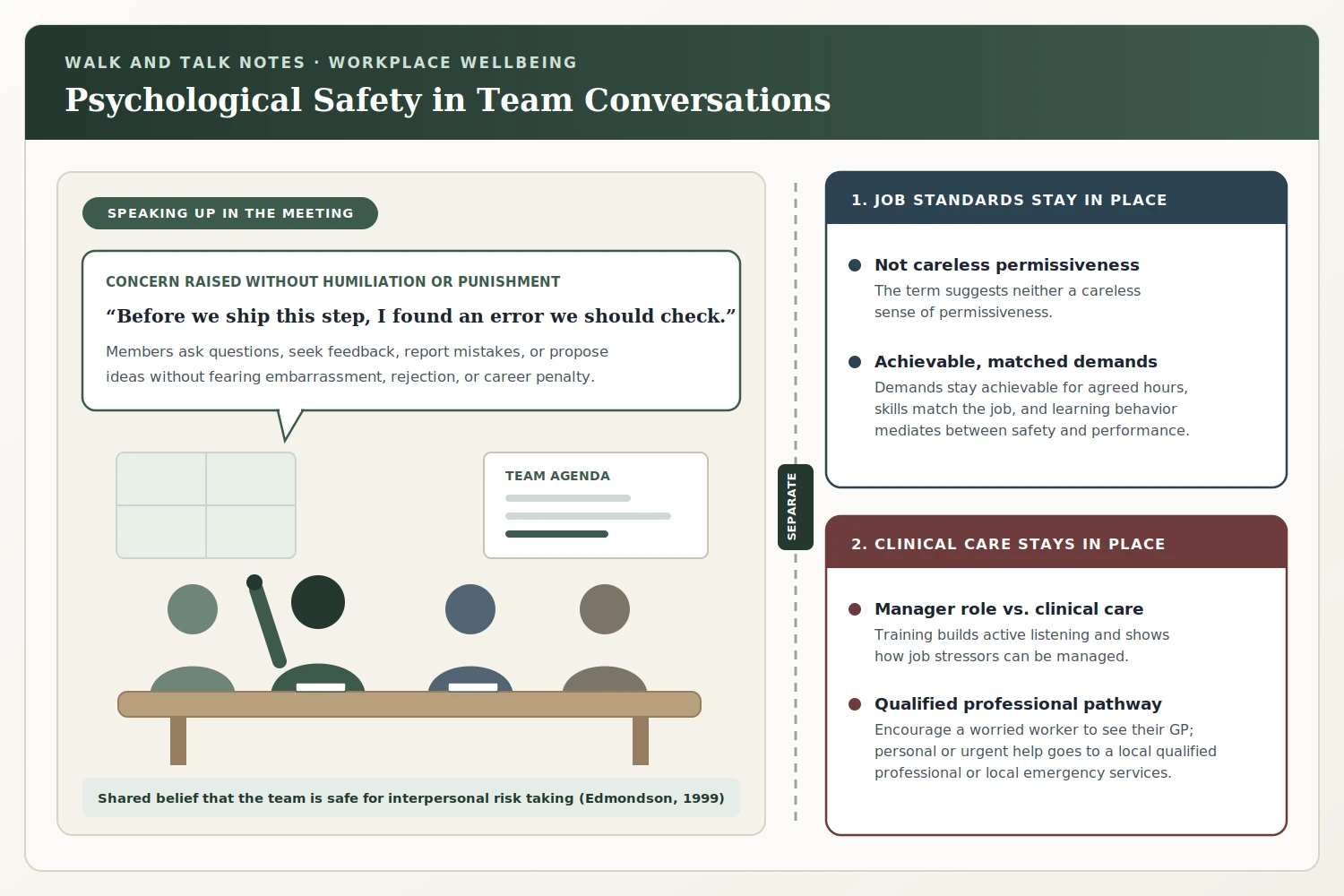
- Clinical and urgent care kept separate: OSHA notes that workplace mental health challenges span both temporary stress and diagnosable clinical conditions. Managers listen, adjust workplace stressors, and share official support directories, while diagnosis, treatment, or urgent help belongs with a local qualified health professional or local emergency services.