Matching a group’s walking pace to side-by-side path width (1.50–2.00 m), a designated Sweep Leader (Back-Marker), and a fixed Turn-Back Time (T_turn) keeps multi-speed walkers connected from step-off to finish. Publishing a single fixed route distance without pace brackets or a clock-based turnaround fails slower walkers and mobility-aid users, stretching a 2.0-mile (3.2-km) outing across 22.5 minutes and 1.2 miles so rear participants finish isolated long after faster walkers have left.
Side-by-side conversation depends on two physical conditions that general fitness pace charts overlook: compatible step cadence (steps/min) between partners and enough horizontal clear width for two people—including a wheelchair user and a standing companion—to move abreast without dropping into single file. While how to start a walking club covers inaugural club setup, volunteer staffing ratios, and participant-carried emergency cards, this guide focuses on calibrating a conversational walking pace, verifying 2-abreast path geometry, scheduling synchronized turn-back benches, and publishing an 8-field route card for Walking and Conversation gatherings.
| Conversational Pace Group | Target Speed (mph & km/h) |
Pace per Mile (and km) |
Step Cadence & 2024 Compendium METs | Talk Test & Conversational Rhythm Cue | Minimum 2-Abreast Clear Width & Rest-Stop Interval |
|---|---|---|---|---|---|
| Group 1: Gentle Social & Mobility-Aid Pace | 1.8–2.4 mph (2.9–3.9 km/h) |
25–33 min/mi (15.5–20.5 min/km) |
65–84 steps/min; 2.3–2.8 METs (Codes 17151 / 17152) |
Full, unhurried sentences with zero breath elevation; natural rhythm for rollators, canes, frames, and wheelchairs | >= 1,500 mm (59.1 in) wheelchair + companion width; initial benches at 50–150 m (UK DfT Inclusive Mobility) |
| Group 2: Standard Conversational Pace (Club Anchor) | 2.5–3.0 mph (4.0–4.8 km/h) |
20–24 min/mi (12.5–15.0 min/km) |
85–99 steps/min; 2.5–3.5 METs (Codes 17162 / 17170 / 17250) |
Complete sentences spoken comfortably side-by-side without gasping; matches social and work-break walking | >= 1,500–2,000 mm (59.1–78.7 in) clear width; seated turnaround pause at T_turn plus mid-route bench |
| Group 3: Brisk Conversational Pace | 3.0–3.5 mph (4.8–5.6 km/h) |
17–20 min/mi (10.6–12.5 min/km) |
>= 100 steps/min; 3.8–4.8 METs (Codes 17190 / 17200) |
NHS Talk Test (~3 mph): can speak in full conversational phrases with a partner, but cannot sing the words to a song |
>= 2,000 mm (78.7 in) two-way corridor so brisk pairs pass oncoming walkers with a 500 mm buffer |
Why Conversational Walking Pace Needs Explicit Speed and Cadence Brackets
An ungraded “all-welcome walk” silently assumes that adults share a uniform natural walking speed. Normative gait measurements across adult age cohorts show why that assumption breaks down on the first block: healthy adults aged 20 to 49 walk at a self-selected speed of 3.00–3.20 mph (4.8–5.1 km/h, or 1.34–1.43 m/s), adults aged 60 to 69 average 2.77–3.00 mph (4.5–4.8 km/h), adults aged 70 to 79 average 2.53–2.82 mph (4.1–4.5 km/h), and adults aged 80 to 89 average 2.10–2.17 mph (3.4–3.5 km/h, or 0.94–0.97 m/s). When a single group steps off without explicit pace brackets, younger or brisker walkers naturally settle near 3.2 mph while older adults, people recovering from illness, or participants using walking sticks and rollators move comfortably at 1.8–2.4 mph. Within 10 minutes, the pack splits across road crossings and blind park turns.
Grounding Pace Groups in Cadence (steps/min), METs, and the Talk Test
For two people to walk side by side and hold an easy conversation, both their forward speed and their step rhythm must align. In a narrative review of 38 adult walking studies published in the British Journal of Sports Medicine (Tudor-Locke et al., 2018), researchers established that a walking cadence of >= 100 steps/min is a consistent heuristic threshold associated with moderate intensity (3.0 METs), while purposeful free-living walking cadences start at 60 steps/min and peak 30-minute cadences in healthy adults average > 70 steps/min (declining as age or body mass index increases). When a walker comfortable at 75 steps/min is paired with someone striding at 105 steps/min, the slower partner is forced to over-stride and breathe harder, while the faster partner has to stutter-step—breaking the natural cadence of speech.
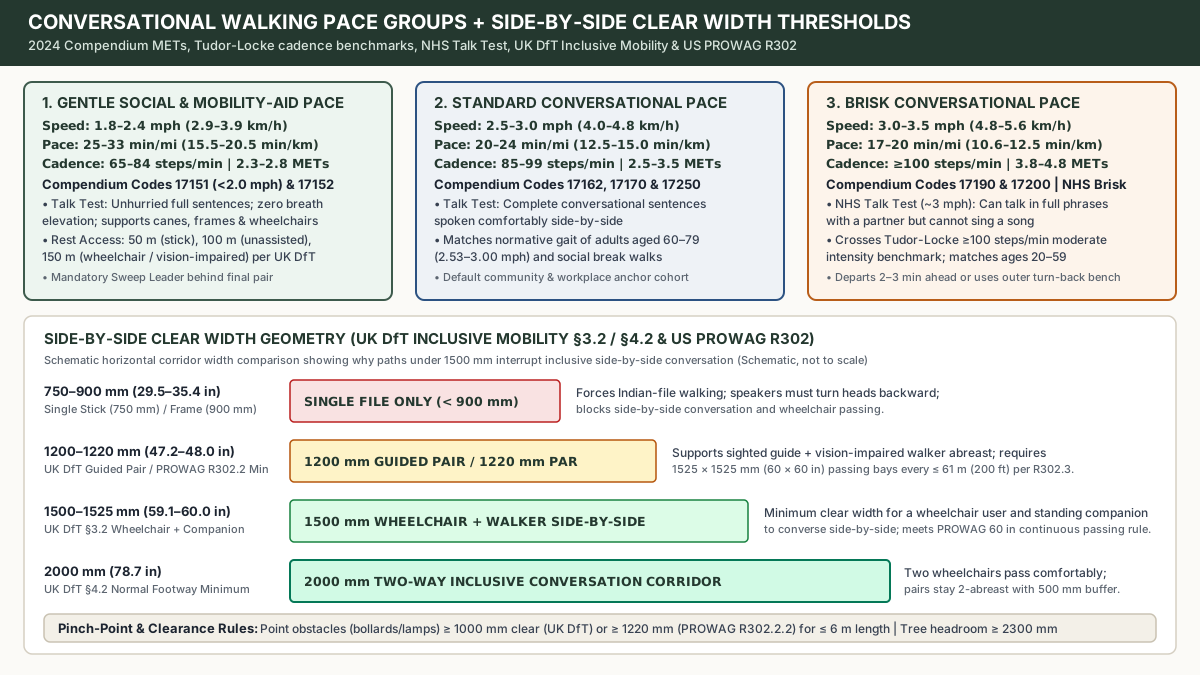
Organisers can remove guesswork by publishing three non-clinical conversational pace brackets grounded in the 2024 Adult Compendium of Physical Activities (Herrmann et al., 2024) and NHS Walking for Health guidance:
- Group 1 — Gentle Social & Mobility-Aid Pace (
1.8–2.4 mph/2.9–3.9 km/h,25–33 min/mile,65–84 steps/min): Aligns with 2024 Compendium Code17151(level strolling< 2.0 mph, very slow =2.3 METs) and Code17152(2.0–2.4 mph, level, slow pace on a firm surface =2.8 METs). Breathing remains effortless, allowing unhurried conversation with frequent pauses at benches spaced50–150 mapart. Matches the Ramblers UK Easy Access and Easy walk grades for step-free paths where ordinary comfortable shoes or trainers are suitable. - Group 2 — Standard Conversational Pace (
2.5–3.0 mph/4.0–4.8 km/h,20–24 min/mile,85–99 steps/min): Aligns with Compendium Code17162(walking for social reasons =2.5 METs), Code17170(2.5 mphon a firm level surface =3.0 METs), and Code17250(walking for pleasure or a work break =3.5 METs). Walkers speak in complete sentences without gasping. This bracket matches the natural gait of adults in their 60s and 70s as well as relaxed multi-generational neighbourhood clubs. - Group 3 — Brisk Conversational Pace (
3.0–3.5 mph/4.8–5.6 km/h,17–20 min/mile,>= 100 steps/min): Aligns with NHS Walking for Health guidance—which defines a brisk walk as about3 miles an hour, verified by the Talk Test (you can tell you are walking briskly if you can still talk but cannot sing the words to a song)—and with Compendium Code17190(2.8–3.4 mph, level moderate pace =3.8 METs) and the lower boundary of Code17200(3.5–3.9 mph, brisk walking =4.8 METs).
Moving Pace vs. Running-Clock Pace (V_clock)
Community clubs like the L.A. Leggers and Finger Lakes Runners Club highlight an operational distinction that every route card needs: moving pace (V_move, your speed while actively walking) is faster than running-clock pace (V_clock, the total elapsed speed from step-off to finish, including traffic lights, road crossings, and bench pauses). Calculate the effective running-clock speed across a walk window (T_window) with total pause minutes (t_stops) using:
V_clock = V_move × (1 - t_stops / T_window)
For example, if a Standard Conversational cohort walks at a moving speed of V_move = 2.7 mph (22.2 min/mile) across a T_window = 45 min outing that includes t_stops = 6 min of cumulative bench and crossing pauses (3 min at the turnaround bench plus 3 min at crossings):
- Active walking ratio:
1 - (6 / 45) = 0.867 - Effective running-clock speed:
V_clock = 2.7 × 0.867 = 2.34 mph(25.6 min/milerunning-clock pace)
Consequently, when a walker times a single nonstop mile on a track and adds 1 to 3 minutes per mile to account for group pauses and crossings, they select a pace cohort where they can converse comfortably for the entire outing.
Takeaway: Publish three pace brackets with both speed (mph and km/h) and Talk Test cues, and size your route using running-clock pace (V_clock) rather than nonstop moving speed.
Side-by-Side Clear Width and Passing Spaces for Paired Conversation
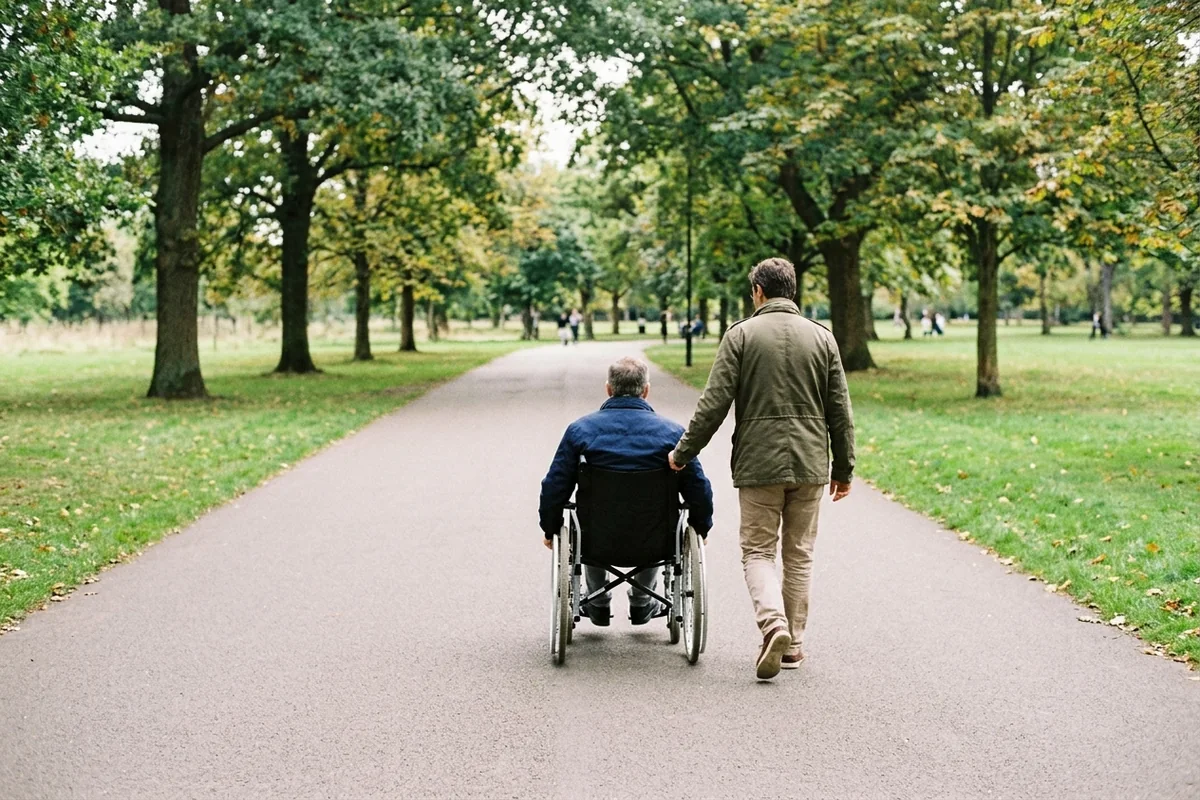
Side-by-side walking (2-abreast) is the spatial key to a low-pressure walking conversation. Walking shoulder-to-shoulder places two companions within a 0.8–1.2 m acoustic envelope where neither person has to maintain continuous eye contact or raise their voice over traffic. Whenever a footpath narrows below the 2-abreast threshold, pairs are forced into single file (“Indian file”): conversation stops or requires the front walker to twist their neck backward while moving over uneven ground.
UK DfT Inclusive Mobility and U.S. PROWAG R302 Clear-Width Tiers
To verify whether a park path, towpath, or promenade truly supports side-by-side conversation, audit horizontal clear width against the UK Department for Transport Inclusive Mobility best-practice guide (Sections 3.2 and 4.2) and the U.S. Access Board Public Right-of-Way Accessibility Guidelines (PROWAG Section R302):
| Corridor Width Tier | Exact Dimension (mm & in) |
Official Standard Locator | Conversational Pairing & Passing Capability |
|---|---|---|---|
| Single-File / Mobility-Aid Minimum | < 700 mm (27.6 in) unassisted; >= 750 mm (29.5 in) walking stick; >= 900 mm (35.4 in) crutches or walking frame |
UK DfT Inclusive Mobility Section 3.2; ADA Temporary Events 915 mm (36 in) minimum (815 mm / 32 in for <= 610 mm / 24 in) |
Zero side-by-side capacity. Accommodates only a single walker or frame user in single file; forces conversational pairs to split up. |
| Long Cane / Guided Pair / PROWAG Baseline | 1,100 mm (43.3 in) cane or assistance dog; 1,200 mm (47.2 in) guided pair; >= 1,220 mm (48.0 in) continuous PAR |
UK DfT Inclusive Mobility Section 3.2; U.S. PROWAG R302.2 & R302.3 |
Supports a sighted guide and a vision-impaired walker abreast (1,200 mm), or two slim standing walkers. Under PROWAG R302.3, any route < 1,525 mm (60 in) wide must provide 1,525 × 1,525 mm (60 × 60 in) passing spaces at intervals <= 61 m (200 ft). |
| Wheelchair + Walking Companion Side-by-Side | >= 1,500 mm (59.1 in) UK DfT; >= 1,525 mm (60.0 in) PROWAG median/shared threshold |
UK DfT Inclusive Mobility Sections 3.2 & 4.2; U.S. PROWAG R302.2.1 & R302.3 |
Minimum inclusive 2-abreast threshold. Allows a wheelchair user and a non-wheelchair companion to travel side by side in conversation (1,500 mm), and enables a wheelchair user and an oncoming walker to pass each other. |
| Two-Way Inclusive Conversation Corridor | >= 2,000 mm (78.7 in) normal footway minimum |
UK DfT Inclusive Mobility Sections 3.2 & 4.2 |
Optimal walking club corridor. Allows two wheelchair users (including larger electric mobility scooters) to pass each other, or a side-by-side conversational pair (1,500 mm) to walk comfortably with 500 mm (19.7 in) lateral clearance. |
Pinch-Point Length Limits and Overhead Tree Clearance
Even on a wide park loop, isolated street furniture can break up conversational pairs or block a mobility aid:
- Point-obstacle clear width and
6-meterlength cap: Under UK DfT Inclusive Mobility Section4.2, where fixed obstacles such as lamp columns, signposts, bins, or bollards narrow a footway, the absolute minimum clear width past the obstacle is1,000 mm(39.4 in) for a maximum restricted length of6 meters(19.7 ft). On shared-use pedestrian and cycle paths governed by U.S. PROWAGR302.2.2, bollards and obstructions must never reduce clear width below1,220 mm(48 in) measured from the edge of the obstruction. - Unobstructed vertical headroom (
>= 2,300 mm): Overhanging tree branches along park paths hazard vision-impaired walkers and tall companions. UK DfT Section3.2and4.2specify a minimum unobstructed vertical clearance of2,300 mm(90.6 in/7.5 ft) above pedestrian ways (2,100 mmminimum under suspended signs;>= 2,030 mm/80 inunder ADA temporary event guidance). - Surface lip bevels and cross-slope: Keep running slopes
<= 1:20(5.0%), cross-slopes<= 1:48(2.08%), and abrupt vertical surface changes<= 6.4 mm(1/4 in, or6.4–13 mmbeveled at1:2). Full ramp and surface-lip checks are covered in how to organise an inclusive walk.
Takeaway: Select routes with >= 1,500 mm (59.1 in) continuous width—and ideally >= 2,000 mm (78.7 in)—so a wheelchair user and a standing companion can converse side by side without stepping into mud or single file.
Time-Based Turn-Back Points vs. Fixed-Distance Loops
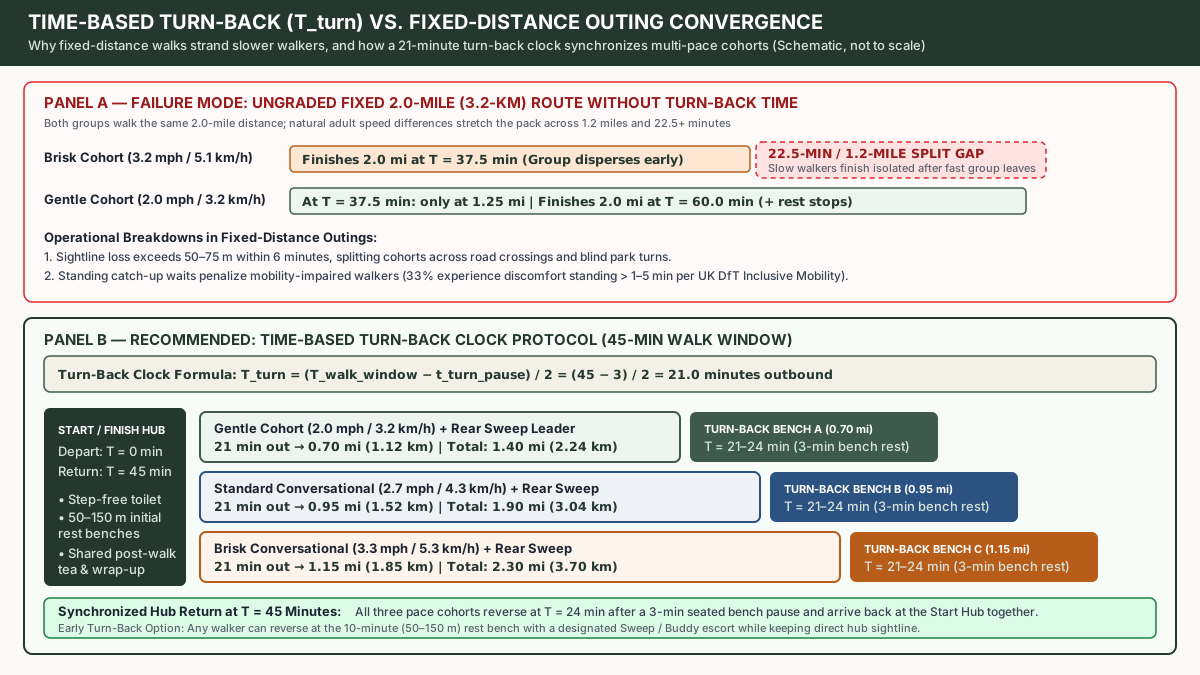
The most common scheduling mistake in a community walking club is announcing a single fixed distance—such as a 2.0-mile (3.2-km) park walk—and expecting participants of different speeds to stay together. Simple kinematics (T = (D / V) × 60) exposes why fixed-distance outings fracture mixed-pace groups:
- On a
2.0-mile(3.2-km) route, a Brisk Conversational group (3.2 mph/5.1 km/h) finishes in(2.0 / 3.2) × 60 = 37.5 minutes. - On the exact same
2.0-mileroute, a Gentle Social group (2.0 mph/3.2 km/h) requires(2.0 / 2.0) × 60 = 60.0 minutesof moving time—plus6–9 minutesof bench pauses—finishing22.5 to 31.5 minutesbehind the brisk walkers. - By the time the Brisk group finishes at
T = 37.5 min, the Gentle group has covered only1.25 miles(2.0 km), trailing0.75 miles(1.2 km) behind. Faster walkers either grow cold waiting at the finish or leave for home before the slower cohort returns, defeating the social purpose of the club.
The Time-Based Turn-Back Protocol (T_turn Clock Math)
When a walk is hosted along a step-free linear corridor—such as a canal towpath, waterfront promenade, greenway, or wide park avenue—replace fixed distance targets with a Time-Based Turn-Back (T_turn). All pace groups meet at the start hub together, step off at T = 0, walk outward at their own comfortable conversational pace until the shared turnaround clock reaches T_turn, take a seated pause of t_pause minutes at a designated turn-back bench, and walk back along the same step-free corridor:
T_turn = (T_walk - t_pause) / 2
And the outbound benchmark bench distance (D_turn) for each pace group moving at speed V_mph is:
D_turn = V_mph × (T_turn / 60)
For a scheduled T_walk = 45 minute walking window (inside a 60-minute gathering that reserves 5 minutes for the welcome briefing and 10 minutes for post-walk tea and conversation) with a t_pause = 3 minute seated turnaround pause:
T_turn = (45 - 3) / 2 = 21.0 minutes
Applying T_turn = 21 minutes across all three conversational pace groups produces a synchronized schedule where every participant returns to the start hub at T = 45 minutes:
| Pace Cohort & Representative Speed | Step-Off Clock (T_0) |
Outbound Turn-Back Time (T_turn) |
Designated Turn-Back Benchmark Bench (D_turn) |
Seated Turnaround Pause (t_pause) |
Total Out-and-Back Distance (2 × D_turn) |
Synchronized Hub Return Clock |
|---|---|---|---|---|---|---|
Early-Return / Short-Spoke Option (1.8 mph / 2.9 km/h) |
T = 0 min |
T = 10 min |
Rest Bench 0: 0.30 mi (0.48 km / 480 m out; intermediate benches at 50–150 m) |
T = 10–13 min (3 min seated rest) |
0.60 mi (0.96 km) |
T = 23 min (or strolls back with Buddy/Sweep) |
Group 1: Gentle Social & Mobility-Aid (2.0 mph / 3.2 km/h) |
T = 0 min |
T = 21 min |
Turn-Back Bench A: 0.70 mi (1.12 km out) |
T = 21–24 min (3 min seated rest) |
1.40 mi (2.24 km) |
T = 45 min |
Group 2: Standard Conversational (2.7 mph / 4.3 km/h) |
T = 0 min |
T = 21 min |
Turn-Back Bench B: 0.95 mi (1.52 km out) |
T = 21–24 min (3 min seated rest) |
1.90 mi (3.04 km) |
T = 45 min |
Group 3: Brisk Conversational (3.3 mph / 5.3 km/h) |
T = 0 min |
T = 21 min |
Turn-Back Bench C: 1.15 mi (1.85 km out) |
T = 21–24 min (3 min seated rest) |
2.30 mi (3.70 km) |
T = 45 min |
Because faster cohorts reverse at Bench C (1.15 miles) or Bench B (0.95 miles) and walk back along the same corridor, they gently pass or converge with the Gentle Social group on the return leg—reinforcing the sense of a single shared community event rather than separate cliques.
Why Turn-Back Points Must Be Physical Benches (50–150 m Rest Limits)
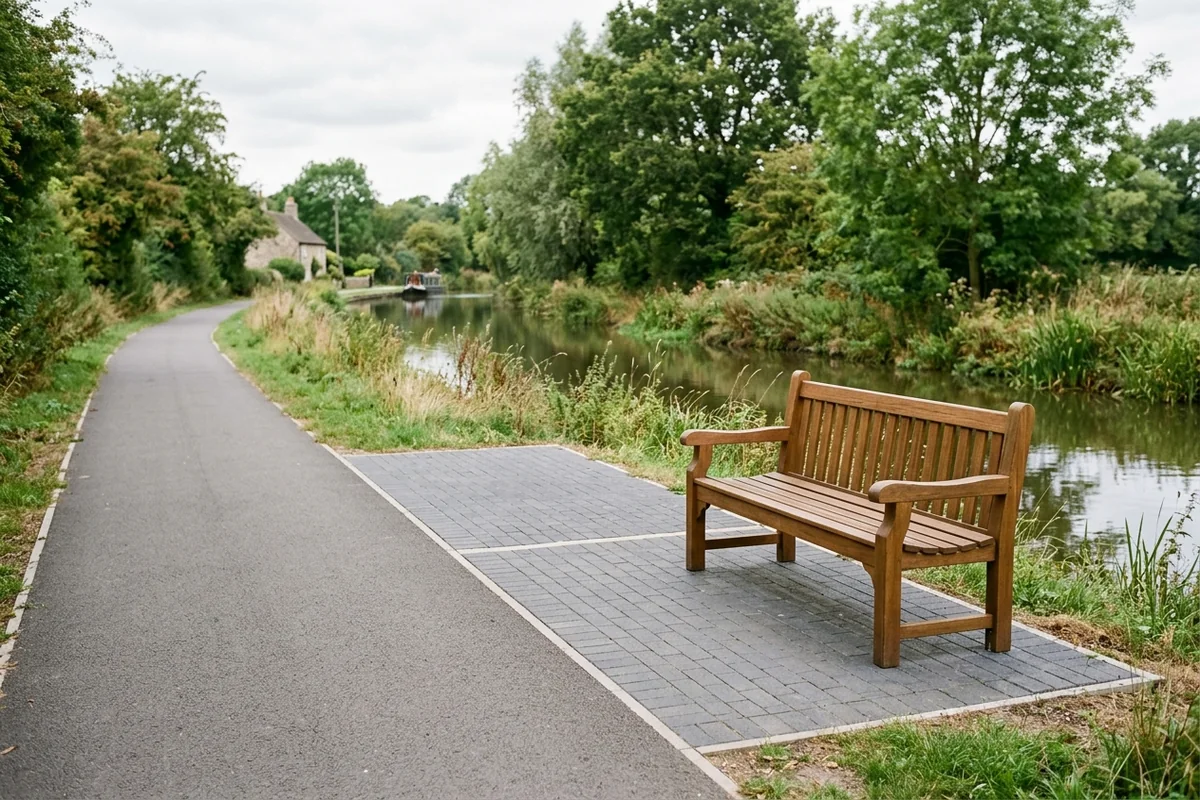
Never schedule a turn-back point or mid-walk regrouping pause at a standing landmark (such as a statue, signpost, or street corner without seating). UK Department for Transport Inclusive Mobility (Section 3.4) establishes recommended maximum walking distance limits without a rest for disabled pedestrians:
- Walking stick and cane users:
50 meters(164 ft) recommended limit without a rest. - Mobility-impaired people without a walking stick:
100 meters(328 ft) recommended limit without a rest. - Wheelchair users and vision-impaired people:
150 meters(492 ft) recommended limit without a rest.
In the London Area Travel Survey follow-up study cited in Inclusive Mobility, approximately 30% of mobility-impaired people able to walk at all could manage no more than 50 meters without stopping or severe discomfort, and a further 20% could manage only 50 to 200 meters. Crucially, standing stationary is painful for people with arthritis, rheumatism, or back conditions: 9% of surveyed respondents could stand for less than 1 minute without discomfort, 24% could manage only 1 to 5 minutes, and 22% could stand for up to 10 minutes.
For that reason, Inclusive Mobility Section 4.5 recommends seating at intervals of no more than 50 meters in core pedestrian zones, placed adjacent to (and never obstructing) the walking route and finished in contrasting colours for vision-impaired walkers. When mapping a community walk, ensure the first 150–300 meters from the start hub contains rest benches every 50–150 meters, and anchor every T_turn turnaround at a physical bench with backrests, armrests, and a level wheelchair bay. When a circular route is preferred over a linear out-and-back path, use a concentric chord shortcut—an inner cross-path lined with benches every 50–150 meters that allows Group 1 (1.4 miles) to rejoin Group 2 (1.9 miles) for the final 10-minute walk back to the hub.
Takeaway: Use T_turn = (T_walk - t_pause) / 2 so every pace group reverses on the clock and finishes together, and place every turn-back landmark at a physical bench rather than a standing corner.
Sweep Leader Duties, Sightlines, and Early-Turnback Escorts
Even within a single conversational pace group, natural stride variations cause “accordion stretching” after road crossings or narrow gates. If the front leader waits at a junction only until the tail walker arrives and then immediately steps off again, the rear walkers get zero seconds of rest while the front walkers have just rested for two minutes. Preventing that accordion trap is the core job of the Sweep Leader (also called the Back-Marker or Tail Walker).
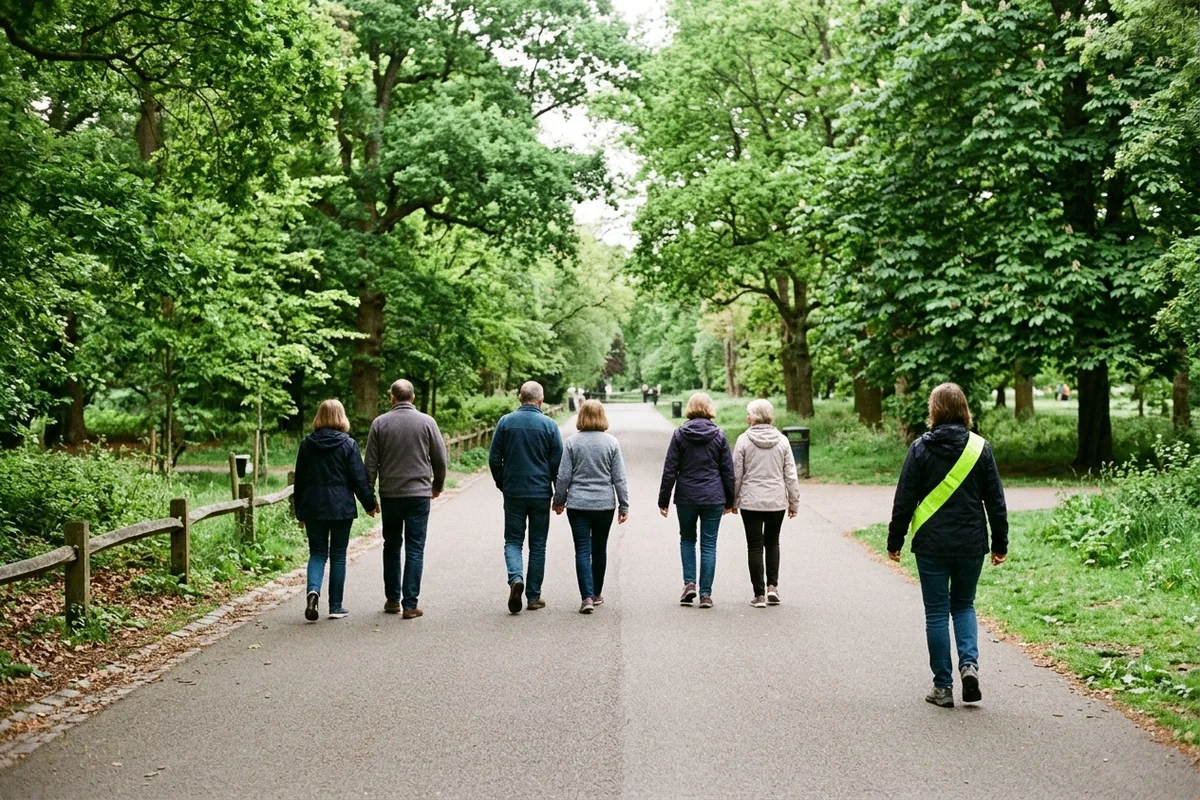
Four Operational Duties of the Sweep Leader (Back-Marker)
- Zero-Drop Rear Boundary: The Sweep Leader walks
2–4 pacesbehind the final conversational pair at that pair’s natural cadence. Because the Sweep Leader is always the last person on the path, slower walkers never experience the embarrassment of trailing behind the pack or feeling watched by a waiting crowd. - Bench-Anchored Sightline Relay (
<= 50–75 m): The Sweep Leader maintains visual sightline with the Front Walk Leader (within50–75 meterson straight park paths, or before every blind bend, fork, or road crossing). When the gap approaches50–75 meters, the Sweep Leader signals the Front Walk Leader via hand wave or mobile message to pause at the next physical bench—and the Front Walk Leader holds the pause for a full2–3 minutesafter the rear pair sits down, ensuring rear walkers receive the exact same rest duration as the front. - Pinch-Point Single-File Callouts (
15–20 mAdvance Notice): When approaching a bollard, bridge approach, or gate where clear width narrows from2,000 mmdown to1,000–1,220 mm(for<= 6 meters), the Front Walk Leader calls back—and the Sweep Leader relays—a calm advance cue15–20 metersbefore the narrowing (“Bollard ahead in 15 meters—step into single file for five paces, then reform pairs”). Pairs glide through without abrupt stops or wheel collisions and resume side-by-side conversation immediately past the obstacle. - Early-Turnback (
10–15 Minute) Buddy Escort: At the pre-walk briefing, announce that turning back at the10-minute(50–150 mor400 m) rest bench is a standard built-in option requiring no explanation. When a participant chooses the early turn-back on an out-and-back route where the start hub remains in direct sightline, the Sweep Leader logs the return on the headcount card; if the path curves out of sight of the hub, a designated Early-Turnback Buddy or second Sweep volunteer accompanies the walker back to the hub.
Non-Clinical Community Leadership vs. Workplace Walking Meetings
Ramblers UK walk-leadership guidance emphasizes that community walk leaders and back-markers do not need outdoor mountain qualifications, navigation certificates, or criminal-record (DBS) checks to lead safe, welcoming neighbourhood walks. Preparation rests on knowing the route’s pinch points and benches in advance, carrying a compact first-aid kit, and encouraging newcomers to try a shorter, gentler group first (such as a Ramblers Wellbeing Walk or Group 1 Gentle Social cohort). For full multi-wave volunteer headcount formulas (N_volunteers = 2 + floor(N_participants / 12)) and wallet-sized Pocket ICE cards, see how to start a walking club.
Keep community pace groups distinct from workplace one-to-one walks. When a manager or colleague suggests a walking conversation during the workday, participation must be completely voluntary, a seated indoor room must be offered as an equal default, and performance reviews or confidential disclosures belong indoors—boundaries detailed in limits of walking conversations at work.
Takeaway: Assign a dedicated Sweep Leader (Back-Marker) to walk behind the final pair, hold cohort sightlines under 50–75 meters, and guarantee that every regrouping stop gives the rear walkers a full 2–3 minutes of seated rest.
Pace Group, Sweep Leader, and Turn-Back Route Card Checklist
Before inviting a group or posting a weekly walk listing, publish a single-page Pace Group & Turn-Back Route Card. Combining Ramblers UK pre-walk listing fields (meeting time, start time, estimated finish time, and walk grade) with U.S. PROWAG R302, UK DfT Inclusive Mobility, and ADA Temporary Events environmental thresholds gives newcomers every fact they need to self-select a comfortable pace cohort.
| Route Card Field | Required Public Specification | Measurement & Standard Benchmark |
|---|---|---|
| 1. Pace Cohort & Talk-Test Cue | Group name, speed in mph (km/h), min/mile (min/km), cadence (steps/min), and Talk Test check |
Group 1: 1.8–2.4 mph (25–33 min/mi, < 85 steps/min); Group 2: 2.5–3.0 mph (20–24 min/mi, 85–99 steps/min); Group 3: 3.0–3.5 mph (17–20 min/mi, >= 100 steps/min, NHS Talk Test) |
| 2. Synchronized Clock Schedule | Meeting time, step-off time (T = 0), exact Turn-Back Time (T_turn), turnaround pause (t_pause), and hub finish time |
T_turn = (T_walk - t_pause) / 2 (for example, 10:00 meet, 10:05 step-off, 10:26 turn-back bench pause for 3 min, 10:50 synchronized hub return) |
| 3. Side-by-Side Clear Width Profile | Minimum continuous clear width (mm / in), percentage of route >= 1,500–2,000 mm, and passing-bay spacing |
>= 1,500 mm (59.1 in) for wheelchair + companion 2-abreast; >= 2,000 mm (78.7 in) for 2-way corridor; 1,525 × 1,525 mm (60 × 60 in) passing bay every <= 61 m (200 ft) if < 1,525 mm (PROWAG R302.3) |
| 4. Pinch-Point & Headroom Log | Location, clear width, and length of any bollard/gate narrowings; minimum tree branch clearance | Point obstacles >= 1,000 mm (39.4 in, UK DfT) or >= 1,220 mm (48 in, PROWAG R302.2.2) for <= 6 m length; overhead tree clearance >= 2,300 mm (90.6 in) |
5. Turn-Back Benches & 50–150 m Rest Seating |
Named turnaround benches (Bench A, Bench B, Bench C) with outbound distances, plus initial hub rest seating |
Initial rest benches at 50 m (stick users), 100 m (unassisted mobility-impaired), and 150 m (wheelchair/vision-impaired) per UK DfT Section 3.4; armrests + adjacent level wheelchair bay |
| 6. Surface & Slope Ceiling | Surface material, maximum running slope, maximum cross-slope, and step-free status | Firm, stable, slip-resistant; running slope <= 1:20 (5.0%); cross-slope <= 1:48 (2.08%); zero vertical lips > 6.4 mm (1/4 in) unbeveled (PROWAG R302 / ADA Temporary Events) |
| 7. Front Leader, Sweep Leader & Early Bailout | Named Front Walk Leader and Sweep Leader (Back-Marker), high-visibility identifier, and 10-min early-return rule |
1 Front Leader + 1 Sweep Leader per cohort; sightline <= 50–75 m; participants wave to Sweep Leader at the 10-min bench to turn back early with no explanation needed |
8. Toilet, Water & 50°F–80°F Shelter Hub |
Step-free public restroom status, drinking water access (<= 36 in spout or cup dispenser), and weather fallback |
Unlocked step-free toilet at start hub; access to temperature-moderated indoor space or level shelter whenever outdoor temperature is > 80°F (26.7°C) or < 50°F (10.0°C) per ADA Temporary Events |
Copy-Ready Pre-Walk Route Card & Briefing Checklist
Organisers can copy and fill in this route card template for printed clipboards and online walk listings:
- Walk Title & Grade:
Riverside Promenade Out-and-Back — Easy Access (Step-Free, Wheelchair & Rollator Friendly) - Meeting Hub & Step-Free Toilet:
North Boathouse Pavilion (Unlocked step-free public restroom and water fountain 30 m from meeting bench; transit stop 120 m) - Clock Schedule (
45-Minute Walk Window):09:55— Meet at Pavilion Bench; collect optional personal Pocket ICE card10:00(T = 0 min) — 3-minute welcome briefing and simultaneous step-off10:10(T = 10 min) — Early-Return Bench 0 (0.30 mi/480 mout; direct sightline to Pavilion)10:21(T_turn = 21 min) — All groups reach their Turn-Back Bench and take a3-minuteseated rest (10:21–10:24)10:45(T = 45 min) — All groups arrive back at North Boathouse Pavilion together for tea
- Published Pace Cohorts & Turn-Back Landmarks:
- Group 1 (Gentle Social & Mobility-Aid,
1.8–2.4 mph/25–33 min/mi): Turns at Bench A (Willow Reach Bench,0.70 mi/1.12 kmout;1.40 mitotal). Rest benches available at50 m,110 m,160 m, and every250 m. - Group 2 (Standard Conversational,
2.5–3.0 mph/20–24 min/mi): Turns at Bench B (Old Lock Footbridge Bench,0.95 mi/1.52 kmout;1.90 mitotal). - Group 3 (Brisk Conversational,
3.0–3.5 mph/17–20 min/mi): Turns at Bench C (Meadow Boathouse Bench,1.15 mi/1.85 kmout;2.30 mitotal).
- Group 1 (Gentle Social & Mobility-Aid,
- Corridor Width & Pinch Points:
2,200 mm(86.6 in) smooth asphalt throughout (100%supports wheelchair + companion side-by-side conversation). Single bollard pair at380 mleaves1,250 mm(49.2 in) clear width for1.5 mlength; max running slope2.4%(< 1:20); max cross-slope1.5%(< 1:48); tree headroom>= 2,500 mm. - Volunteer Roster: Front Walk Leader (green lanyard, sets ceiling speed) + Sweep Leader / Back-Marker (high-visibility yellow sash, walks behind final pair, holds
<= 50 msightline, and logs early turn-backs). - Weather Fallback: If outdoor temperature is below
50°F(10°C) or above80°F(26.7°C), walk window shortens to20 minutes(T_turn = 9 min) and reconvenes inside the temperature-moderated Boathouse Community Room.
When your group maintains a local list of step-free park hubs, accessible toilets, or neighbourhood support venues, verify and date-stamp each listing using how to keep a community support directory reliable. More guides on inclusive group design are collected under Walking and Conversation.
Takeaway: Publish the 8-field Route Card before every walk so participants know the exact mph/km/h pace bracket, 1,500–2,000 mm side-by-side path width, named T_turn turnaround bench, and Sweep Leader contact protocol before leaving home.